Have you ever swapped your brand-name medication for a cheaper generic version and wondered if it actually works the same way? You aren't alone. Millions of people make this switch every year to save money. But how do regulators guarantee that the generic pill hitting your bloodstream is just as effective-and just as safe-as the original drug? The answer lies in two specific numbers: Cmax and AUC. These aren't just abstract scientific terms; they are the gatekeepers of modern medicine.
When you take a pill, your body doesn't absorb it instantly or uniformly. It’s a complex journey through your digestive system into your blood. To prove that a generic drug is equivalent to the innovator (brand-name) drug, scientists don’t run massive clinical trials on thousands of patients. Instead, they measure exactly how much drug gets into your blood and how fast. This process is called bioequivalence testing. If the generic matches the brand in these key metrics, it is deemed therapeutically equivalent. Let's break down what Cmax and AUC actually mean for your health.
What Is Cmax? Understanding Peak Concentration
Imagine drinking a glass of water. You swallow it, and it hits your stomach. Then, it moves into your intestines and enters your blood. At some point, the amount of water (or drug) in your blood peaks before your kidneys start filtering it out. That peak level is Cmax. It is usually measured in milligrams per liter (mg/L).
Why does this peak matter? For many drugs, the speed at which they reach this peak determines how quickly you feel relief. Take painkillers like ibuprofen. If you have a headache, you want the drug to hit its Cmax quickly so you can stop suffering. If a generic version takes too long to reach that peak, it might not relieve your pain as fast as the brand name, even if the total amount absorbed is the same.
Conversely, Cmax is critical for safety. Some drugs have a "narrow therapeutic index," meaning the difference between a helpful dose and a toxic dose is tiny. If a generic drug spikes too high-creating a higher Cmax than the reference drug-it could cause side effects or toxicity. Regulatory agencies like the FDA and EMA monitor Cmax closely to ensure generics don't overshoot this dangerous peak.
What Is AUC? Measuring Total Exposure
To understand AUC, picture a graph. On the vertical axis, you have the drug concentration in your blood. On the horizontal axis, you have time. As the drug absorbs, the line goes up. As your body eliminates it, the line goes down. The area underneath this entire curve is the AUC. It is typically expressed in mg·h/L (milligram-hours per liter).
AUC tells us the total amount of drug your body was exposed to. This is crucial for drugs where efficacy depends on sustained presence rather than a quick spike. For example, antibiotics need to stay in your system at certain levels for a specific duration to kill bacteria effectively. If a generic drug has a lower AUC, it means less drug entered your system overall. You might not get the full therapeutic benefit, leading to treatment failure.
In regulatory science, AUC is often considered the most important parameter for establishing bioequivalence. It reflects the extent of absorption. If two drugs have similar AUCs, we know that, over the course of the dosing interval, your body received roughly the same total dose. This ensures that chronic medications, like those for blood pressure or cholesterol, work consistently day after day.

The 80-125% Rule: How Regulators Decide Equivalence
You might think that for a generic to be approved, it needs to match the brand name exactly. But biology isn't precise enough for that. No two humans absorb drugs identically. Even the same person will absorb a drug slightly differently on different days depending on what they ate or their hydration levels. So, regulators allow a margin of error.
The gold standard rule is the 80-125% criterion. Here is how it works:
- Scientists conduct a study comparing the generic drug to the reference (brand) drug.
- They calculate the ratio of the geometric means for both Cmax and AUC.
- They determine the 90% confidence interval for this ratio.
- This interval must fall entirely within the range of 80% to 125% (0.80 to 1.25).
For instance, if the generic drug delivers 90% of the exposure (AUC) of the brand name, and the statistical confidence interval stays between 85% and 95%, it passes. Why 80-125%? This range is mathematically symmetrical on a logarithmic scale. It assumes that a difference of less than 20% in exposure is not clinically significant for most drugs. In other words, if a generic is slightly weaker or slightly stronger, but within this window, it is considered safe and effective.
Both Cmax and AUC must pass this test independently. A generic can have perfect AUC but fail if its Cmax is too erratic. Both parameters are non-negotiable pillars of the approval process.
How Bioequivalence Studies Are Conducted
These studies aren't done in a vacuum. They follow strict protocols designed to minimize variables. Typically, researchers recruit 24 to 36 healthy volunteers. The study design is usually a "crossover" trial. This means each participant acts as their own control.
- Period 1: Participants take the brand-name drug. Blood samples are taken at multiple time points over several hours or days.
- Washout Period: Participants wait for a set time (usually five half-lives of the drug) to ensure the first drug is completely out of their system.
- Period 2: Participants take the generic drug. Blood samples are taken again using the exact same schedule.
Blood sampling is critical. For rapidly absorbed drugs, samples might be taken every 15 minutes for the first few hours to accurately capture the Cmax peak. Modern labs use highly sensitive techniques like LC-MS/MS (Liquid Chromatography-Mass Spectrometry) to detect drug concentrations as low as nanograms per milliliter. This precision ensures that even small differences in absorption are caught.
Data analysis involves statistical software. Because drug concentrations in the body follow a log-normal distribution, the raw data is transformed before calculating ratios. This step is vital for accurate comparison. If the study shows that the 90% confidence intervals for both AUC and Cmax fall within the 80-125% box, the generic receives approval.

Exceptions and Complex Cases
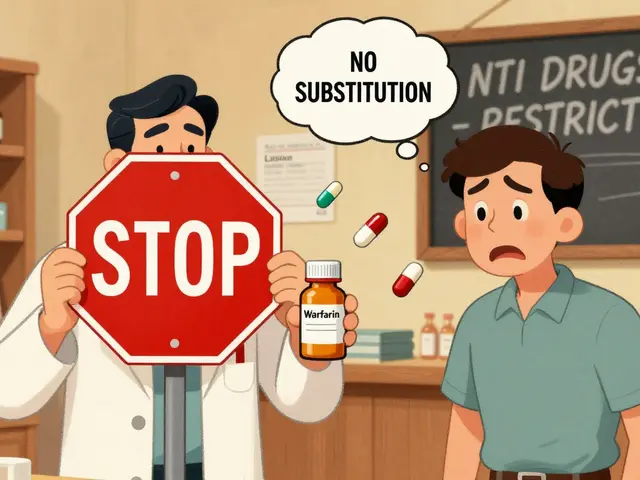
While the 80-125% rule works for most drugs, some medications require tighter scrutiny. These are known as Narrow Therapeutic Index (NTI) drugs. Examples include warfarin (a blood thinner), levothyroxine (for thyroid conditions), and certain anti-seizure medications.
For NTI drugs, a small change in exposure can lead to serious consequences. Too little warfarin might cause a stroke; too much might cause bleeding. Therefore, regulatory bodies like the EMA and FDA often apply stricter limits for these drugs. Instead of 80-125%, the acceptable range might be narrowed to 90-111%. This ensures that generics for these critical medicines are virtually indistinguishable from the brand names in terms of exposure.
Another challenge is "highly variable drugs." Some drugs show huge differences in absorption even among individuals taking the same product. If the variability is too high, the standard 80-125% rule might reject a genuinely equivalent generic simply because the noise in the data is too loud. In these cases, regulators may use "scaled average bioequivalence" methods, which adjust the acceptance limits based on the variability of the reference drug itself. This is a sophisticated statistical approach to keep good generics on the market without compromising safety.
| Drug Type | Acceptance Range (AUC & Cmax) | Reason for Criteria |
|---|---|---|
| Standard Drugs | 80% - 125% | Small differences are not clinically significant for most therapies. |
| Narrow Therapeutic Index (NTI) | 90% - 111% | Tiny changes in exposure can cause toxicity or lack of efficacy. |
| Highly Variable Drugs | Scaled Limits | Adjusts for high natural variability to avoid rejecting equivalent products. |
Why This Matters to You
Understanding Cmax and AUC helps demystify the generic drug industry. When you pick up a generic prescription, you are relying on decades of rigorous science. The Hatch-Waxman Act of 1984 established the pathway for generics in the US, and similar laws exist globally. These laws mandate that generics must be bioequivalent to their brand-name counterparts.
Studies consistently show that for the vast majority of drugs, generics perform just as well as brands. A meta-analysis published in JAMA Internal Medicine reviewed dozens of studies and found no clinically meaningful differences in efficacy or safety between generic and innovator products that met standard bioequivalence criteria. This means you can trust that your generic medication is delivering the right amount of drug, at the right speed, to produce the desired effect.
However, individual experiences can vary. Factors like food intake, genetics, and other medications can influence how your body processes drugs. If you feel a generic isn't working as well as the brand, talk to your doctor. It might be worth switching back, or it might be an unrelated issue. But statistically, the science behind Cmax and AUC supports the safety and efficacy of generics.
Is Cmax more important than AUC?
Neither is universally more important; they serve different purposes. AUC measures the total amount of drug absorbed, which is critical for overall efficacy. Cmax measures the peak concentration, which is vital for onset of action and avoiding toxicity. Both must meet regulatory standards for a drug to be approved as bioequivalent.
Can a generic drug fail bioequivalence testing?
Yes. If the 90% confidence intervals for Cmax or AUC fall outside the 80-125% range, the generic fails. Manufacturers must then reformulate the drug-changing excipients or manufacturing processes-to improve absorption consistency before resubmitting for approval.
Why is the range 80-125% and not 90-110%?
The 80-125% range is statistically symmetrical on a logarithmic scale, which is how drug concentrations are distributed. It allows for a reasonable margin of biological variability while ensuring that the difference between generic and brand is not clinically significant for most drugs. Tighter ranges like 90-110% are reserved for narrow therapeutic index drugs.
Do bioequivalence studies involve patients with the disease?
Typically, no. Most bioequivalence studies are conducted in healthy volunteers to reduce variability caused by the disease state. The assumption is that if the pharmacokinetics (absorption and elimination) are similar in healthy people, they will be similar in patients, provided the disease doesn't drastically alter drug metabolism.
What happens if I feel different on a generic drug?
If you notice a difference in efficacy or side effects, consult your healthcare provider. While bioequivalence ensures statistical similarity, individual responses can vary due to factors like diet, genetics, or other medications. Your doctor may switch you back to the brand name or try a different generic manufacturer.