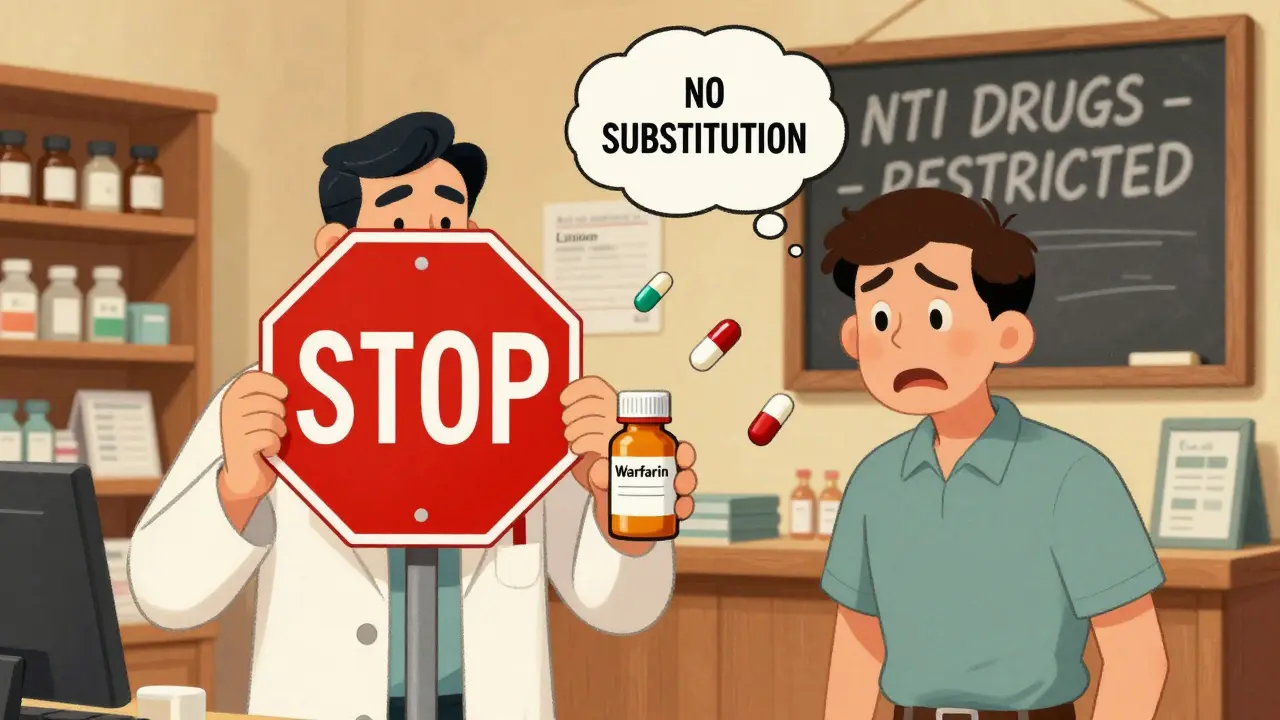
When you or a loved one takes a medication like warfarin, levothyroxine, or phenytoin, even a tiny change in dosage can mean the difference between life and serious harm. These are called Narrow Therapeutic Index (NTI) drugs - medications where the line between effective and toxic is razor-thin. The FDA says approved generic versions of these drugs are just as safe and effective as the brand-name versions. But in more than half of U.S. states, pharmacists aren’t allowed to swap them out without extra steps - sometimes not at all. Why? And which states are blocking substitution? Here’s what you need to know.
What Exactly Is an NTI Drug?
NTI stands for Narrow Therapeutic Index. It means the drug has a very small window between the dose that works and the dose that causes harm. For example, if your blood level of warfarin drops just a little, you might clot dangerously. If it goes too high, you could bleed uncontrollably. The same goes for lithium (used for bipolar disorder) and levothyroxine (for hypothyroidism). A 10% difference in absorption - something that can happen between brand and generic versions - could trigger hospitalization.
The FDA doesn’t officially label drugs as NTI in its Orange Book. Instead, it treats all bioequivalent generics the same way: if they pass the same tests, they’re considered interchangeable. But states aren’t convinced. Since the 1990s, state pharmacy boards have created their own lists, driven by real-world reports of adverse events and inconsistent patient outcomes.
How States Differ: Three Main Approaches
Not every state handles NTI substitution the same way. Research from 2019 breaks it down into three clear models:
- Carve-Out Provisions - 17 states completely exclude NTI drugs from automatic substitution rules. Pharmacists can’t switch them unless the prescriber specifically allows it. Kentucky, North Carolina, and Connecticut are strict here.
- Affirmative Consent - 9 states require both the patient and the prescriber to give written approval before a substitution can happen. In North Carolina, both must sign a form. In Connecticut, if either person objects within 14 days, the substitution is canceled.
- Notification Requirements - 11 states allow substitution but force pharmacists to notify the prescriber and patient within 72 hours. Pennsylvania requires this for drugs like digoxin and warfarin. If the doctor doesn’t respond, the substitution still goes through - but they’re in the loop.
Some states, like South Carolina, don’t require anything. They just recommend avoiding substitutions for NTI drugs. Others, like California and Texas, follow federal rules and allow substitution without extra steps.
States With the Strictest Rules
Three states stand out for their detailed, hardline policies:
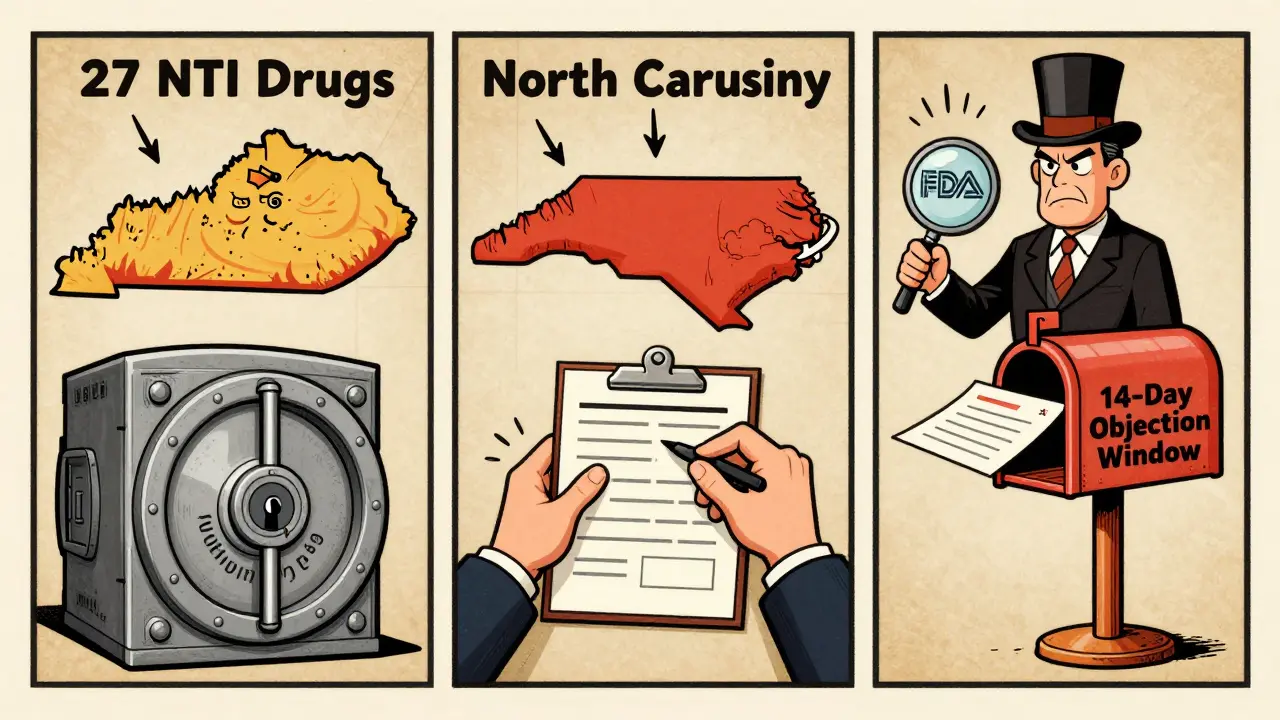
- Kentucky maintains a formal list of 27 NTI drugs where substitution is prohibited unless the prescriber writes explicit permission. This includes digoxin, levothyroxine, lithium, and all strengths of warfarin sodium tablets. Pharmacists must manually check each prescription against this list - adding 5 to 7 minutes per fill.
- North Carolina requires dual consent: both the patient and prescriber must sign a form before any substitution. That form must be kept on file for three years. It’s one of the most bureaucratic systems in the country.
- Connecticut has special rules for anti-epileptic drugs. Substitution is allowed only if both the patient and doctor are notified in writing. If either objects within 14 days, the brand drug must be filled. The Epilepsy Foundation credits this law with a 19.2% drop in seizure-related ER visits after it was implemented.
These states aren’t just being cautious - they’re responding to real data. A 2021 study in the Journal of the American Pharmacists Association found states with carve-out rules had 28.7% fewer NTI-related adverse events. That’s not proof of causation, but it’s enough for many pharmacists to keep the restrictions.
States With the Most Flexible Rules
On the other end of the spectrum, states like California, Texas, and Virginia follow the FDA’s lead. Pharmacists can substitute any therapeutically equivalent generic without extra paperwork. A 2023 survey of chain pharmacy managers in Virginia found patient complaints about NTI substitutions were under 0.5% - a rate comparable to non-NTI drugs.
California even passed a law in 2022 requiring its pharmacy board to base NTI designations on scientific evidence, not tradition. That’s a shift toward what experts call “evidence-based regulation.” Other states may follow.
Why the Conflict? FDA vs. State Boards
The tension comes down to philosophy. The FDA says: if a generic passes bioequivalence testing, it’s safe. State boards say: real patients aren’t lab rats. Clinical outcomes matter more than lab data.
Dr. Aaron Kesselheim from Harvard points out that warfarin’s dose-response curve is so steep that even minor differences in absorption can cause bleeding or clots. The FDA counters that its approval standards are rigorous - and that 12,345 Medicare patients showed no difference in INR stability between brand and generic warfarin.
Meanwhile, the Generic Pharmaceutical Association (now Association for Accessible Medicines) argues that many drugs on state NTI lists aren’t even proven to have narrow therapeutic indexes. Only 12 out of 47 drugs listed across states have solid clinical evidence backing their classification.
What This Means for Patients and Pharmacists
If you’re on an NTI drug, your experience depends entirely on where you live.
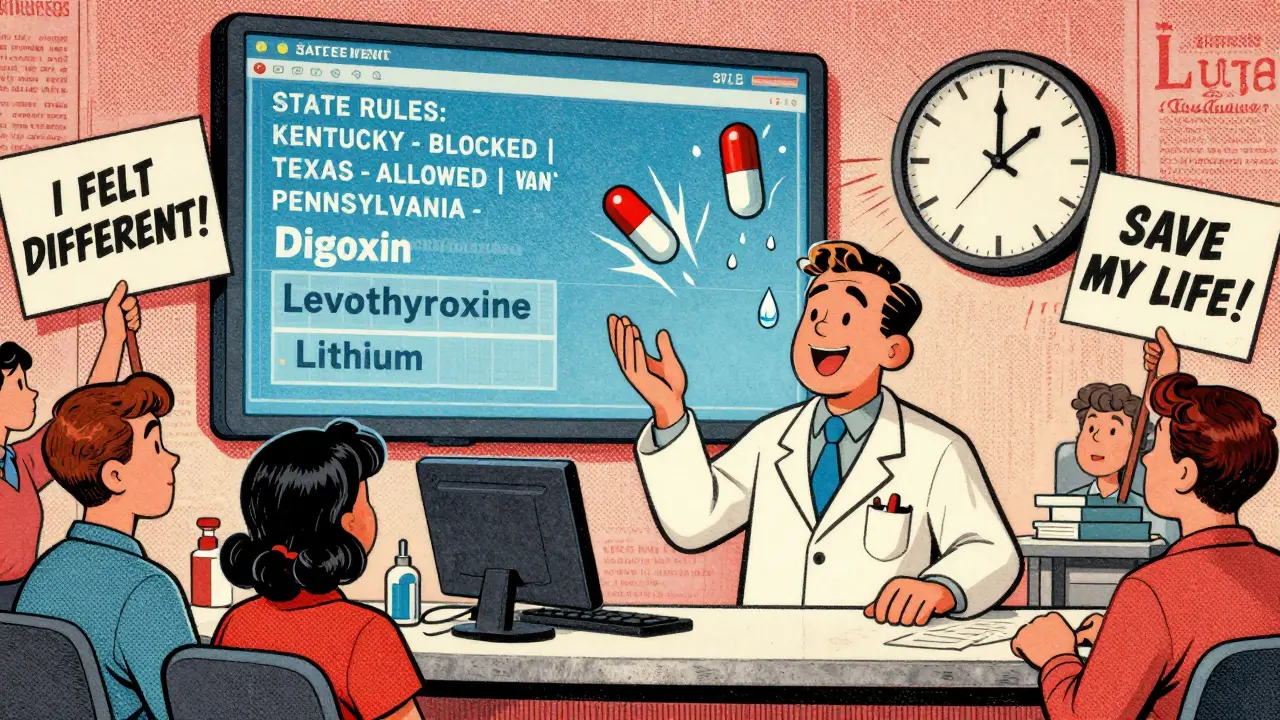
- In Kentucky, you’ll likely get the brand drug unless your doctor signs off on a generic.
- In Texas, you’ll probably get the cheaper generic - and your pharmacist won’t even ask.
- In Connecticut, you’ll get a letter after your refill, telling you what was dispensed and giving you 14 days to object.
For pharmacists, the burden is real. In states with carve-outs, it takes an average of 3.2 minutes per prescription just to verify substitution rules - more than four times longer than in states without restrictions. That adds up to nearly 9 extra hours of work per month. Many pharmacies now use software that auto-checks state-specific NTI lists. Chain pharmacies adopted this at an 82% rate in 2022. Independent pharmacies? Not so much.
What’s Changing? The Future of NTI Rules
The FDA released draft guidance in 2023 suggesting a standardized way to define NTI drugs - using a ratio of minimum toxic dose to minimum effective dose. If adopted, it could force states to rewrite their lists.
Nine states, including New York and Ohio, are already reviewing their rules using this new framework. New York’s proposed law would limit NTI designation to drugs with a ratio of 2.0 or less - a scientifically grounded threshold.
But change is slow. The Association for Accessible Medicines sued Kentucky in 2023, claiming its NTI list violates interstate commerce laws. Meanwhile, the National Association of Boards of Pharmacy is drafting a model law to bring some consistency - but it won’t be mandatory.
One thing is clear: NTI substitution rules aren’t going away. They’re evolving. And whether you’re a patient, pharmacist, or prescriber, knowing your state’s rules isn’t optional - it’s essential.
Are all generic NTI drugs unsafe to substitute?
No. The FDA considers all approved generic versions of NTI drugs therapeutically equivalent to their brand-name counterparts. The concern isn’t safety - it’s variability in absorption. Some patients report changes in how they feel after switching, even when lab tests show no difference. That’s why some states require extra steps - not because generics are dangerous, but because individual responses can vary.
Can I ask my pharmacist to use the brand name instead of a generic?
Yes - and you should. In every state, you have the right to refuse substitution. You can ask for the brand drug even if your state allows generics. Some pharmacies may charge more if the brand isn’t covered by insurance, but you can’t be forced to accept a generic if you’re uncomfortable. Always speak up.
Which NTI drugs are most commonly restricted by states?
The most common NTI drugs on state restriction lists are warfarin (blood thinner), levothyroxine (thyroid hormone), lithium (mood stabilizer), digoxin (heart medication), and phenytoin or carbamazepine (anti-seizure drugs). These are the ones with the steepest dose-response curves and the most documented case reports of adverse events after substitution.
Does insurance cover the brand-name version if I refuse a generic?
It depends. Many insurers will still cover the brand if you refuse substitution, but you may have to pay a higher copay. Some require a letter from your doctor stating substitution is not appropriate. Others won’t cover the brand at all unless you’ve tried the generic first. Always check with your plan before refusing a substitution.
How do I find out if my state restricts NTI substitutions?
Contact your state’s Board of Pharmacy - their website usually has a section on generic substitution laws. You can also ask your pharmacist directly. Most have access to state-specific software that flags restricted drugs. If you’re on a critical NTI drug, don’t assume - ask.


8 Comments
I've been on warfarin for 8 years and switched generics twice without a hitch. My INR stayed dead on. But I get why some folks freak out - it's scary when your life depends on a number that changes by 0.1. Still, the data says it's fine. States clinging to old fears are just slowing down savings for everyone. 🤷♂️
So... let me get this straight... the FDA says it's fine, but states are like 'nah, we know better'... because...? Because some guy in 2007 had a bad day after switching? And now we're stuck with 27-page PDFs and 5-minute verification rituals? I mean... wow. Just... wow.
It is imperative to note that the FDA's regulatory framework is not infallible. In fact, the agency has a documented history of approving pharmaceuticals with subsequent adverse event reports. The states' cautionary approach is not merely prudent-it is ethically non-negotiable. To equate bioequivalence with clinical equivalence is a gross oversimplification of human physiology.
bro the whole NTI thing is wild. like yeah warfarin’s tricky but so is my morning coffee. one day i’m chill, next day i’m vibrating through my couch. if i can handle that, why can’t my body handle a generic? also, 3.2 mins per script?! that’s like 30 extra latte breaks a month. pharmacies are gonna start charging extra for ‘emotional support prescriptions’ 😂
This is actually such an important topic! I didn’t realize how much it varies by state. My mom’s on levothyroxine and we moved from Texas to Ohio last year - suddenly she had to jump through hoops just to get her med. I called her pharmacist and they had no idea the rules changed. So much confusion! If you’re on one of these meds, PLEASE ask your doc and pharmacist - don’t assume anything. Knowledge = safety 💪❤️
The FDA is just a puppet of Big Pharma. They want you on generics so they can sell you more pills later. The real reason states block substitutions is because they know the generics are cut with cheap fillers that mess with your liver. You think your INR is stable? Wait till you get the 2024 batch. I know people who got sick. They never told you that part.
I mean, if it ain't broke don't fix it. I got my brand name and I'm not touching nothing else. Why should I risk it? I don't care if it costs more. My life's not a math problem.
So you're telling me Kentucky pharmacists spend 7 minutes per script just checking a list? That's not safety - that's a productivity nightmare. Meanwhile, in Texas, people get their meds faster, pay less, and don't have to fill out a form just to breathe. The real question isn't 'is it safe?' - it's 'why are we making healthcare harder for everyone?' And hey - if you're worried about variability, why not just standardize the damn testing protocol instead of playing state-by-state roulette?
Write a comment