
You land in Tokyo after a long flight from New York. It is morning there, but your body thinks it is the middle of the night. You feel exhausted, groggy, and completely out of sync. This is jet lag, or desynchronosis, a temporary sleep-wake disorder caused by rapid travel across multiple time zones. Many travelers reach for a pill to fix this feeling quickly. A common choice is melatonin, a hormone that regulates our internal clock. But not all melatonin pills are created equal. In fact, taking the wrong type-specifically time-released melatonin-can make your symptoms worse instead of better.
The core issue with managing jet lag isn't just getting sleep; it is resetting your biological clock to match the local sun. Your body needs precise signals to know when to wake up and when to wind down. When you take medication that releases slowly over many hours, you confuse that delicate system. Understanding the difference between immediate-release and time-released formulations is critical for anyone who travels frequently across time zones.
Why Jet Lag Happens and How Long It Lasts
Jet lag occurs because your internal circadian rhythm-the roughly 24-hour cycle that controls alertness and sleep-lags behind the external environment. According to the American Academy of Sleep Medicine, this misalignment causes sleep disturbances, cognitive impairment, daytime sleepiness, and gastrointestinal issues. The condition was formally described in medical literature decades ago, but modern understanding highlights how individual adaptation rates vary wildly.
A general rule of thumb is that it takes about one day to adjust for every time zone crossed. However, direction matters significantly. Eastward travel (like flying from London to Dubai) requires your body to advance its clock, which is physiologically harder than delaying it during westward travel. Research indicates eastward travel often requires 1.5 days per time zone to fully adjust, compared to just one day for westward trips. About 25% of travelers crossing eight or more time zones experience "antidromic adaptation," where they accidentally adjust in the wrong direction, making recovery even slower.
- Sleep disturbances: Difficulty falling asleep or waking up too early.
- Cognitive impairment: Trouble concentrating or remembering things.
- Daytime sleepiness: Extreme fatigue despite being awake.
- Gastrointestinal symptoms: Digestive upset due to mismatched meal times.
These symptoms typically last until your body clock realigns. For short trips, you might ride them out. For longer stays or business-critical travel, active management is necessary. This is where medication comes into play, but timing is everything.
The Problem With Time-Released Melatonin
Melatonin is the most evidence-supported pharmacological intervention for jet lag. It acts as a phase-shifting agent, telling your brain it is time to sleep. However, the formulation matters immensely. The CDC Yellow Book 2024 explicitly states that slow-release melatonin is not recommended for jet lag management. Why? Because it stays in your system too long.
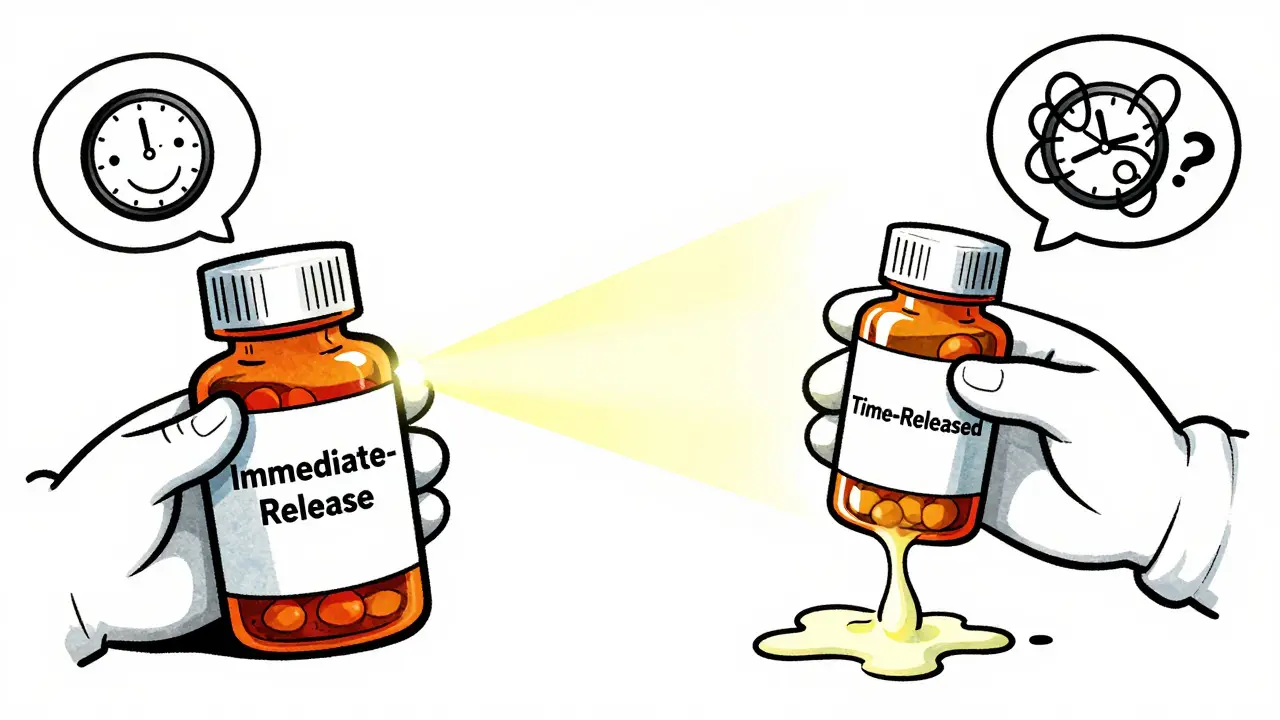
Your circadian system responds to discrete, sharp signals of melatonin, not sustained elevation. Think of it like a light switch versus a dimmer bulb. To reset your clock, you need a clear "off" signal at a specific time. Time-released melatonin maintains elevated levels for 6 to 8 hours. If you take this before bed, it keeps pumping melatonin into your bloodstream during your biological morning when your body actually needs low levels to stay alert. This can cause phase delays when you need advances, or vice versa.
Data supports this concern. A study published in Sleep Medicine found that 3 mg of immediate-release melatonin taken at 10:00 PM produced a 1.8-hour phase advance. The same dose in a time-released formulation only produced a 0.6-hour shift. That is a massive difference in effectiveness. Furthermore, users of time-released melatonin reported taking 2.4 days longer to adapt to new time zones compared to those using immediate-release versions. Common complaints include waking up at 3 AM feeling wired or experiencing severe morning grogginess that lasts all day.
| Feature | Immediate-Release Melatonin | Time-Released Melatonin |
|---|---|---|
| Half-Life | 40-60 minutes | 6-8 hours (sustained release) |
| Phase-Shifting Effect | High (up to 2 hours advance) | Low (approx. 0.6 hours advance) |
| Adaptation Speed | Faster (avg. 3.3 days for 8 zones) | Slower (avg. 5.7 days for 8 zones) |
| Risk of Grogginess | Low | High (morning confusion) |
| Expert Recommendation | Strongly Recommended (Level A) | Not Recommended |
The European Medicines Agency approved a prolonged-release version called Circadin for insomnia in adults over 55, but specifically excluded jet lag indications due to insufficient evidence. For travelers, sticking to immediate-release is the safer, more effective bet.
How to Dose Immediate-Release Melatonin Correctly
If you choose to use melatonin, less is often more. High doses do not necessarily mean faster results. Research by Herxheimer and Petrie showed that 0.5 mg is just as effective as 5 mg for shifting your circadian phase. Higher doses (3-5 mg) may help you fall asleep faster due to hypnotic effects, but they don't shift your clock any better and can increase side effects.
Timing depends entirely on your direction of travel. Here is a practical guide based on Mayo Clinic protocols and CDC guidelines:
Eastward Travel (e.g., New York to London)
When traveling east, you need to advance your clock (go to bed earlier). Take 0.5 to 3 mg of immediate-release melatonin 30 minutes before your target bedtime at the destination. Do this for 4-5 nights. For example, if you want to sleep at 10 PM in London, take the pill at 9:30 PM London time. Avoid bright light exposure after taking it, as light cancels out melatonin's effect.
Westward Travel (e.g., London to New York)
When traveling west, you need to delay your clock (stay up later). Melatonin is less commonly used here because natural light exposure works well. However, if you use it, take it in the morning upon waking at your destination for 2-3 days. This helps push your wake-up time later. Alternatively, focus on getting bright light exposure in the late afternoon/evening at your destination to delay your rhythm naturally.
- Determine your target sleep time at the destination.
- Calculate the dose: Start with 0.5 mg. Increase to 3 mg only if crossing 7+ time zones eastward.
- Set an alarm for 30 minutes before your target bedtime.
- Take the pill and avoid screens/blue light immediately after.
- Repeat for 3-5 days until your body adjusts.
Precision is key. Dr. Phyllis Zee of Northwestern University notes that even immediate-release melatonin requires accurate timing based on your individual circadian phase. Most people cannot determine their exact phase without testing, so following strict local time schedules is the next best thing.
Light Exposure: The Other Half of the Equation
Melatonin alone won't fix jet lag if you ignore light. Light is the primary zeitgeber (time-giver) for your circadian rhythm. You must combine melatonin dosing with strategic light exposure to maximize results.
For eastward travel, seek bright light (2,000-10,000 lux) in the morning at your destination. This helps advance your clock further. Avoid bright light in the evening. For westward travel, seek bright light in the late afternoon or evening. Wear sunglasses or blue-light-blocking glasses when you need to avoid light. The combination of melatonin (to suppress alertness) and light (to stimulate alertness) creates a powerful reset mechanism.
Apps like Timeshifter have gained popularity because they calculate these precise windows based on your departure, arrival, and chronotype. They tell you exactly when to take melatonin and when to seek or avoid light. Without such tools, travelers often mistime their doses by two or more hours, reducing effectiveness.
Prescription Alternatives and Risks
Some travelers turn to prescription medications like zolpidem (Ambien) or eszopiclone (Lunesta) for sleep, or modafinil for daytime alertness. These drugs address symptoms but do not facilitate circadian adaptation. Zolpidem has a half-life of 2.5 hours, while eszopiclone lasts around 6 hours. Modafinil has a long half-life of 15 hours, which can interfere with sleep if taken too late.
While these may help you function in the short term, they do not shift your internal clock. In fact, relying solely on sedatives can mask the need for proper light/dark cycle adjustment. Newer agents like tasimelteon (Hetlioz), a melatonin receptor agonist approved by the FDA in 2024, offer more selective binding but still require precise timing due to their 1.3-hour half-life. They are generally reserved for non-24-hour sleep-wake disorder rather than standard jet lag.
Regulatory challenges also exist. The FDA classifies melatonin as a supplement, not a drug. This means content variability can be huge-some studies show actual melatonin content ranging from 83% to 478% of the labeled amount. Always buy from reputable brands that undergo third-party testing to ensure you are getting what is on the label.

Practical Tips for Frequent Travelers
If you travel internationally often, consider these strategies to minimize jet lag impact:
- Hydrate aggressively: Dehydration worsens fatigue. Drink water throughout the flight.
- Avoid alcohol and caffeine: Both disrupt sleep quality and hydration.
- Adjust gradually: If possible, shift your sleep schedule by 15-30 minutes per day before your trip.
- Use earplugs and eye masks: Improve sleep quality on the plane to reduce baseline fatigue.
- Stick to local time: As soon as you board the plane, switch your watch to the destination time. Eat and sleep according to that clock if feasible.
Corporate travel departments are increasingly adopting these protocols. A survey found that 42 of the Fortune 100 companies provide immediate-release melatonin and timing guidance to frequent flyers. None endorse time-released versions. This reflects a growing consensus among sleep specialists that precision beats potency when it comes to circadian adjustment.
Conclusion
Jet lag is more than just tiredness; it is a physiological misalignment that requires careful management. While time-released melatonin might seem convenient for ensuring a full night's sleep, it often backfires by confusing your circadian clock. Immediate-release melatonin, taken in low doses at precise times, combined with strategic light exposure, offers the most effective path to rapid adaptation. By understanding how your body responds to these cues, you can turn a disorienting travel experience into a manageable transition.
Is time-released melatonin bad for jet lag?
Yes, time-released melatonin is generally not recommended for jet lag. It stays in your system for 6-8 hours, which can keep melatonin levels high during your biological morning. This confuses your circadian clock and can lead to morning grogginess and slower adaptation. Immediate-release melatonin provides a sharp signal that aligns better with your body's need for precise timing.
How much melatonin should I take for jet lag?
Start with a low dose of 0.5 mg. Studies show this is as effective as higher doses for shifting your circadian rhythm. If you are crossing 7 or more time zones eastward, you may increase to 3 mg. Higher doses (5 mg+) do not shift your clock faster and may increase side effects like drowsiness.
When should I take melatonin for eastward travel?
For eastward travel, take immediate-release melatonin 30 minutes before your target bedtime at the destination. For example, if you want to sleep at 10 PM local time, take it at 9:30 PM. Do this for 4-5 nights. Avoid bright light after taking it to enhance the phase-advancing effect.
Does light exposure matter when taking melatonin?
Absolutely. Light is the strongest cue for your circadian rhythm. To maximize melatonin's effect, avoid bright light (especially blue light from screens) after taking it. Conversely, seek bright light during the day at your destination to reinforce the new time zone. Combining melatonin with strategic light exposure speeds up adaptation significantly.
Are prescription sleeping pills better for jet lag?
Prescription hypnotics like zolpidem help you sleep but do not shift your internal clock. They treat the symptom (insomnia) rather than the cause (circadian misalignment). Melatonin, when timed correctly, actually helps reset your body clock. Therefore, melatonin is preferred for long-term adjustment, while prescriptions might be used sparingly for acute sleep initiation.
How long does it take to recover from jet lag?
Recovery typically takes one day per time zone crossed. Eastward travel is harder and may take 1.5 days per time zone. Using immediate-release melatonin and strategic light exposure can speed this process up. Without intervention, it may take several days to a week to fully adjust, depending on the number of zones crossed and individual factors.
Is melatonin safe for short-term use?
Yes, short-term use of melatonin (3-7 days) for jet lag is considered low-risk by most sleep specialists. However, long-term safety data beyond 13 weeks is limited. Since melatonin is regulated as a supplement in the US, quality varies. Choose reputable brands that undergo third-party testing to ensure accurate dosage.
Can I take melatonin on the plane?
You can, but timing is crucial. Only take it if it corresponds to nighttime at your destination. Taking it during daylight hours at your destination can disrupt your adjustment. Use an app or calculator to determine if it is appropriate to sleep on the plane based on your arrival time and target bedtime.