Your heart is supposed to beat in a steady, predictable rhythm. But for millions of people, that rhythm goes haywire. You might feel your heart racing, skipping beats, or fluttering like a bird trapped in a chest cavity. This isn’t just uncomfortable; it can be dangerous. These irregular heartbeats are called arrhythmias. When medications fail to keep them in check, doctors turn to procedures. The two main options are catheter ablation and device therapy involving implants like pacemakers and defibrillators. Knowing the difference between these treatments can save you from anxiety and help you make the right choice for your health.
This guide breaks down exactly what happens during these procedures, who they are for, and what you can expect afterward. We’ll look at the latest technology, success rates, and real-world outcomes so you can talk to your doctor with confidence.
Understanding Arrhythmias and Why Treatment Matters
An arrhythmia occurs when the electrical signals that control your heartbeat become disorganized. The most common type is atrial fibrillation (AFib), where the upper chambers of the heart quiver instead of contracting properly. Other types include supraventricular tachycardia (SVT) and ventricular tachycardia (VT).
If left untreated, AFib can lead to blood clots, stroke, and heart failure. That’s why treating it isn’t optional-it’s essential. While antiarrhythmic drugs are often the first line of defense, they don’t work for everyone. In fact, many patients find that pills only mask the symptoms without fixing the underlying electrical problem. This is where procedural interventions come in.
What Is Catheter Ablation?
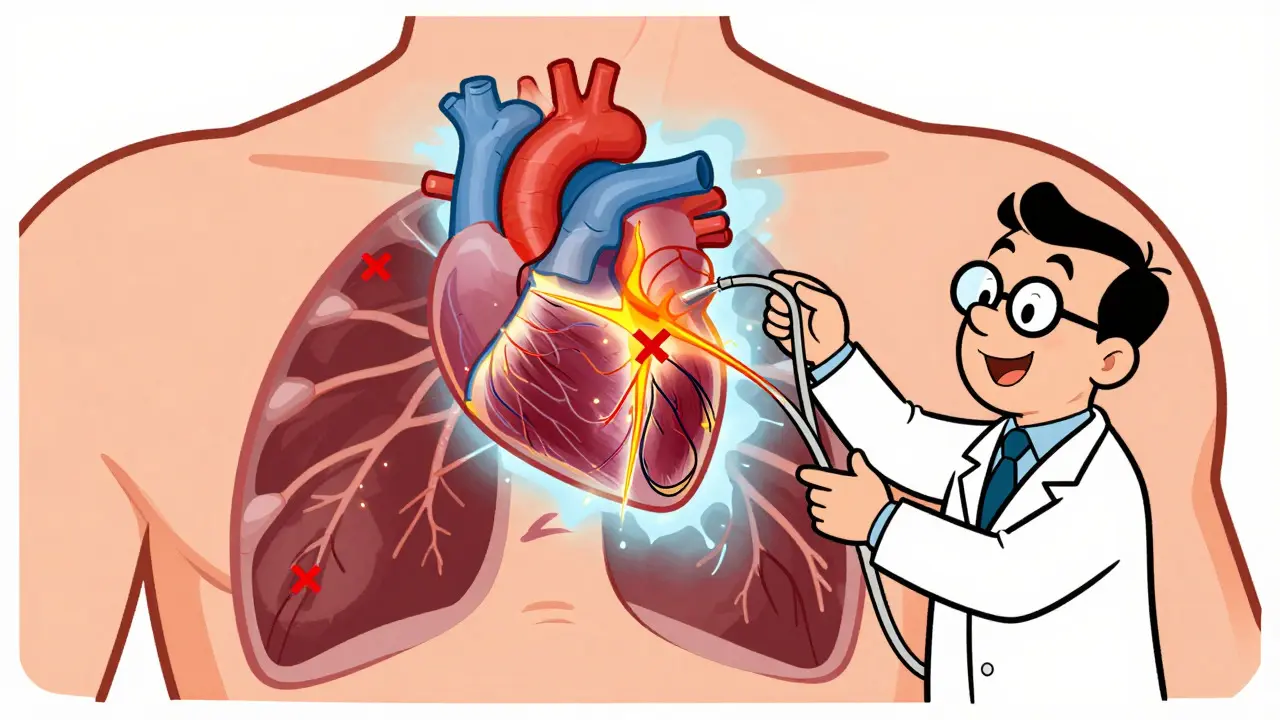
Catheter ablation is a minimally invasive procedure that destroys small areas of heart tissue causing abnormal electrical signals. Think of it as rewiring your heart’s faulty circuits. Doctors insert thin tubes called catheters through veins in your groin or neck and guide them up to your heart using X-ray imaging and 3D mapping systems.
Once the catheter reaches the problematic area, energy is delivered to create controlled scars. These scars block the erratic electrical impulses, forcing the heart to resume its normal rhythm. The most common strategy for AFib is pulmonary vein isolation (PVI), where the veins leading to the heart’s upper chambers are isolated because they are often the source of the triggers.
The technology has evolved significantly since the late 1980s. Today, we use radiofrequency energy (heat) or cryoablation (extreme cold). Newer tools, like contact force-sensing catheters, provide real-time feedback to ensure the scar tissue is deep enough to be effective but safe. Studies show that advanced catheters improve freedom from arrhythmia by 12-15% compared to older models.
How Device Therapy Works
If ablation fixes the wiring, device therapy involves implanting electronic devices to monitor and correct heart rhythm problems. There are two primary types:
- Pacemakers: These small devices sit under the skin near your collarbone. They send mild electrical pulses to keep your heart beating at a minimum rate. They are ideal for bradycardia (slow heart rate) or pauses in heartbeat.
- Implantable Cardioverter Defibrillators (ICDs): ICDs constantly monitor your heart rhythm. If they detect a life-threatening fast rhythm like ventricular fibrillation, they deliver a shock to reset the heart. This is a lifesaver for patients at high risk of sudden cardiac death.
Unlike ablation, which aims to cure the rhythm disorder, device therapy manages it. It doesn’t stop the arrhythmia from happening; it prevents the consequences. For some patients, especially those with structural heart disease, this management is the safest and most reliable option.
Ablation vs. Medications: The Evidence
You might wonder if you really need a procedure when there are pills available. The data suggests otherwise. A major meta-analysis published in Circulation: Arrhythmia and Electrophysiology found that catheter ablation reduced the recurrence of atrial arrhythmias by 58% compared to medical therapy alone. More importantly, it cut cardiovascular hospitalizations by 44%.
For patients with heart failure, the benefits are even clearer. Research shows that ablation can improve the heart’s pumping ability (ejection fraction) and reduce mortality by nearly half in specific groups. Dr. Jonathan P. Piccini, a leading expert in the field, noted that ablation offers a significant survival advantage for patients with AFib and reduced ejection fraction.
However, it’s not a magic bullet for everyone. The CABANA trial showed no overall mortality benefit for all AFib patients, highlighting that patient selection is key. Your age, overall health, and the type of arrhythmia all play a role in whether ablation is the right move.
| Feature | Catheter Ablation | Device Therapy (Pacemaker/ICD) |
|---|---|---|
| Goal | Cure or significantly reduce arrhythmia burden | Manage slow or fast rhythms; prevent sudden death |
| Invasiveness | Minimally invasive (vein access, no incision) | Surgical implant (small pocket under skin) |
| Recovery Time | 1-2 weeks for full activity | 2-4 weeks (arm restrictions) |
| Success Rate | 70-90% for SVT; 60-75% for AFib | Near 100% for pacing/shock delivery |
| Risks | Bleeding, perforation, stroke (rare) | Infection, lead displacement, battery replacement |
Technological Advances in Ablation
The field of electrophysiology is moving fast. One of the biggest recent shifts is the adoption of the Ablation Index. This metric combines force, time, and power to ensure each lesion is adequate. Centers using this technology report higher success rates and fewer complications.
Cryoablation, which uses a balloon cooled to -55°C to -65°C, offers a different approach. It freezes the tissue rather than burning it. This method is often faster and may have a lower risk of certain complications, though it carries a small risk of phrenic nerve injury. Then there’s pulsed field ablation (PFA), a newer technique approved by the FDA in 2023. PFA uses electrical fields to selectively target heart cells without damaging nearby structures like the esophagus. Early trials show impressive results, with high freedom from AFib and shorter procedure times.
Who Should Consider These Procedures?
Not everyone needs an ablation or a device. Here is how doctors typically decide:
- Choose Ablation If: You have symptomatic paroxysmal AFib that hasn’t responded to at least one medication. You also want to avoid long-term drug side effects. Guidelines give ablation a Class I recommendation for these patients.
- Choose Device Therapy If: You have a slow heart rate (bradycardia) or frequent pauses. An ICD is recommended if you have survived a cardiac arrest or have severe heart muscle weakness with a high risk of dangerous rhythms.
- Consider Both: Some patients with heart failure benefit from ablation to restore normal rhythm, combined with a device for backup protection.
Your cardiologist will evaluate your heart structure, symptom severity, and overall health. Age is less of a barrier than it used to be; healthy older adults often tolerate ablation well.

Risks and Realistic Expectations
No procedure is without risk. Major complications from catheter ablation occur in about 8% of cases. The most serious is cardiac tamponade, where fluid builds up around the heart, occurring in roughly 1.2% of patients. Stroke is another rare but feared complication. However, experienced centers minimize these risks with careful monitoring and anticoagulation.
Device therapy risks include infection at the implant site and lead issues. Batteries last 5-15 years, meaning future surgeries may be needed to replace them. It’s important to weigh these against the quality-of-life gains. Many patients report feeling "normal" again after ablation, returning to sports and daily activities without fear of palpitations.
Cost and Insurance Coverage
Money is a real concern. Catheter ablation costs range from $16,000 to $21,000 upfront. Device implants can be similar or higher depending on the complexity. While this seems steep, studies show that ablation becomes cost-saving within 3 to 8 years due to fewer hospital visits and less medication. In the US, Medicare and private insurers typically cover these procedures if they are medically necessary. Always check with your provider to understand your out-of-pocket costs.
Preparing for Your Procedure
If your doctor recommends a procedure, preparation is key. You may need to stop blood thinners a few days before surgery. Fasting is required for several hours prior. On the day of the procedure, you’ll receive sedation to keep you comfortable. Most ablations take 2-4 hours. Afterward, you’ll spend the night in the hospital for monitoring. Recovery at home involves resting for a few days and avoiding heavy lifting. Follow-up appointments are crucial to check for any recurrence of arrhythmias.
Is catheter ablation painful?
Most patients do not feel pain during the procedure because they are under moderate sedation. You might feel pressure or mild discomfort when the catheter moves, but it is generally well-tolerated. Afterward, you may have soreness at the insertion site in your groin or arm for a few days.
How long does a pacemaker battery last?
Pacemaker batteries typically last between 5 and 15 years, depending on usage and model. Your doctor will monitor the battery level during regular check-ups. When it gets low, a minor surgical procedure replaces the generator, leaving the leads in place if they are still functioning correctly.
Can ablation cure atrial fibrillation permanently?
Ablation can significantly reduce or eliminate AFib episodes, but it is not always a permanent cure. Success rates vary based on the type of AFib. Paroxysmal AFib has higher success rates (around 70-80%) compared to persistent AFib. Some patients may need a second procedure if symptoms return.
What is the recovery time after catheter ablation?
Most people can return to light activities within a few days. Full recovery, including returning to exercise and heavy lifting, usually takes about 1 to 2 weeks. Your doctor may advise avoiding strenuous activity for a month to allow the heart tissue to heal completely.
Are there alternatives to surgery for arrhythmias?
Yes, lifestyle changes like reducing alcohol intake, managing stress, and losing weight can help. Medications such as beta-blockers or antiarrhythmics are also standard. However, if these fail to control symptoms or protect your heart, procedural interventions like ablation or device therapy become the next best step.