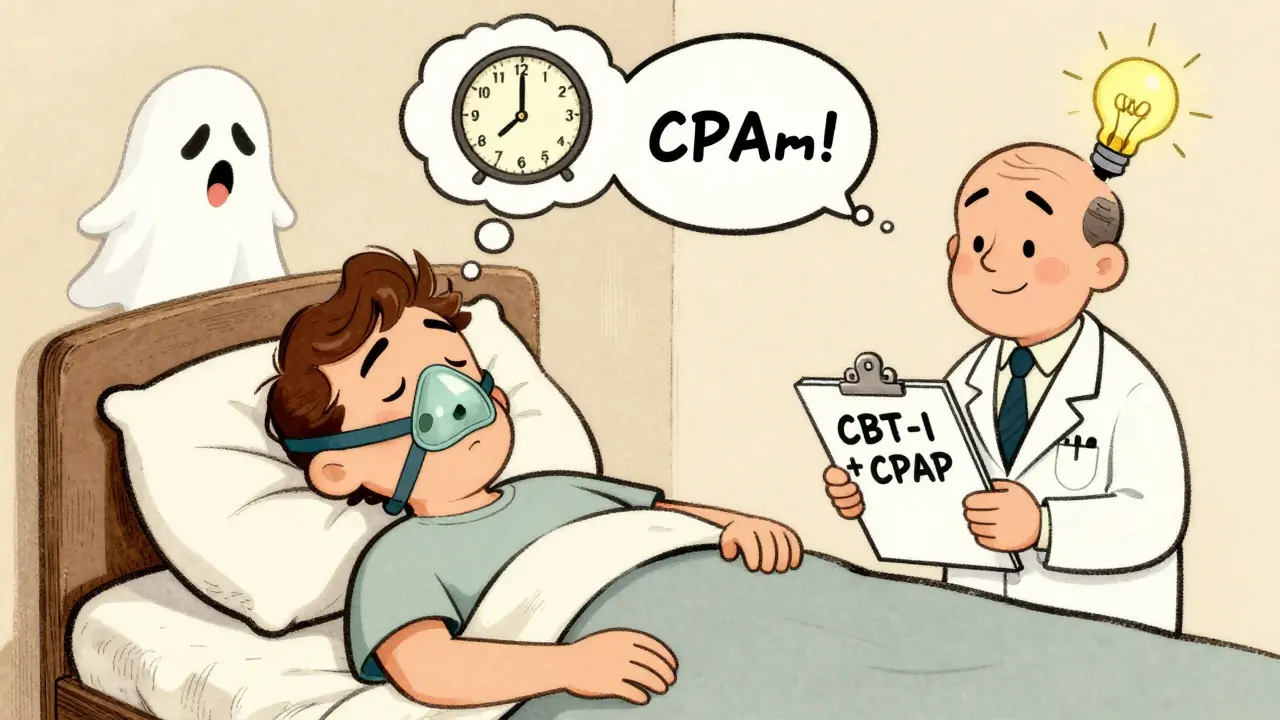
If you’ve been struggling to sleep - tossing and turning at night, waking up gasping for air, or feeling exhausted even after 8 hours in bed - you might not just have insomnia or sleep apnea. You could have COMISA: comorbid insomnia and sleep apnea. This isn’t just two sleep problems stacked on top of each other. It’s a distinct condition that needs a completely different approach than treating either one alone. And if you’re being treated for just one, you’re probably not getting the full relief you need.
What Exactly Is COMISA?
COMISA stands for Comorbid Insomnia and Sleep Apnea. It means you have both conditions at the same time. About 4 in 10 people diagnosed with obstructive sleep apnea (OSA) also have clinical insomnia. That’s not rare - it’s the norm. And here’s the catch: treating just the apnea with a CPAP machine often doesn’t fix the insomnia. In fact, for many, the mask, the noise, and the pressure make falling asleep even harder.
Insomnia in COMISA usually shows up as sleep maintenance insomnia - waking up multiple times through the night and struggling to fall back asleep. That’s different from sleep onset insomnia (taking a long time to fall asleep in the first place), which is less common in COMISA. Studies show 68% of COMISA patients have trouble staying asleep, not just starting sleep. And while CPAP therapy works well for OSA - fixing breathing issues in 85-90% of cases - adherence drops to just 42.7% in COMISA patients. Why? Because the insomnia keeps them from tolerating the device.
Why Standard Treatments Fail
Most doctors treat sleep apnea first. They put you on a CPAP machine and assume that once your breathing improves, so will your sleep. But research shows that doesn’t happen for a lot of people. In fact, 39% of OSA patients on CPAP still report insomnia symptoms. Why? Because CPAP doesn’t fix the brain’s learned habit of staying alert at night. It doesn’t calm the racing thoughts, the anxiety about not sleeping, or the conditioned fear of lying in bed.
On the flip side, if you only do cognitive behavioral therapy for insomnia (CBT-I) - the gold standard for treating insomnia - you’re still ignoring the physical blockages in your airway. Those breathing pauses? They’re still happening. And they’re still stressing your heart, raising your blood pressure, and disrupting your deep sleep. CBT-I alone won’t stop those events.
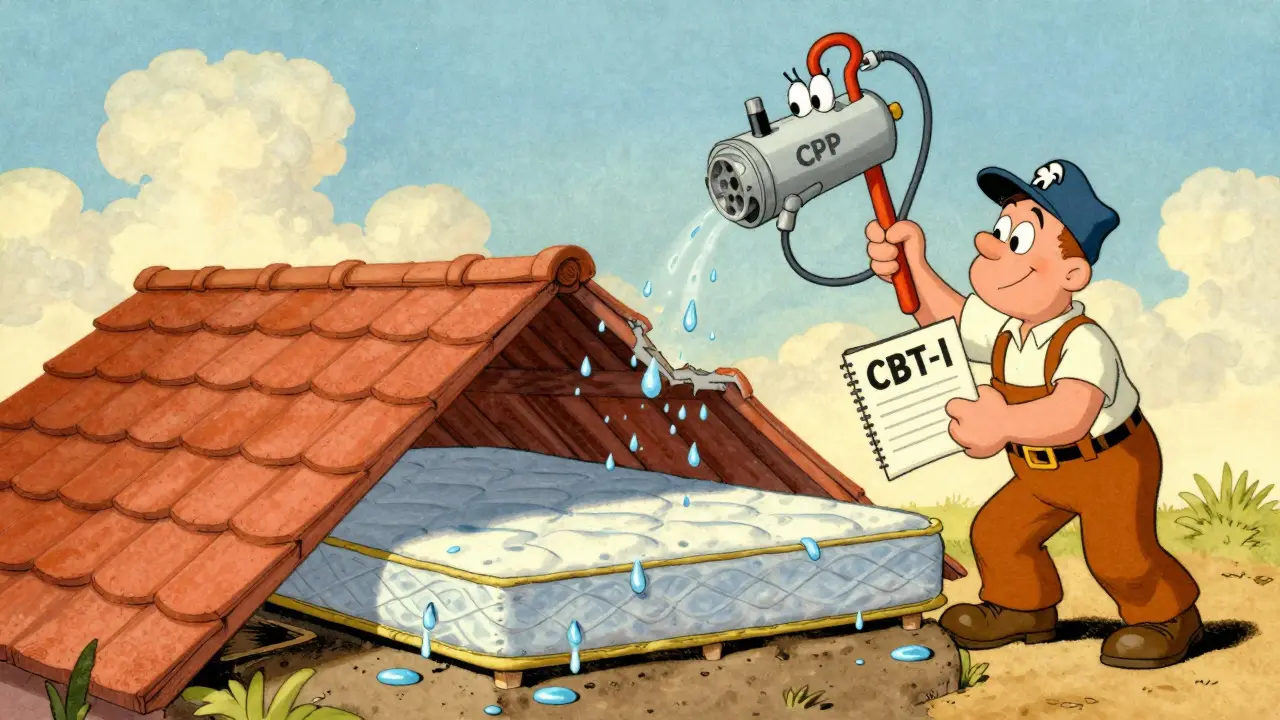
So here’s the problem: treating one condition without the other is like patching a leaky roof while ignoring the broken foundation. You’ll get some relief, but not the full recovery you need.
The Only Approach That Works: Combined Treatment
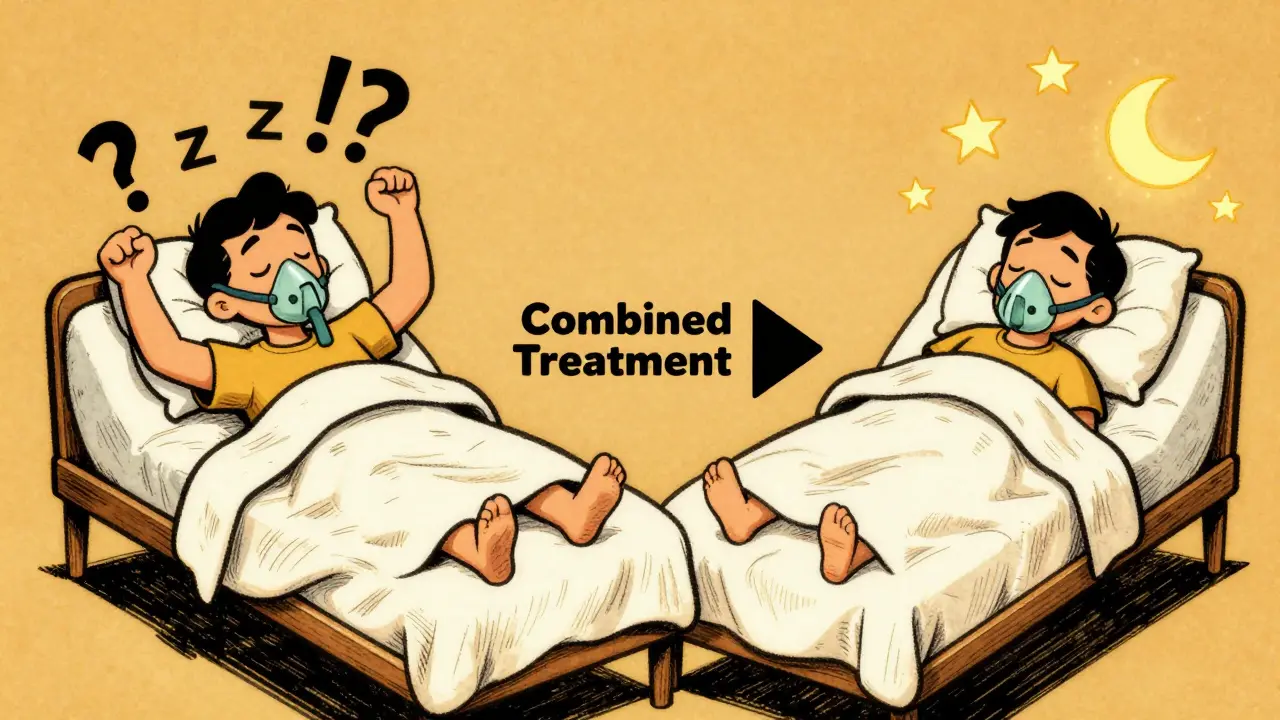
Multiple clinical trials now show that the best - and often only - way to treat COMISA is to tackle both conditions at the same time. That means starting CBT-I and CPAP therapy together, not one after the other.
CBT-I isn’t just about sleep hygiene. It’s a structured, evidence-based therapy that changes how you think about sleep. It includes:
- Stimulus control: Only using the bed for sleep and sex. No scrolling, no watching TV in bed.
- Sleep restriction: Limiting time in bed to match actual sleep time, then gradually increasing it. This builds sleep pressure and reduces nighttime wakefulness.
- Cognitive restructuring: Challenging beliefs like “I need 8 hours” or “If I don’t sleep, I’ll die.”
- CPAP-specific adaptations: Learning to tolerate the mask, using ramp features, adjusting pressure settings, and managing anxiety around the device.
A 2020 randomized trial found that patients who got CBT-I plus CPAP improved their insomnia symptoms by 54% and increased CPAP usage by 1.2 hours per night - compared to those who only got sleep education. At six months, those in the combined group were 70% more likely to stick with CPAP.
Another study showed that 63% of COMISA patients achieved insomnia remission with combined treatment, versus only 29% with CPAP alone. The effect size? Strong. Comparable to taking a powerful medication - but without side effects.
What About Digital CBT-I?
Digital CBT-I platforms like Sleepio and Somryst are becoming more common. They’re cheaper, more accessible, and can be done from home. But they’re not one-size-fits-all for COMISA.
Studies show digital CBT-I works well for mild COMISA (AHI 5-15) - achieving 65% remission rates. But for moderate to severe OSA (AHI >15), the success rate drops to 38%. Why? Because if your breathing is severely disrupted, the brain stays in survival mode. No app can override that without real-time CPAP data and clinical oversight.
That’s why the best digital programs now integrate CPAP usage data. Somryst’s COMISA module, launched in 2023, adjusts therapy based on your nightly apnea events and CPAP compliance. It’s not just a self-help app - it’s a clinical tool. But it still needs supervision. Not every COMISA patient is a good candidate for self-guided treatment.
Barriers to Getting Help
Here’s the hard truth: most people with COMISA never get diagnosed - let alone treated properly.
- 79% of patients wait an average of 7.2 years between first noticing symptoms and getting a dual diagnosis.
- Only 12% of patients have access to a psychologist trained in CBT-I for COMISA.
- Wait times for sleep specialists average 14.3 weeks.
- Many primary care doctors still treat insomnia with sleeping pills or OSA with CPAP alone - never connecting the two.
And then there’s cost. A full course of CBT-I with a licensed therapist can run $1,200-$1,800. CPAP machines cost $800-$3,000. Insurance often covers CPAP but not CBT-I - or only if it’s done in a sleep clinic.
But things are changing. In January 2024, Medicare and Medicaid added new billing codes (G2212-G2214) specifically for integrated COMISA treatment. Each session is now reimbursable at $125-$185. That’s a game-changer. And insurers like UnitedHealthcare report $1,843 per patient per year in savings when COMISA is treated properly - because patients end up in the ER less, take fewer medications, and miss less work.
What’s New in 2026?
Technology is catching up. ResMed’s AirSense 11, released in late 2023, automatically adjusts pressure based on sleep stage - reducing wake-ups caused by high pressure during light sleep. Suvorexant, an orexin antagonist approved by the FDA in December 2023, is now being prescribed for COMISA. In trials, it improved insomnia remission to 57% when paired with CPAP - far better than CPAP alone.
Machine learning is also entering the picture. Researchers at Flinders University built a model that predicts COMISA treatment success with 78% accuracy by analyzing sleep patterns, anxiety levels, and CPAP adherence. This could soon help doctors personalize treatment before it even starts.
But the biggest shift is in mindset. The American Academy of Sleep Medicine now officially recognizes COMISA as its own diagnosis. And sleep medicine fellows - the next generation of doctors - are being trained to treat both conditions together. In 2018, only 42% of fellows said COMISA was essential. By 2023, that jumped to 78%.
What Should You Do?
If you have OSA and insomnia, don’t accept partial relief. Ask your sleep doctor for a combined treatment plan. Here’s what to request:
- Confirm both diagnoses: Get a full polysomnography (sleep study) and an Insomnia Severity Index (ISI) score. If your ISI is 15 or higher, you have clinical insomnia.
- Ask if CBT-I can start at the same time as CPAP - not after.
- Find out if your provider offers integrated care. Ask: “Do you have a psychologist or sleep coach who works with CPAP users who have insomnia?”
- If your clinic doesn’t offer it, ask for a referral to a behavioral sleep medicine specialist.
- Look for digital tools that sync with your CPAP - like Somryst - if you can’t access in-person therapy.
And if you’re using CPAP but still waking up 3-4 times a night? That’s not normal. That’s COMISA. You’re not broken. You just need the right treatment.
Real Stories
One user on MyApnea.org shared: “I hated my CPAP. I’d take it off after 20 minutes. Then I got CBT-I. My therapist helped me reframe the mask - not as a nuisance, but as my ticket to sleep. In 8 weeks, I went from 2.1 hours of use to 6.7. I haven’t woken up at 3 a.m. in months.”
Another said: “I was told to just take sleeping pills. I did. I got addicted. Then I found a COMISA clinic. I got CBT-I and a new CPAP with a ramp setting. I sleep 7 hours now. I didn’t know this was possible.”
Final Thoughts
COMISA is not a rare oddity. It’s common. It’s treatable. And it’s being ignored by most of the healthcare system. But the evidence is clear: treating both conditions together gives you back your sleep - and your life. You don’t have to live with exhaustion, anxiety, and frustration. You just need to ask for the right kind of help.
Is COMISA the same as just having insomnia and sleep apnea?
No. Having both conditions doesn’t automatically mean you have COMISA. COMISA is a clinical diagnosis that requires both conditions to be actively interfering with each other. For example, CPAP use might be triggering insomnia, or chronic insomnia might be worsening your apnea by disrupting sleep architecture. It’s the interaction - not just the presence - that defines COMISA.
Can I treat COMISA with just medication?
Medications like sleeping pills or orexin antagonists (e.g., suvorexant) can help, but they’re not the first-line solution. Sleep aids don’t fix the learned behaviors behind insomnia, and they don’t address the physical airway blockage in OSA. The gold standard is still combined CBT-I and CPAP. Medications may be used short-term to help during transition, but long-term relief comes from behavior change and device use.
How do I know if I have COMISA?
You likely have COMISA if you’ve been diagnosed with OSA and still struggle with sleep despite using CPAP. Look for signs like frequent nighttime awakenings, difficulty falling back asleep, feeling unrefreshed in the morning, or anxiety about sleep. A formal diagnosis requires a sleep study (to confirm OSA) and the Insomnia Severity Index (ISI) score of 15 or higher.
Why does CPAP make my insomnia worse?
CPAP can worsen insomnia because of mask discomfort, air pressure, noise, or feeling claustrophobic. These physical sensations train your brain to associate the bed with frustration - not rest. This is called conditioned arousal. CBT-I helps reverse this by reassociating the bed with calm, restful sleep - even with the mask on.
Is CBT-I covered by insurance?
In the U.S., coverage varies. Many insurers cover CBT-I if it’s delivered in a sleep clinic with a licensed psychologist, especially now that new billing codes (G2212-G2214) exist for integrated COMISA care. Digital CBT-I platforms may be covered if they’re FDA-cleared and prescribed by a provider. Always ask your insurance about “behavioral sleep medicine” and “comorbid sleep disorder treatment.”



8 Comments
I cannot believe how long I struggled with this!! I had CPAP for 3 years and still woke up 5 times a night!!! 😭 Then I found a COMISA specialist-AND IT CHANGED MY LIFE. I started CBT-I at the same time as my CPAP adjustment, and now? I sleep 7 hours straight. No more anxiety. No more 3 a.m. panic. I even started hugging my mask. 🤗 Seriously, if you’re reading this and still struggling-DON’T GIVE UP. It’s not you, it’s the treatment. Combined therapy is the key!!
lol so you're telling me the medical industry didn't figure out that two problems exist at once until 2026? groundbreaking. next they'll tell us water is wet and gravity exists. i got my cpap in 2019 and still woke up like a startled raccoon. they gave me melatonin. i gave up. now i just nap in my car during lunch. progress?
You people are so dramatic. Just take a pill. Or don't. Who cares. Sleep is overrated anyway. I sleep 4 hours and run a startup. You're all just addicted to comfort. Your brain is weak. CPAP is for people who can't handle reality. I've never even seen a sleep study. My pillow? My therapist.
As someone from India where sleep clinics are rare and doctors still prescribe sleeping pills like candy, I’m so glad this article exists. My dad had CPAP for 5 years but never got help for his insomnia-he just snored louder and got angrier. We found a telehealth CBT-I program last year that synced with his machine. Now he sleeps 6 hours. He says he feels like a new man. We didn’t know this was possible. Thank you for writing this. We need more awareness here.
OMG I CRIED READING THIS. I thought I was broken. I thought I was lazy. I thought I was just ‘bad at sleep.’ I’ve been on 3 different CPAPs, tried 4 different masks, took 7 different meds, and STILL woke up every hour. My husband said I was ‘too sensitive.’ My therapist said ‘just relax.’ But no one said: YOU HAVE COMISA. I found a clinic that does combined treatment. I started CBT-I last month. I used to scream at my machine. Now I whisper ‘goodnight’ to it. I slept 7.5 hours last night. I’m not okay. I’m AMAZING.
This is the kind of post that makes me believe in healthcare again. Seriously. I’ve been a sleep tech for 12 years and I’ve seen so many people give up because they were told ‘just use the CPAP.’ But the real problem? No one told them how to *live* with it. CBT-I isn’t just ‘sleep hygiene’-it’s therapy for your whole relationship with rest. And pairing it with CPAP? That’s not treatment. That’s liberation. If you’re struggling, don’t wait. Find a behavioral sleep specialist. It’s worth every second. You deserve to wake up feeling human again.
As a sleep physician in the UK, I can confirm: COMISA is underdiagnosed by 90%. We’re still stuck in a siloed system-respiratory guys do CPAP, psychology guys do CBT-I. No overlap. No coordination. But we’re changing it. Our clinic now has integrated sessions: one hour with the sleep tech, next hour with the CBT-I coach, all under one roof. Patient adherence jumped from 38% to 79%. The data doesn’t lie. If your provider doesn’t offer this, demand it. And if they say ‘it’s not covered’-ask them to bill G2213. It’s there. They’re just not trained to use it.
I don't have time for this. I have a job. I have kids. I have a dog. I have a car. I have a mortgage. I have a therapist. I have a doctor. I have a CPAP. I have insomnia. I have sleep apnea. I have a life. I have no time for a 14 week wait. I have no money for $1800 therapy. I have no patience. I have sleep. I have exhaustion. I have no solution. I have no hope. I have no comment.
Write a comment