Creatine Impact Simulator
Your Parameters
Enter Your Details
Fill in your parameters to see how creatine affects your lab results
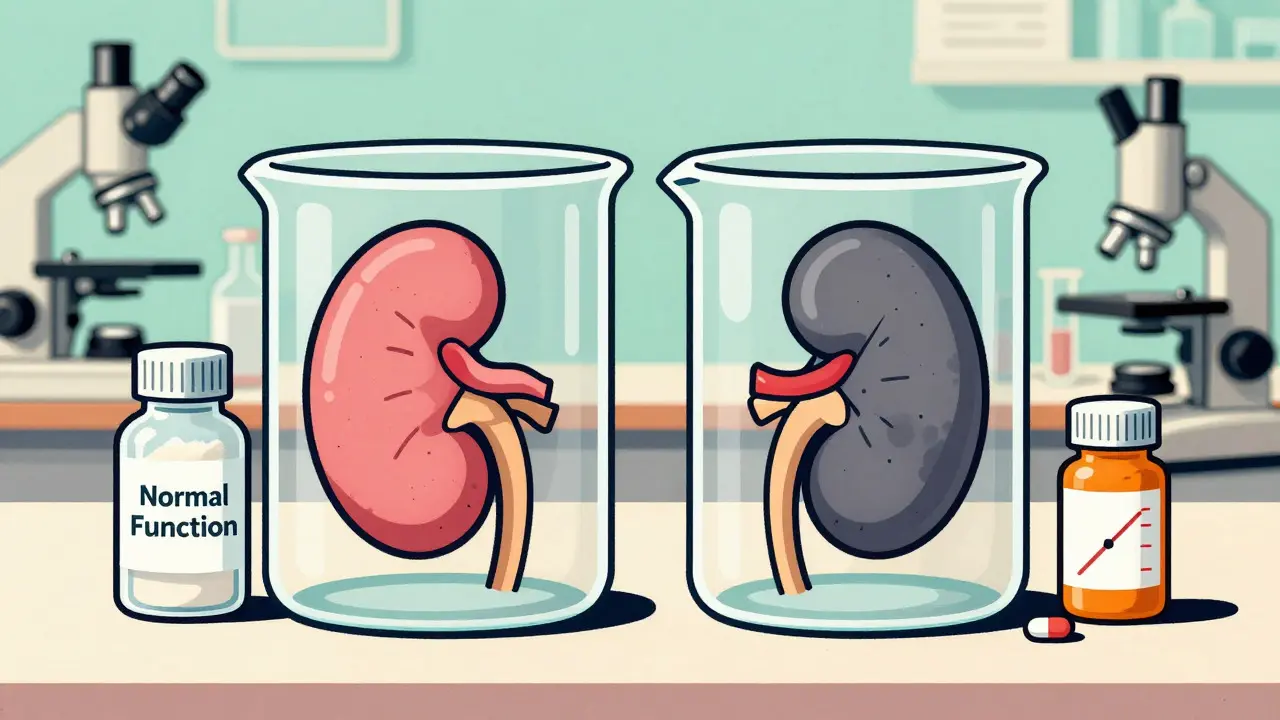
Imagine walking into your doctor's office for a routine checkup. You're healthy, you work out, and you feel great. Then the results come back. Your blood test shows elevated creatinine levels. The automatic calculation on the report flags a low estimated glomerular filtration rate (eGFR). Suddenly, you're being told you might have early-stage kidney disease. But here is the twist: you aren't sick. You just take creatine monohydrate. This scenario plays out more often than most people realize, creating unnecessary panic and leading to invasive follow-up tests that rarely reveal any actual problem.
The confusion stems from how we measure kidney health. For decades, serum creatinine has been the gold standard biomarker for assessing renal function. It works well in theory because creatinine is a waste product filtered by the kidneys. However, when you supplement with creatine, you flood your system with extra substrate that converts into creatinine. This artificial spike tricks standard lab algorithms into thinking your kidneys are struggling, even when they are functioning perfectly. Understanding this interaction is crucial, especially if you are taking medications for existing conditions or simply want accurate health data.
Why Creatine Skews Your Blood Test Results
To understand why your numbers look bad, we need to look at the chemistry. Creatine monohydrate is a naturally occurring compound found in muscle cells that helps produce energy during high-intensity exercise. When you ingest it, about 90% of it is processed by your body. A small percentage-roughly 1.7% per day-spontaneously converts into creatinine. If you are not supplementing, your body produces a steady, predictable amount of creatinine based on your muscle mass. Labs use this baseline to calculate your eGFR, which estimates how much blood your kidneys filter each minute.
When you add 3 to 5 grams of creatine daily, you disrupt this baseline. Research published in the Journal of Strength and Conditioning Research shows that standard supplementation can raise serum creatinine concentrations by 15 to 25 µmol/L within weeks. In some cases, levels rise by up to 30%. Since eGFR formulas are inversely related to creatinine levels, a higher creatinine number mathematically forces the eGFR number down. A drop from an eGFR of 95 to 80 might technically push you into the "Stage 2 Chronic Kidney Disease" category on paper, despite having zero structural damage to your kidneys. This is a diagnostic artifact, not a medical reality.
Distinguishing True Kidney Damage from Supplement Effects
If creatine raises creatinine without harming the kidneys, how do doctors tell the difference between a false alarm and real trouble? The answer lies in looking beyond a single marker. True kidney dysfunction rarely presents as isolated creatinine elevation. It typically involves a cluster of abnormalities. When kidneys are actually failing, you will see other red flags appear simultaneously.
- Blood Urea Nitrogen (BUN): In true renal impairment, BUN levels usually rise alongside creatinine. Studies by Brose et al. (2003) demonstrated that while creatine users saw increased serum creatinine, their BUN levels remained stable.
- Proteinuria: Healthy kidneys keep protein in the blood. Damaged kidneys leak it into urine. Creatine supplementation does not cause protein leakage.
- Electrolyte Imbalances: Issues with potassium, sodium, or phosphorus regulation suggest genuine tubular or glomerular damage, which is absent in healthy creatine users.
- Cystatin C Levels: This is the game-changer. Unlike creatinine, cystatin C is a protein produced by all nucleated cells at a constant rate. It is filtered by the kidneys but is not influenced by muscle mass or dietary creatine intake.
A landmark study by Gualano et al. (2008) followed sedentary men taking high doses of creatine for months. Their serum creatinine spiked, but their cystatin C levels stayed rock solid. This stability proves that the glomerular filtration rate itself hadn't changed; only the measurement tool was broken. Relying on multiple markers provides a complete picture rather than a misleading snapshot.
| Biomarker | Effect of Creatine Supplementation | Effect of Actual Kidney Disease |
|---|---|---|
| Serum Creatinine | Elevates (False Positive) | Elevates (True Positive) |
| eGFR (Calculated) | Artificially Low | Genuinely Low |
| Cystatin C | Stable/Normal | Elevated |
| Blood Urea Nitrogen (BUN) | Stable/Normal | Often Elevated |
| Urine Protein | Normal | Often Present (Proteinuria) |
Interactions with Kidney Disease Medications
The stakes get higher when you introduce prescription drugs. Many people with mild hypertension or diabetes take medications that affect renal hemodynamics, such as ACE inhibitors or NSAIDs. These drugs can slightly reduce kidney filtration efficiency as part of their mechanism of action or side effect profile. Adding creatine to this mix creates a complex diagnostic puzzle.
If you are taking an ACE inhibitor like lisinopril, your baseline creatinine might already be slightly elevated compared to someone not on medication. Add creatine supplements, and that number climbs further. Without context, a physician might assume the drug is causing toxicity and switch your medication unnecessarily, potentially compromising your blood pressure control. Conversely, if you have pre-existing chronic kidney disease (CKD), nephrologists generally advise against creatine supplementation. Not because creatine destroys kidneys, but because it obscures the monitoring tools needed to manage your condition safely.
Recent Mendelian randomization studies published in Renal Failure (2024) provide strong causal evidence that creatine levels themselves do not trigger renal issues. However, caution remains warranted for those with established CKD Stage 3 or higher. The primary risk isn't acute damage from the powder; it's the inability to accurately monitor disease progression. If your doctor can't trust your creatinine numbers, they can't adjust your dialysis schedule or medication dosages correctly.
How to Monitor Renal Function Accurately
You don't have to choose between your fitness goals and your health transparency. There are practical steps you can take to ensure your medical team gets an accurate read on your kidney function. The first step is communication. Always list creatine under "supplements" or "dietary habits" when filling out medical forms. Most standard medication history questions skip over gym supplements, leading to blind spots in diagnosis.
Second, request specific testing protocols. If you are a regular creatine user, ask your provider to order a Cystatin C-based eGFR instead of, or in addition to, the standard creatinine-based eGFR. The CKD-EPI CysC equation correlates with actual filtration rates regardless of your creatine intake. It costs slightly more, but it prevents misdiagnosis. If cystatin C testing isn't available in your region, a 24-hour urinary creatinine clearance test offers another robust alternative. This measures how much creatinine you excrete over a full day, providing a direct assessment of filtration capacity that isn't skewed by serum concentration spikes.
Third, establish a baseline before you start. If you haven't taken creatine yet, get a comprehensive metabolic panel done now. Save these results. When you start supplementing, compare future tests against this personal baseline rather than generic population norms. This contextual data empowers you to explain to your doctor, "My creatinine went up, but my cystatin C and BUN are unchanged, so my kidneys are fine."

Navigating Medical Misconceptions
Despite the science, awareness among healthcare providers lags behind. A survey in the Journal of Clinical Nephrology revealed that only 42% of primary care physicians routinely screen for creatine use when evaluating elevated creatinine levels. This gap leads to unnecessary referrals to nephrologists, expensive imaging scans like CTs or MRIs, and patient anxiety. You may find yourself in a room where a doctor recommends stopping the supplement immediately. While stopping will normalize your labs, it may not be necessary if your other markers are clean.
Be prepared to advocate for yourself. Bring printouts of recent studies showing the safety of creatine in healthy adults. Mention that organizations like the American College of Sports Medicine affirm its safety for healthy individuals. If your doctor insists on cessation, consider asking for a trial period where you stop for two weeks, retest, and then restart if advised, to demonstrate the reversible nature of the creatinine spike. This collaborative approach builds trust and ensures your treatment plan reflects your actual physiology, not just a lab error.
Future Directions in Renal Monitoring
The medical community is slowly catching up. Emerging research from institutions like the University of Toronto suggests developing adjustment factors for eGFR calculations specifically for creatine users. Imagine a future where your lab report automatically detects supplement use via questionnaire input and adjusts the algorithm accordingly. Until then, patients must bridge the gap through education and proactive testing choices.
New guidelines from the National Kidney Foundation are expected to address this gap more explicitly, aiming to provide clear protocols for managing supplement users. For now, the responsibility falls on both the patient and the provider to recognize that creatine is a performance enhancer, not a nephrotoxin. By understanding the distinction between biochemical noise and biological signal, you can maintain your training regimen without sacrificing accurate health monitoring.
Does creatine permanently damage kidneys?
No. Extensive research, including long-term trials and Mendelian randomization studies, shows that creatine monohydrate does not cause permanent kidney damage in healthy individuals. The elevated creatinine levels seen in blood tests are a temporary, reversible artifact of metabolism, not a sign of tissue injury.
Can I take creatine if I have stage 1 or 2 CKD?
It depends on your doctor's advice. While creatine doesn't worsen kidney function, it makes monitoring difficult. In early stages (1-2), some specialists may allow it if you use cystatin C for monitoring. However, many prefer to avoid it to prevent diagnostic confusion. Always consult your nephrologist before starting.
What is the best test to check kidney function if I take creatine?
The Cystatin C blood test is the most accurate alternative. Unlike creatinine, cystatin C levels are not affected by muscle mass or creatine supplementation. It provides a reliable estimate of your glomerular filtration rate (GFR) without the interference caused by creatine metabolites.
Will stopping creatine lower my creatinine levels?
Yes. Serum creatinine levels typically return to baseline within 1 to 2 weeks after discontinuing creatine supplementation. This rapid normalization confirms that the previous elevation was due to the supplement and not underlying kidney pathology.
Do I need to drink more water if I take creatine?
While creatine pulls water into your muscle cells, there is no strict requirement to drastically increase fluid intake solely for kidney protection. However, staying well-hydrated supports overall renal health and helps maintain optimal filtration rates, especially if you are exercising intensely.