
Imagine taking your blood pressure medication every single day, yet your readings remain stubbornly high. You follow the instructions, but the results don't match your effort. This disconnect is often not about the drug's effectiveness, but about medication adherence, defined by the degree to which a person's behavior corresponds with agreed recommendations from a healthcare provider. According to the World Health Organization, this gap between prescribed and actual intake affects more than half of people living with chronic diseases. The cost? An estimated $100 billion to $300 billion annually in avoidable hospitalizations in the U.S. alone.
If you are a patient struggling to track your habits, or a clinician trying to understand why treatment plans fail, you need a reliable way to measure this behavior. There is no single "gold standard" tool, as confirmed by industry experts at GoodRx HCP. Instead, effective measurement requires choosing the right method for your specific situation. This guide breaks down the practical checklist for assessing adherence, from simple self-reports to advanced electronic monitoring, helping you identify gaps before they become health crises.
Understanding the Three Phases of Adherence
Before picking a measurement tool, you must define what you are measuring. The EQUATOR Network’s EMERGE guidelines clarify that adherence is not a single event but a process with three distinct phases. Each phase requires a different approach to assessment.
- Initiation: Did the patient take the first dose? This is a binary yes/no metric, often tracked via pharmacy fill records shortly after prescription issuance.
- Implementation: Does the actual dosing match the prescribed regimen? This looks at frequency, timing, and dosage accuracy over time.
- Persistence: How long does the patient stay on the therapy before discontinuing? This measures the duration from initiation to stopping the medication.
For example, a patient might initiate their diabetes medication correctly (Phase 1) but skip doses due to side effects (Phase 2 failure), eventually quitting entirely (Phase 3 failure). Identifying which phase is breaking down helps tailor the intervention. If initiation fails, the issue might be access or cost. If implementation fails, it could be complexity or forgetfulness.
The Patient’s Toolkit: Self-Reporting and Diaries
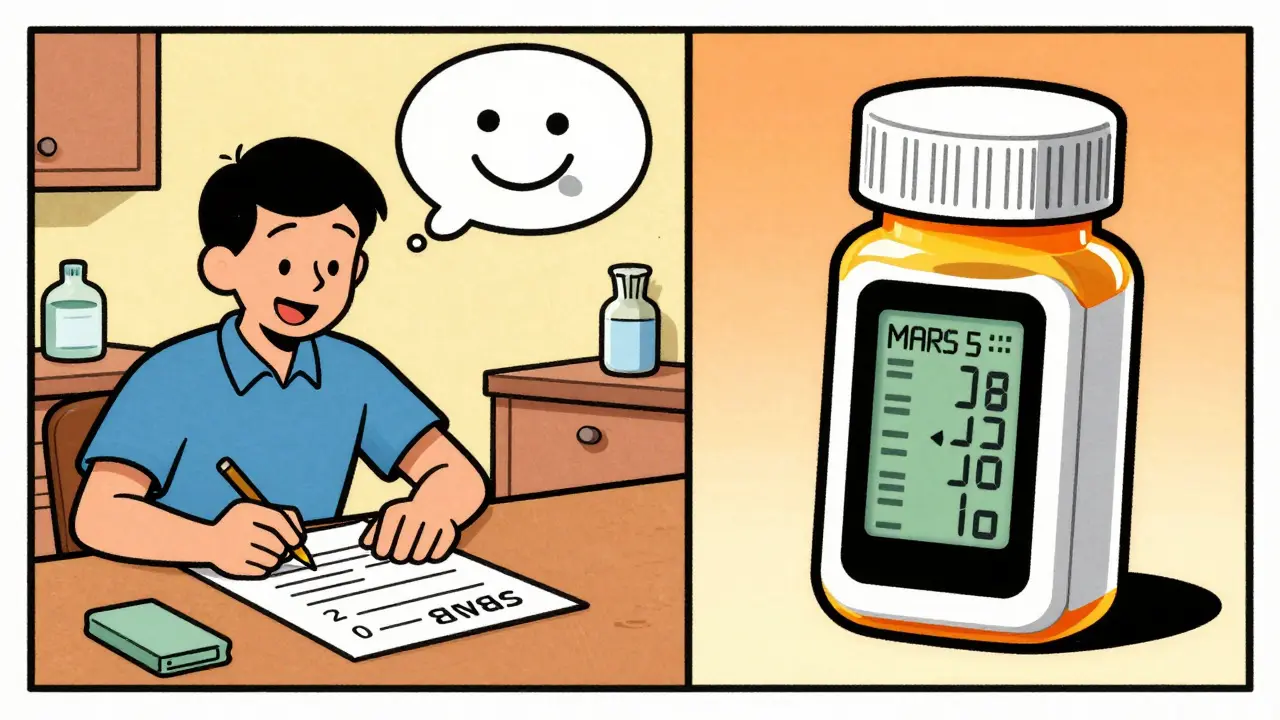
For many individuals, the most accessible way to measure adherence is through self-reporting. While subjective, these methods provide insight into the patient’s perspective and barriers. The most validated tool here is the Medication Adherence Report Scale (MARS-5), developed by Professor Rob Horne. It consists of five questions where patients rate behaviors on a scale from 1 (very often) to 5 (never).
To use the MARS-5 effectively, administer it during a routine visit. It takes under two minutes. Higher scores indicate better adherence. However, be aware of "social desirability bias," where patients overreport good behavior because they want to please their doctor. Studies show self-report identifies non-adherence in only 32.1% of cases, compared to 58.3% detected by electronic monitoring. Therefore, pair self-reports with open-ended questions using the BATHE method (Background, Affect, Trouble, Handling, Empathy) to encourage honest disclosure without judgment.
Clinical Metrics: PDC vs. MPR
For clinicians and health systems, pharmacy claims data offers an objective view. The Pharmacy Quality Alliance (PQA) recommends the Proportion of Days Covered (PDC) as the preferred metric for chronic therapies. PDC calculates the percentage of days a patient had medication available during a specific period. The standard threshold for optimal clinical benefit is 80%. If your PDC is below 80%, you are likely missing out on the full therapeutic effect.
Do not confuse PDC with the Medication Possession Ratio (MPR). MPR can exceed 100% if patients overlap prescriptions, leading to an overestimation of adherence. PDC caps at 100%, providing a more accurate ceiling. For acute therapies, such as antibiotics for hepatitis C, PDC may be inappropriate; instead, look for completion metrics that ensure no significant gaps occurred during the short treatment window.
| Method | Accuracy | Cost | Best Use Case |
|---|---|---|---|
| Self-Report (MARS-5) | Moderate (Bias risk) | Low ($0) | Routine clinical visits, identifying psychological barriers |
| Prescription Fill Records (PDC) | High (Objective) | Medium (Data integration costs) | Population health, chronic disease management |
| Electronic Monitoring (MEMS) | Very High (Real-time) | High ($25-$50/device) | Clinical trials, complex regimens, research |
| Blood Sampling | Highest (Direct) | Very High (Lab fees) | Narrow therapeutic index drugs (e.g., warfarin) |

Technological Advances: Smart Packaging and AI
The landscape of adherence measurement is shifting toward automation. Companies like AiCure and AdhereTech are developing cellular-enabled medication bottles and smartphone-based monitoring apps. These tools record when a bottle is opened or a pill is taken via camera verification. In 2023, Flatiron Health demonstrated that AI prediction models could identify at-risk patients with 87.4% accuracy using Electronic Health Record (EHR) data.
While promising, these technologies face adoption barriers. Only 32% of independent primary care practices have systematic adherence measurement tools integrated into their workflows. Furthermore, data fragmentation remains a hurdle; 35.7% of Medicare beneficiaries use three or more pharmacies annually, making it difficult to get a unified PDC score without robust health information exchanges.
A Practical Checklist for Action
Whether you are managing your own health or overseeing a practice, use this checklist to improve adherence tracking:
- Define the Goal: Are you measuring initiation, implementation, or persistence? Choose the metric that matches this phase.
- Select the Tool: For chronic conditions, aim for a PDC ≥80%. For quick insights, use the MARS-5 questionnaire.
- Check Data Sources: Ensure you have access to complete pharmacy fill records. If patients split prescriptions across multiple pharmacies, request a consolidated report.
- Engage the Patient: Use non-judgmental communication (BATHE method) to discuss gaps. Ask, "What makes it hard to take this medication daily?" rather than "Did you take it?"
- Monitor Trends: Track adherence over time, not just as a one-off snapshot. Look for patterns related to refills, holidays, or side effects.
- Leverage Technology: Consider smart packaging for high-risk patients or those on complex regimens.
Remember, measuring adherence is not about blaming the patient. It is about identifying systemic or personal barriers-such as cost, confusion, or forgetfulness-and addressing them proactively. By combining objective data like PDC with empathetic patient engagement, you can close the gap between prescription and health outcomes.
What is the gold standard for measuring medication adherence?
There is no single gold standard. Direct methods like blood sampling or electronic monitoring (MEMS) are most accurate but costly and impractical for routine care. Indirect methods like Proportion of Days Covered (PDC) from pharmacy records are the preferred standard for chronic disease management due to their balance of accuracy and feasibility.
How is Proportion of Days Covered (PDC) calculated?
PDC is calculated by dividing the number of days a patient had medication available by the total number of days in the measurement period. For example, if a patient has 20 days of medication covered in a 30-day month, their PDC is 67%. The standard threshold for good adherence is 80%.
Why do self-report questionnaires often underestimate non-adherence?
Self-reports are subject to social desirability bias, where patients unconsciously or consciously report better behavior than they actually exhibit to please healthcare providers. Studies show self-report detects non-adherence in only about 32% of cases, compared to nearly 60% when using electronic monitoring.
What is the difference between PDC and MPR?
PDC (Proportion of Days Covered) caps at 100%, preventing overestimation when patients overlap prescriptions. MPR (Medication Possession Ratio) can exceed 100%, which artificially inflates adherence scores. PDC is therefore preferred for chronic therapies.
How can I improve my own medication adherence?
Start by using a simple checklist or app to track doses. Identify barriers like cost or complexity and discuss them with your doctor. Consider using pill organizers or setting alarms. Engaging in open, non-judgmental conversations with your healthcare provider using the BATHE method can also help address underlying issues.