
The Architecture of a Modern QbD Framework
Building a generic drug using QbD requires a structured technical roadmap. You can't just jump into the lab; you need a blueprint that links the final product's performance to the raw materials and machine settings. First comes the Quality Target Product Profile (or QTPP), which is essentially the "ideal portrait" of the drug. It lists everything from the assay and impurity levels to the dissolution profile. To get approved, the FDA generally requires at least 95% similarity to the Reference Listed Drug (or RLD) in terms of in vitro performance. Once the QTPP is set, developers identify Critical Quality Attributes (or CQAs). These are the physical, chemical, or biological properties that must stay within a specific limit to ensure the drug is safe and effective. For a typical generic, you're looking at 5 to 12 CQAs. For example, the dissolution rate must show a similarity factor (f2) greater than 50 compared to the RLD, and content uniformity should have a relative standard deviation (RSD) of 6.0% or less. Next, we move to the factory floor: Critical Process Parameters (or CPPs). These are the variables that can actually change the CQAs. Think of granulation moisture content (usually 1.5-3.0%) or compression force (10-15 kN). By using Design of Experiments (or DoE), scientists can map out how these parameters interact without running thousands of trial-and-error batches.Breaking the 'Recipe' Mentality with Design Space
Traditional manufacturing is like following a strict cookbook: "Mix for 15 minutes at 25°C." If the temperature hits 26°C, you might have to deviate or even scrap the batch. Design Space changes that. It is the multidimensional combination of input variables and process parameters that have been proven to yield a quality product. When a company defines and validates a design space, they gain immense regulatory flexibility. If they stay within that scientifically proven "safe zone," they can adjust parameters without filing a new supplement with the FDA. This can save a manufacturer between $1.2 and $2.8 million per product annually in regulatory paperwork and change management. Real-world data shows that companies using approved design spaces implement process changes 73% faster than those stuck in the old "fixed-point" model.| Feature | Traditional Approach | QbD Approach |
|---|---|---|
| Process Definition | Fixed set-points ("Recipe") | Flexible Design Space |
| Quality Assurance | End-product testing | In-process monitoring (PAT) |
| Regulatory Risk | Higher CRL rates | 31% fewer CRLs |
| Scale-up Success | Prone to batch failure | 28-42% greater robustness |
| Initial Cost | Lower initial spend | 25-40% higher initial cost |

The Role of PAT and Real-Time Control
To make a design space work, you need eyes inside the process. This is where Process Analytical Technology (or PAT) comes in. Instead of taking a sample to a lab and waiting hours for a result, PAT tools like near-infrared spectroscopy provide real-time data on the blend or the tablet's moisture level. About 87% of generic manufacturers adopting QbD use some form of PAT. The impact is huge: it can reduce end-product testing requirements by 35-60%. For a company like Viatris, these control strategies have allowed for dozens of manufacturing adjustments without prior approval, ensuring that supply chains stay intact even during global disruptions.Is QbD Always the Right Move?
While the benefits are clear, QbD isn't a magic wand. It requires a significant upfront investment. You're looking at 25-40% higher initial development costs and an extra 4 to 8 months added to the development cycle. You also need specialized software like MODDE Pro and scientists trained in ICH Q9 risk management. There is also the risk of "over-engineering." For a simple immediate-release tablet with a well-known formula, spending $450,000 on exhaustive DoE studies might be a waste of resources. The goal should be proportionate implementation. If the product is low-risk and the design space is already common knowledge in the industry, a lightweight approach is more sensible. However, for complex generics-think inhalers, transdermal patches, or modified-release tablets-QbD is virtually mandatory. These products have tricky In Vitro-In Vivo Correlation (or IVIVC) issues. When you can't easily predict how a drug will behave in the body based on a lab test, the deep mechanistic understanding provided by QbD is the only way to ensure bioequivalence and avoid costly clinical failures.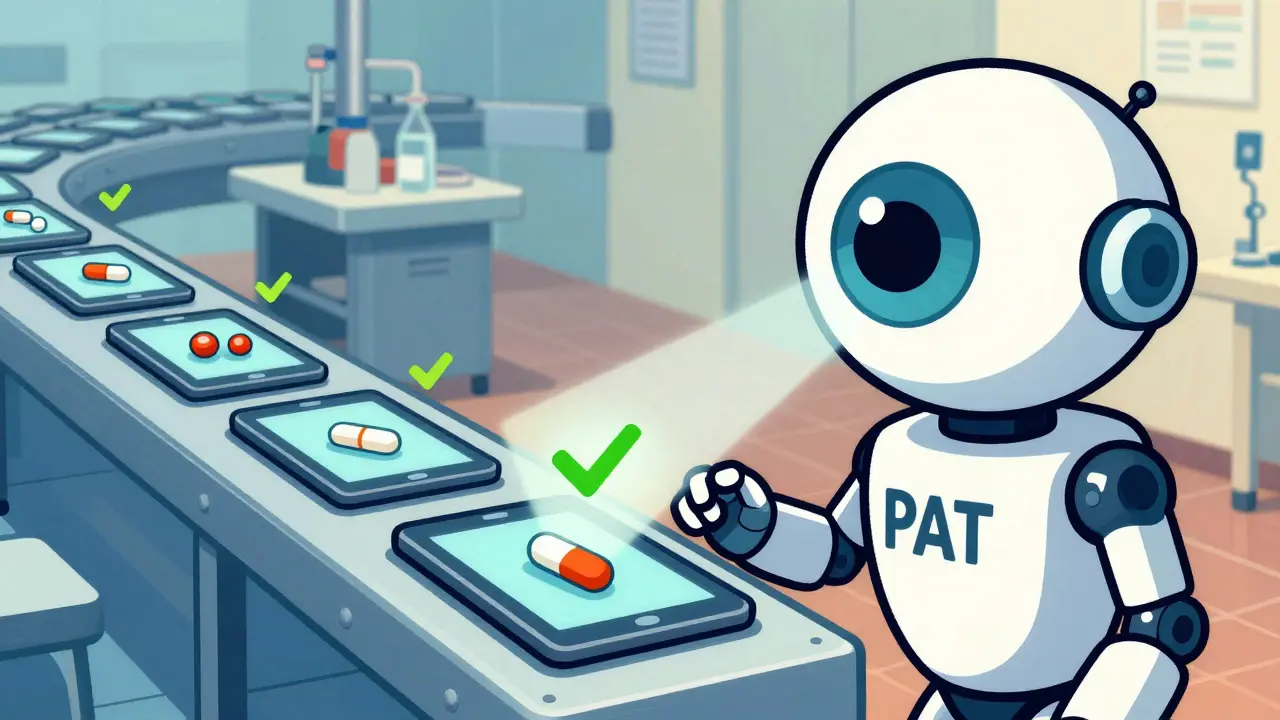
Practical Implementation Steps
If you're moving your team toward a QbD model, the roadmap usually takes 6-9 months for simple products and up to 18 months for complex ones. Here is the logical sequence:- Step 1: Define the QTPP. Determine exactly what the final product needs to be to match the RLD.
- Step 2: Identify CQAs. Use risk assessment tools (like Fishbone diagrams or FMEA) to decide which attributes affect safety and efficacy.
- Step 3: Run DoE Studies. Test different combinations of raw materials and process settings to see how they impact the CQAs.
- Step 4: Establish the Design Space. Define the boundaries where the product is guaranteed to be high quality.
- Step 5: Implement the Control Strategy. Integrate PAT tools and real-time monitoring to keep the process within the design space.
- Step 6: Continuous Improvement. Use the data from every batch to refine the model and further optimize the process.
The Future: Continuous Manufacturing and AI
We are seeing a convergence between QbD and continuous manufacturing. Unlike batch processing, where you make one giant pot and hope it's uniform, continuous manufacturing flows the product through a system. When combined with a QbD design space, this increases batch consistency by nearly 30%. Looking toward 2027, analysts predict that nearly 95% of new generic approvals will involve QbD. We are also seeing a shift toward "Analytical Procedure Development" (ICH Q14), which applies these same design principles to the way we test the drugs themselves. This lifecycle approach means that validation becomes faster because the methods are built to be robust from day one.Does the FDA require QbD for all generic drugs?
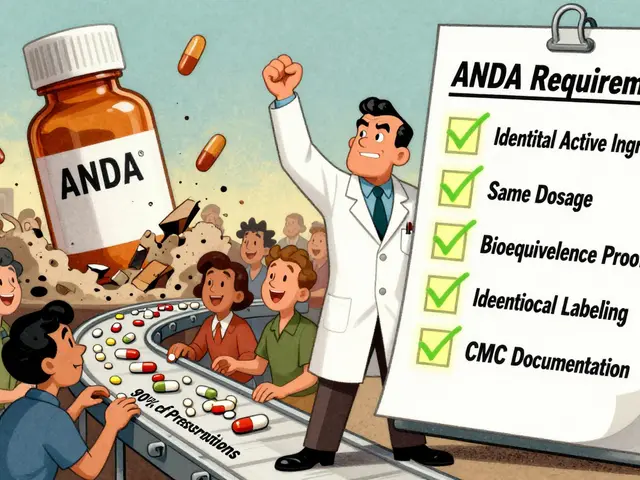
While not a strict legal mandate for every single product, the FDA strongly expects QbD elements in all ANDAs submitted after October 1, 2017. It is especially critical for "complex generics" (like long-acting injectables or inhalers) where the EMA and FDA often require it to prove equivalence without exhaustive clinical trials.
How does QbD actually reduce the cost of development?
Although initial costs are 25-40% higher, you save money in the long run by reducing "Complete Response Letters" (CRLs) from the FDA, which can delay a product's launch by months. Additionally, a validated Design Space allows you to make manufacturing changes without filing new regulatory supplements, saving millions in administrative and testing costs.
What is the difference between a CQA and a CPP?
A Critical Quality Attribute (CQA) is a property of the product itself-like its purity or how fast it dissolves. A Critical Process Parameter (CPP) is a setting on the machine or a condition in the environment-like the temperature of the dryer or the speed of the mixer. The goal of QbD is to understand exactly how changing a CPP will affect a CQA.
What are the most common reasons for QbD implementation failure?
According to the EMA, about 63% of failures stem from a lack of mechanistic understanding. Basically, companies treat the software as a "black box" and run experiments without actually understanding the chemistry or physics of how the drug is forming, leading to a design space that doesn't work in the real world.
Is QbD worth it for very cheap, high-volume generics?
Not necessarily. For ultra-low-cost generics where the profit margins are razor-thin and the product is a simple immediate-release tablet, an exhaustive QbD approach can be over-engineering. In these cases, a proportionate, risk-based approach is recommended to keep development costs under 15% of projected lifetime revenue.


12 Comments
The integration of Process Analytical Technology (PAT) is indeed the cornerstone of a successful Quality by Design implementation. In my professional experience, the transition from offline sampling to real-time monitoring significantly mitigates the risk of batch failure during the scale-up phase, particularly for modified-release formulations where granulation kinetics are highly sensitive.
Everyone knows that the FDA just wants more paperwork to justify their jobs. QbD is just a fancy name for doing the work you should have done anyway if you weren't lazy.
im sure this all looks great on a slide deck but its just another layer of bureaucrasy masking the void of actual inovation. we pretend science is a linear path of "design spaces" while actually just gambling with different variabels until something sticks. its a philsophical farce to believe we can control nature with a software package from modde pro
Keep pushing these science-based standards! It is so inspiring to see the industry move toward a proactive model that ensures patient safety while streamlining the approval process. Let's keep striving for that 100% similarity!
Notice how they only mention the "FDA expectations" and not who is actually funding these "modern" frameworks. It's a closed loop designed to keep smaller labs out of the market so the giants can keep their grip on the generic supply chain.
The 23% jump in approvals is a lie to hide the real agenda.
DoE is basic math. Most people just fail at executing the plan
you guys in the west love overcomplicating things with these frameworks but in india we see the real struggle with raw material variability that no design space can fully fix if the vendor is lying about the grade of the excipient get your hands dirty in the plant first
This is a lot of big words but it sounds like a good way to make better medicine 💊👍
It's really heartening to see how this approach helps avoid those devastating Complete Response Letters. I can only imagine the stress a team feels when millions of dollars are on the line and the process isn't robust. It's a wonderful step forward for global health equity by getting generics to market faster and more reliably.
Typical academic garbage that ignores the reality of American manufacturing dominance we dont need these bloated European ICH guidelines to tell us how to make a pill just get the plants back on US soil and stop relying on overseas garbage and you wont need to worry about your design space
I completely get where some of you are coming from regarding the cost. It's a huge pill to swallow for a small company to spend an extra 40% upfront when you're already struggling with cash flow. But if it prevents a CRL, it's basically an insurance policy for your product launch.
Write a comment