Generic drugs are supposed to be the affordable alternative. They’re cheaper than brand-name versions by up to 85%, right? So why do you still feel the pinch at the pharmacy counter? For millions of people, that $5 or $10 copay adds up fast, especially when you need multiple refills every month. The good news is that help exists, but it’s hidden behind a maze of government programs, nonprofit initiatives, and pharmacy discounts that most patients never find on their own.
If you’re struggling with medication costs, you aren’t alone. About one in four U.S. adults report difficulty affording prescriptions, even generics. This article cuts through the confusion to show you exactly where to look for financial support, what qualifies you for aid, and how to maximize your savings starting today.
Quick Summary / Key Takeaways
- Medicare Extra Help is the most powerful tool for seniors, capping generic copays at just $4.90 per prescription in 2025-2026.
- Pharmacy discount programs like Walmart’s $4/$10 list require no application and work instantly if you don’t use insurance.
- The Inflation Reduction Act has lowered the annual out-of-pocket cap for Medicare Part D to $2,000, protecting you from catastrophic costs.
- Nonprofit organizations such as NeedyMeds and PAN Foundation offer grants for those who fall between Medicaid and commercial insurance thresholds.
- Avoid stacking errors: You usually cannot combine pharmacy discount coupons with insurance copays; choose the lower price at checkout.
Why Generic Copay Assistance Is Different From Brand-Name Aid
You’ve likely seen ads for brand-name drug copay cards that promise $0 cost. Those come directly from pharmaceutical manufacturers who have deep pockets. Generic drug makers operate on thin margins-often less than 1% profit per pill-so they rarely offer direct assistance programs. Instead, the burden shifts to government safety nets, nonprofit charities, and retail pharmacy strategies.
This structural difference means you can’t just search online for a “generic copay card” and expect results. You have to navigate a fragmented system. According to data from the Association for Accessible Medicines, generic drugs enter the market at significantly lower prices, but without manufacturer subsidies, the base cost still matters when your insurance tier places you in a high-deductible plan. Understanding this gap is the first step to finding relief.
The Gold Standard: Medicare Extra Help (Low-Income Subsidy)
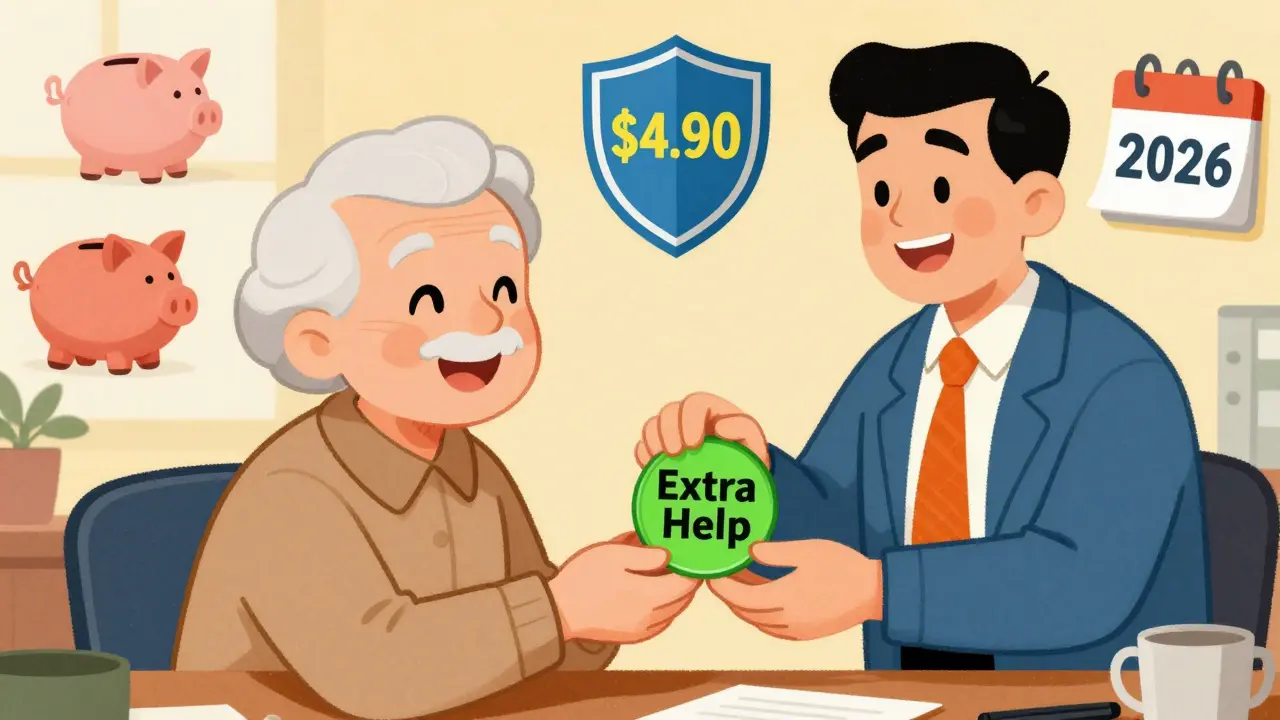
If you are enrolled in Medicare, the single best resource is the Extra Help program, also known as the Low-Income Subsidy (LIS). This federal program drastically reduces what you pay for both premiums and prescriptions.
For 2025 and 2026, the cost-sharing structure is fixed and predictable:
- Generic drugs: You pay exactly $4.90 per prescription.
- Brand-name drugs: You pay exactly $12.15 per prescription.
There is no deductible, and you never face the "donut hole" coverage gap. Eligibility is automatic if you receive Supplemental Security Income (SSI), Medicaid, or certain Medicare Savings Programs. If you don’t qualify automatically, you must apply through Social Security. The income limits are strict-generally below $23,850 for individuals-but the savings are life-changing. One user on the Medicare Rights Center forum noted dropping from $45 monthly to just $24.50 for five generics after qualifying.
Pharmacy Discount Programs: The Instant Fix
Not everyone qualifies for government aid. That’s where pharmacy discount networks come in. These programs negotiate lower cash prices with pharmacies, bypassing insurance entirely. They are free to join and require no medical documentation.
| Program Name | Typical Cost for Generics | Best For | Key Limitation |
|---|---|---|---|
| Walmart $4/$10 List | $4 or $10 for 90-day supply | Patient taking common meds (metformin, lisinopril) | Covers only ~150 specific medications |
| Kroger Health | $15 for 30-day supply | Shoppers at Kroger/Family Dollar locations | Higher than Walmart for some drugs |
| SingleCare / GoodRx | Varies ($5-$15 average) | Independent pharmacies and chains nationwide | Price fluctuates by location |
The catch? You cannot use these discounts if you submit your insurance card. Insurance companies often refuse to count the discounted cash price toward your deductible or out-of-pocket maximum. Always ask the pharmacist: “What is the cash price with this coupon versus my insurance copay?” Pick the lower number.
Nonprofit Grants and Disease-Specific Funds
If you make too much for Medicaid but not enough to comfortably afford copays, nonprofit organizations fill the void. These groups provide direct grants to cover medication costs.
- NeedyMeds: A comprehensive database that connects patients with over 300 assistance programs. In 2023, they processed hundreds of thousands of applications, with a 78% approval rate for those earning below 250% of the Federal Poverty Level.
- PAN Foundation: Offers disease-specific funds. While many focus on expensive brand-name treatments, about 17 of their active programs cover conditions primarily treated with generics, such as hypertension and diabetes.
- HealthWell Foundation: Provides copay assistance for specific chronic conditions, though eligibility often requires commercial insurance.
Applying takes time-usually 3 to 6 weeks-and requires proof of income, tax returns, and doctor letters. But for those who qualify, it covers 100% of the copay. Apply to multiple foundations simultaneously; successful applicants typically use an average of 2.3 different sources.
The 2025-2026 Landscape: Inflation Reduction Act Changes
Major regulatory shifts are reshaping the landscape. The Inflation Reduction Act, fully implemented by 2025, introduced a hard $2,000 annual out-of-pocket cap for Medicare Part D beneficiaries. Previously, this cap was $8,300, meaning patients could spend thousands before hitting catastrophic coverage.
This change disproportionately benefits generic users. Since generics are taken regularly for chronic conditions like heart disease or diabetes, patients hit refill limits quickly. With the new cap, once you spend $2,000 in a year, you pay nothing more for covered drugs. Additionally, deductibles for Extra Help recipients have been eliminated, and insulin costs (including generic versions) are capped at $2 per month.
However, a risk remains for the “near-poor”-those earning just above Medicaid thresholds. They may still face higher initial costs before reaching the $2,000 cap, creating a temporary financial strain. State Health Insurance Assistance Program (SHIP) counselors report handling over a million inquiries related to these new rules, highlighting widespread confusion.
Practical Steps to Lower Your Costs Today
Don’t wait until you’re overwhelmed. Take these steps now:
- Check your formulary tier. Call your insurance provider or check their website. Ensure your generic is on Tier 1 (lowest cost). If it’s on Tier 2, ask your doctor for a therapeutic interchange to a cheaper equivalent.
- Apply for Extra Help immediately. Go to ssa.gov or call 1-800-772-1213. Even if you think you earn too much, apply. The process takes 45-90 days, and back-payments are possible.
- Download a discount app. Install SingleCare, GoodRx, or RxSaver on your phone. Compare prices at three nearby pharmacies before filling your script.
- Contact SHIP. Your state’s State Health Insurance Assistance Program offers free, unbiased counseling. They can review your specific plan and identify overlooked savings.
- Ask about 90-day supplies. Many mail-order plans charge less per pill for a 90-day supply compared to a 30-day supply at the retail pharmacy.
Avoid the pitfall of assuming generics don’t need help. Studies show 38% of patients skip doses because they underestimate the cumulative cost of small copays. Consistency saves money in the long run by preventing emergency room visits.
Frequently Asked Questions
Can I use a pharmacy discount coupon if I have Medicare?
Generally, no. Most pharmacy discount programs explicitly exclude Medicare and Medicaid beneficiaries. Using them may violate anti-kickback statutes. However, if you have a Medicare Advantage plan with additional benefits, check with your insurer. Otherwise, rely on Medicare Extra Help or charity care programs designed for government-insured patients.
How much does Medicare Extra Help cost in 2026?
If you qualify for full Extra Help, you pay $4.90 per generic prescription and $12.15 per brand-name prescription. There is no monthly premium for Part D, and no deductible. Partial Extra Help recipients pay slightly more based on their income, but still significantly less than standard rates.
Why don’t generic drug manufacturers offer copay cards?
Generic manufacturers operate on very thin profit margins, often less than 1% per unit. Offering copay assistance would erode these margins, potentially making production unviable. Brand-name drugs have higher prices and marketing budgets that allow for patient assistance programs, which is why you see fewer options for generics.
What happens if I exceed the $2,000 out-of-pocket cap?
Once you reach the $2,000 threshold in a calendar year, your Medicare Part D plan pays 100% of the negotiated price for all covered drugs for the rest of the year. You owe nothing further. This protection applies to both generic and brand-name medications.
Can I combine Walmart’s $4 generics list with my insurance?
No. You must choose one payment method. If your insurance copay is lower than $4, use insurance. If it’s higher, use the cash discount. Note that using the cash discount will not count toward your insurance deductible or out-of-pocket maximum.