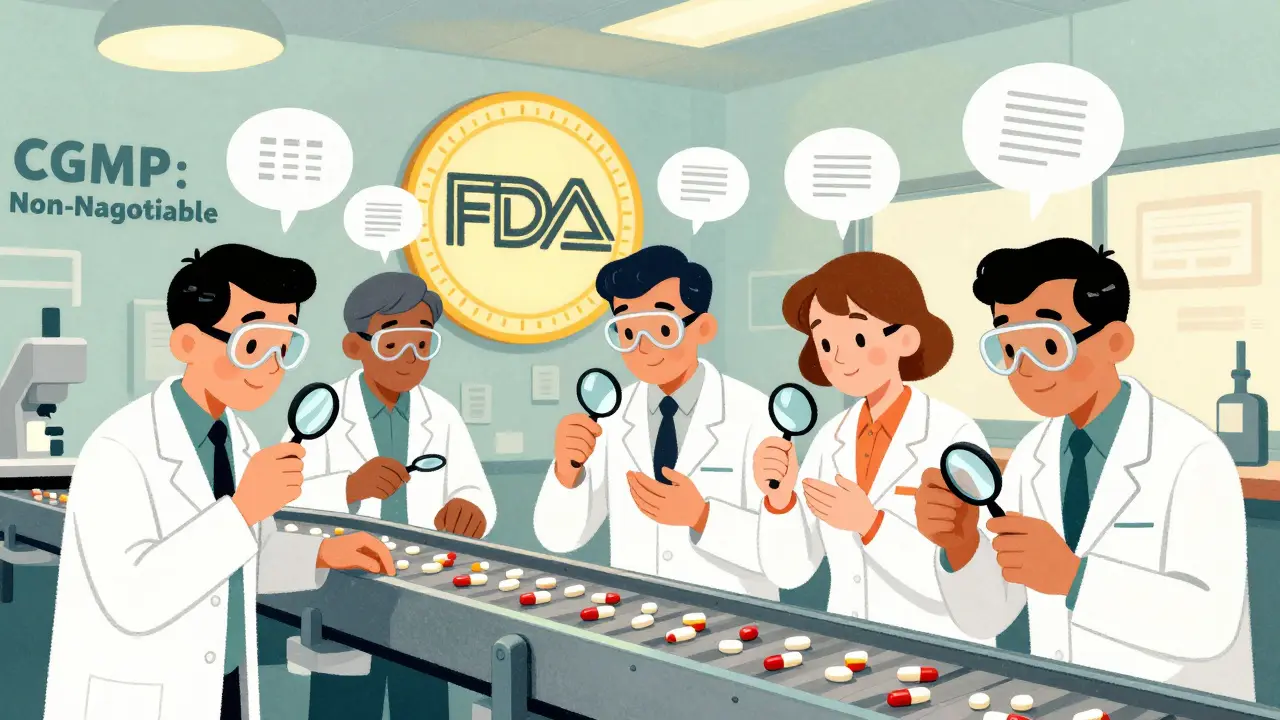
When you pick up a generic drug at the pharmacy, you expect it to work just like the brand-name version. That’s not luck. It’s the result of strict, non-negotiable rules called Current Good Manufacturing Practices (CGMP). These aren’t suggestions. They’re federal law. The FDA enforces them to make sure every pill, capsule, or injection you take is safe, pure, and effective - no matter where it was made or who produced it.
What Exactly Are CGMP Requirements?
CGMP stands for Current Good Manufacturing Practices. The word "current" matters. It means manufacturers can’t just follow old methods. They have to use modern tools, up-to-date procedures, and the best available science. These rules are written into Title 21 of the Code of Federal Regulations, specifically Parts 210 and 211. They apply equally to brand-name drugs and generics. There’s no special set of rules for generics. If you’re making a generic version of a blood pressure pill, you must follow the same standards as the company that made the original.The goal is simple: consistency. Every batch of a generic drug must be identical in strength, purity, and quality. One pill from a bottle made in 2024 should perform exactly like one from a bottle made in 2026. That’s why CGMP isn’t just about cleanliness. It’s about systems - documented, controlled, and constantly monitored systems.
Key Areas the FDA Inspects
The FDA doesn’t guess what’s happening inside a manufacturing plant. They look at 11 specific areas, each with detailed rules. Here’s what they check:- Personnel: Everyone who touches the drug - from lab techs to managers - must be trained and qualified. Training records are mandatory. No exceptions.
- Facilities: Buildings must be designed to prevent contamination. Air quality, humidity, and cleaning schedules are tightly controlled. Dust, microbes, and even human hair can be reasons for a warning letter.
- Equipment: Machines must be cleaned, calibrated, and maintained. If a machine isn’t working right, it can’t be used. Maintenance logs are reviewed during inspections.
- Components: Every raw material - even something as simple as cornstarch - must be tested before use. Suppliers aren’t trusted blindly. Each batch gets checked against approved specs.
- Production: Every step of making the drug must be documented. From mixing ingredients to filling capsules, there’s a written procedure for everything. And those procedures must be validated - proven to work consistently.
- Labeling: Labels must be correct. Wrong dosage? Wrong name? That’s a recall waiting to happen. Systems are required to catch errors before the product leaves the facility.
- Testing: Finished products are tested for potency, purity, and stability. Stability testing isn’t a one-time thing. Manufacturers must prove the drug stays effective over its entire shelf life.
- Records: Everything is written down. Every step, every test, every deviation. Records must be kept for at least one year after the drug expires. Electronic records must have audit trails to show who changed what and when.
Why Does This Matter for Generics?
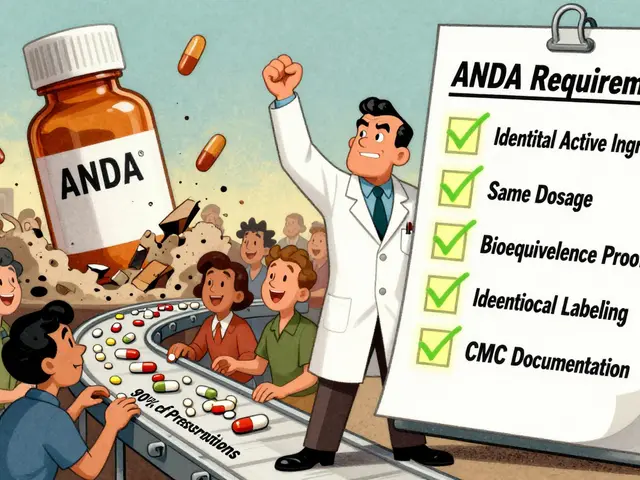
Generic drugs make up 90% of all prescriptions filled in the U.S. In 2022, Americans spent $105.7 billion on them. That’s a huge market. But without CGMP, that market would be built on trust - not proof.The FDA reviews every single Abbreviated New Drug Application (ANDA) before approving a generic. That review includes a deep dive into the manufacturer’s CGMP compliance. If the facility has a history of violations, the application is delayed - or denied. This isn’t about punishing companies. It’s about protecting patients.
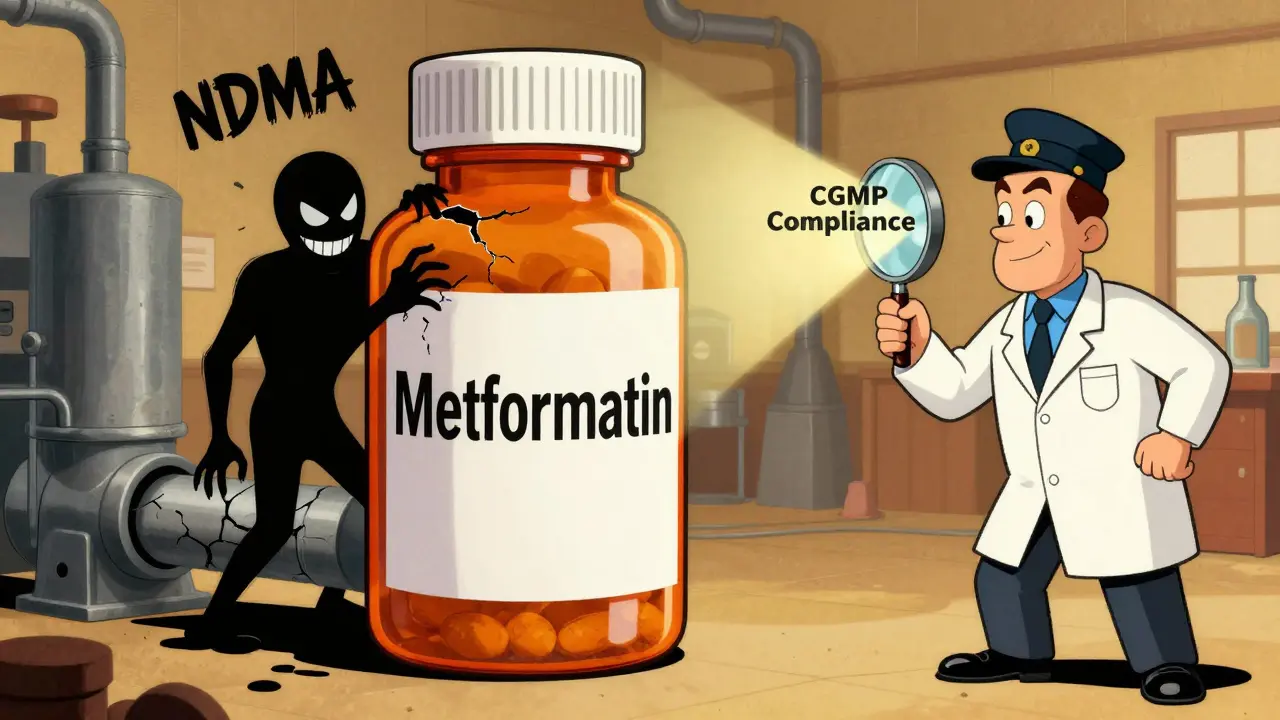
Take the 2022 recall of 12 generic metformin products. The cause? NDMA contamination. The root cause? Inadequate process controls and failed cleaning validation. These were CGMP failures. And they led to real-world harm. That’s why the FDA doesn’t wait for disasters. They inspect, they audit, and they act.
Challenges Manufacturers Face
Implementing CGMP isn’t easy. For small companies, it’s expensive. A 2022 survey found that mid-sized generic manufacturers spend an average of $2.3 million per year just on compliance. One Reddit user, "GenericChemist42," shared that switching to electronic batch records at their 50-person facility took 14 months and cost $1.2 million.Common pain points include:
- Data integrity: Ensuring electronic records can’t be altered. The FDA’s ALCOA+ principles (Attributable, Legible, Contemporaneous, Original, Accurate, plus Complete, Consistent, Enduring, Available) are now standard. But 78% of manufacturers say implementing audit trails is hard.
- Supply chain control: Active pharmaceutical ingredients (APIs) often come from overseas. In 2022, 43% of generic manufacturers had at least one component batch fail testing.
- Inspection inconsistency: A 2023 survey found that 57% of manufacturers felt different FDA inspectors interpreted rules differently. One inspector might accept a procedure; another might reject it.
Foreign facilities face even more scrutiny. In 2022, 63% of FDA warning letters for data integrity issues came from overseas plants. And while domestic facilities get inspected about 1.3 times per year on average, foreign sites get fewer inspections - a point of criticism from experts like Harvard’s Aaron Kesselheim.
What’s Changing in 2024 and Beyond?
The rules aren’t frozen. The FDA is adapting.In May 2023, they issued an immediate guidance requiring testing of high-risk ingredients like glycerin and sorbitol for toxic contaminants like diethylene glycol - a response to deaths linked to contaminated medicines in Pakistan. That’s the kind of reactive, targeted update you won’t find in outdated textbooks.
The FDA’s 2023-2027 strategic plan includes:
- 25% more resources for inspecting foreign facilities
- Finalizing guidance on continuous manufacturing - a newer, more efficient way to produce drugs that doesn’t fit neatly into old batch-based CGMP rules
- Stronger enforcement of Part 11 (electronic records) and supply chain security under the Drug Supply Chain Security Act
Industry experts predict that by 2028, 65% of manufacturers will use AI and predictive analytics to catch quality issues before they happen. This isn’t science fiction. It’s the next step in CGMP evolution.
What Happens If You Don’t Comply?
Violating CGMP isn’t a slap on the wrist. The FDA can:- Issue a warning letter
- Block imports from foreign facilities
- Order a product recall
- Initiate civil penalties
- Prosecute individuals criminally
Dr. Janet Woodcock, former head of the FDA’s drug center, warned that non-compliance can lead to "a prohibition on the sale of an adulterated drug." That means your entire product line can be taken off the market - and you might not get it back.
How Do Manufacturers Get Started?
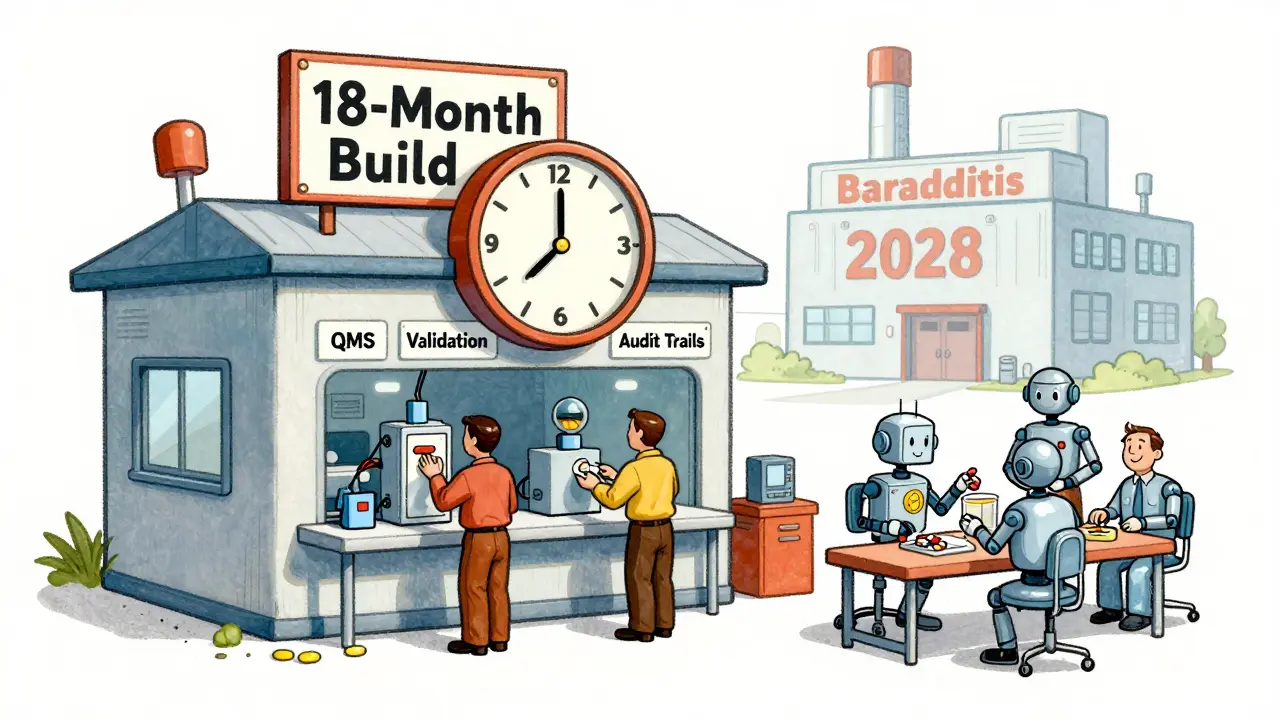
Building a CGMP-compliant facility from scratch takes 18 to 24 months. It starts with:- Designing a Quality Management System (QMS) with documented procedures
- Qualifying the facility (Installation Qualification, Operational Qualification, Performance Qualification)
- Validating all critical processes
- Training every employee
- Setting up electronic records systems
Large manufacturers have 97% compliance rates. Small ones? Only 82%. The gap isn’t just about money - it’s about expertise. Companies that hire certified professionals - like ASQ Certified Quality Engineers - see 22% higher retention rates and fewer audit findings.
Final Thought: CGMP Isn’t a Burden. It’s a Guarantee.
Some manufacturers complain about the cost and complexity. But ask yourself: would you want your child’s asthma inhaler, your grandfather’s heart medication, or your own diabetes pill made without these rules?The FDA’s CGMP system isn’t perfect. It’s expensive. It’s inconsistent in places. But it’s the reason you can trust a $5 generic pill as much as a $50 brand-name one. It’s the invisible safety net behind every prescription you fill.
As FDA Commissioner Robert M. Califf said in 2023: "CGMP provides for systems that assure proper design, monitoring, and control of manufacturing processes." That’s not bureaucracy. That’s patient safety - built into every step.

12 Comments
Honestly I never thought about how much goes into making a generic pill work the same as the brand. I just grab the cheaper one and move on. But now I get why they have to be so strict. It’s not just about saving money, it’s about safety.
My cousin works at a pharmacy and she says they get shipments from all over the world. Scary to think about what could go wrong if someone cuts corners.
CGMP isn’t optional. It’s the bedrock. No compromises. If your facility can’t meet it, you shouldn’t be making pills. Period. The FDA isn’t being petty-they’re the only thing standing between you and a poisoned bottle of metformin.
I read this article while waiting for my prescription. Honestly it made me feel a bit better. I always worried about generics made overseas. But knowing they’re held to the same standard as US-made ones? That helps. Still, I wish inspections were more consistent.
OMG YES 😍 I’ve been saying this forever! America’s drug safety system is still the gold standard. 🇺🇸 Everyone else is just playing catch-up. Why do you think we’re the only ones with real oversight? 🤷♀️其他国家的药厂连基本卫生都做不到!
I work in pharma in India and we follow CGMP too. It’s hard but worth it. We have audits every 6 months. Yes its expensive but we don’t cut corners. Every pill matters. My uncle took generic insulin for 10 years. It saved his life. So yes we care.
So what you’re saying is we just trust the FDA? What if they’re corrupt? What if they get bribed? I’ve seen too many recalls. This whole system feels like a facade.
Oh please. You think the FDA is some noble guardian? They’re a bureaucratic swamp. I’ve worked with inspectors who rejected a process because the floor tile was the wrong shade of gray. Meanwhile, real risks like supply chain opacity? Ignored. This isn’t safety-it’s performative compliance.
The fact that small manufacturers spend over $2 million just to comply is insane. But I’ll tell you this: the alternative is worse. People die when quality slips. I’d rather pay more and know my meds are solid. No shortcuts.
Did you know the FDA doesn’t inspect foreign plants as often? And yet they approve 90% of our generics from there. Coincidence? I think not. There’s a reason so many recalls come from Asia. Someone’s got a hidden agenda.
Stop pretending this is about safety. It’s about control. The FDA uses CGMP to crush small players so Big Pharma keeps its monopoly. Generics are cheaper because they’re better. Not because they’re regulated.
I mean, it’s all very noble to talk about systems and validation, but let’s be real: the average person has no idea what ALCOA+ even means. And yet we’re supposed to trust our lives to it? That’s not confidence. That’s surrender.
You’re not wrong about the inspection gap. But that’s not a reason to trash the whole system. It’s a reason to demand more funding. Fix the oversight, don’t tear down the foundation.
Write a comment