
Every year, tens of thousands of people end up in the hospital because of a simple mistake: they took the wrong pill, at the wrong time, or too much of it. And most of these mistakes? They happen right at home. If you or someone you care for is managing multiple medications, this isn’t just a worry-it’s a real risk. The CDC says medication errors contribute to 22% of hospital readmissions after discharge. That’s not just numbers. That’s someone’s parent, grandparent, or neighbor who got sick because their system failed.
The good news? You don’t need to live in fear. You just need a system. Not a fancy gadget. Not a magic app. A simple, reliable, no-mistake system built around how real people actually take their meds.
Start with the list-every pill, every supplement
Before you buy anything, before you even think about a smart dispenser, you need to know exactly what’s in the medicine cabinet. Not guess. Not remember. Write it down.
This includes:
- Prescriptions (name, dose, frequency)
- Over-the-counter drugs (pain relievers, sleep aids, antacids)
- Vitamins, herbal supplements, and even eye drops or patches
Don’t trust your memory. Don’t rely on the pharmacy label alone. A 2023 study by the Partners in Care Foundation found that nearly 60% of older adults had at least one error in their self-reported medication list. That’s not because they’re careless. It’s because the list changes. A new pill gets added. An old one gets stopped. The doctor forgets to tell you. The pharmacist doesn’t update the label.
Here’s how to get it right:
- Gather every bottle and container.
- Write down the name, dose, and time of day for each one.
- Check with your pharmacist or doctor. Ask: "Is this still needed?" "Could this interact with anything else?"
- Keep this list updated. Put it in your wallet. Share it with your caregiver. Update it every time something changes.
This list is your foundation. Everything else builds on it.
Smart dispensers: More than just a box that beeps
Pill organizers? They’re cheap. A $10 AM/PM box from the drugstore seems like a good idea. But if you’re taking five or six different pills at different times, a simple box won’t cut it. You’ll mix them up. You’ll forget which day it is. You’ll double-dose because you didn’t realize you already took it.
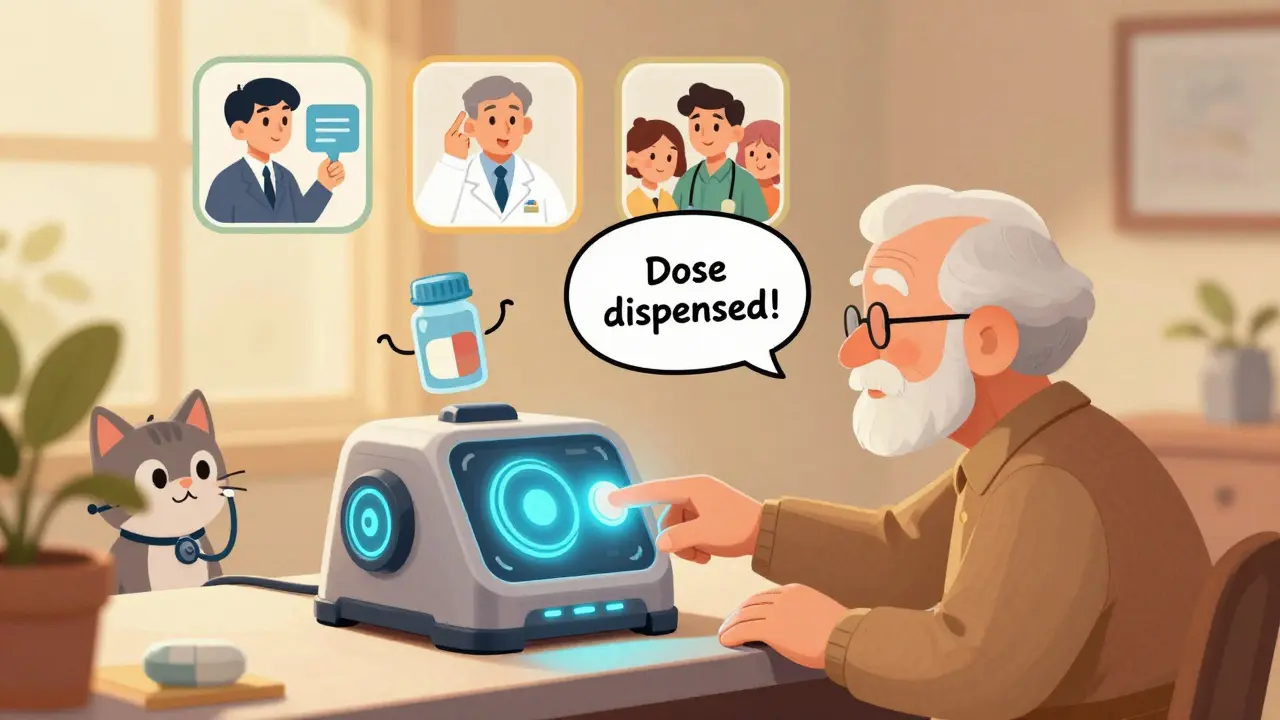
Smart dispensers-like Hero, MedMinder, or DosePacker-are different. These aren’t just boxes. They’re automated systems that:
- Dispense the right pill at the right time
- Alert you with sound, light, and even voice prompts
- Send alerts to caregivers if a dose is missed
- Let you answer questions or video-call a nurse directly from the device
A 2022 NIH study found users of these devices had a 98% adherence rate over six months. That’s nearly perfect. Compare that to the average of 50% adherence for people on complex regimens without any help.
But here’s the catch: they’re not plug-and-play.
Setting one up takes 2-4 hours. You need to load each pill into its own compartment. You need to program the schedule. You need to teach the person using it how to respond to alerts. If they’re hard of hearing or have trouble with screens, you’ll need to adjust settings-bigger buttons, louder sounds, simpler language.
Cost? Around $150-$300 upfront, plus $15-$50 a month for service. It’s not cheap. But think about it: one hospital readmission costs $15,000-$30,000. A smart dispenser pays for itself.
When tech alone isn’t enough
Technology helps. But it doesn’t fix everything.
Take as-needed medications. "Take this when you feel chest pain." "Take this if your headache gets worse." Smart dispensers can’t handle those. They’re built for fixed schedules. What happens if your painkiller runs out on a weekend? Who do you call? How do you know if it’s safe to take another?
Or what about pills that must be taken with food? Or spaced two hours apart? Or avoided with grapefruit juice? These details slip through the cracks.
That’s why the best systems combine tech with human support. A 2024 MedPro analysis found that adherence jumped from 93% to 98% when a pharmacist checked in weekly. Not every week. Just once a month. A 15-minute call. A quick review of the list. A check-in on side effects.
One case from AgingCare.com tells the story: a 78-year-old woman used a Hero dispenser and hit 96% adherence. But she still needed a home health aide to come in every week to adjust her meds when her doctor changed her dose. The machine didn’t know her doctor had switched her blood pressure pill. The aide did.
Technology doesn’t replace human judgment. It supports it.
Digital platforms: For families and professionals
If you’re helping someone else manage their meds-maybe a parent or spouse-there’s another tool worth knowing: digital platforms like HomeMeds.
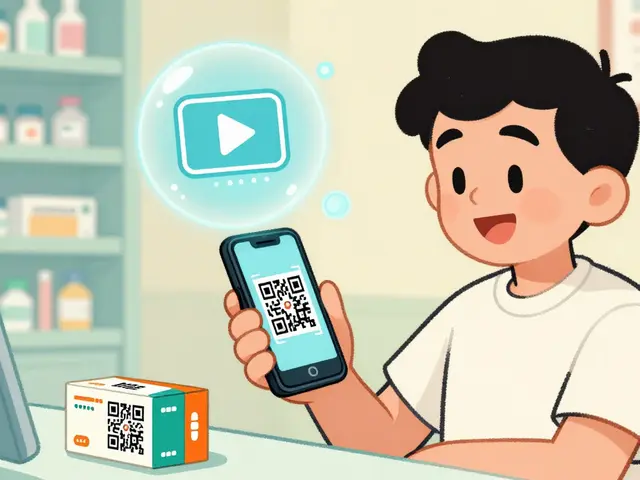
These aren’t for the patient. They’re for the people who care for them. HomeMeds lets you scan a pill bottle with your phone camera. The app reads the label, auto-fills the name, dose, and instructions, and syncs everything to a secure online profile. No typing. No guesswork.
It’s designed for home health workers and family caregivers. In 2024, it cut medication assessment time by 50%. That means less stress, fewer errors, and faster updates when changes happen.
And here’s what’s coming: in Fall 2025, HomeMeds will launch an AI version that doesn’t just read labels-it spots potential interactions. "This painkiller and this blood thinner together? Risk of bleeding." "This supplement reduces the effect of your thyroid med." It’ll flag problems before they happen.
But it’s not for everyone. It requires a smartphone, Wi-Fi, and someone willing to use it. If the person you’re helping doesn’t use tech, this won’t work. But if you’re the one managing the list, it’s a game-changer.
What to avoid
Not all "medication safety" tools are created equal.
Don’t fall for:
- Basic pill organizers with no alarms. They’re fine for one or two pills a day. Not for anything more.
- Apps that require daily manual entry. If you have to remember to log each dose, you’ll forget. The whole point is to remove the burden.
- Systems that don’t support changes. If your mom’s doctor adds a new pill, can the system update it in minutes? Or does it take a technician, a call, and a week?
- Devices without backup power. If the power goes out, does it stop working? Look for battery backup or rechargeable models.
Also, avoid assuming that "more tech = better." A system that’s too complicated leads to frustration. Frustration leads to skipping doses. Skipping doses leads to hospital visits.
Building your no-mistake system: A step-by-step plan
Here’s how to build a system that actually works:
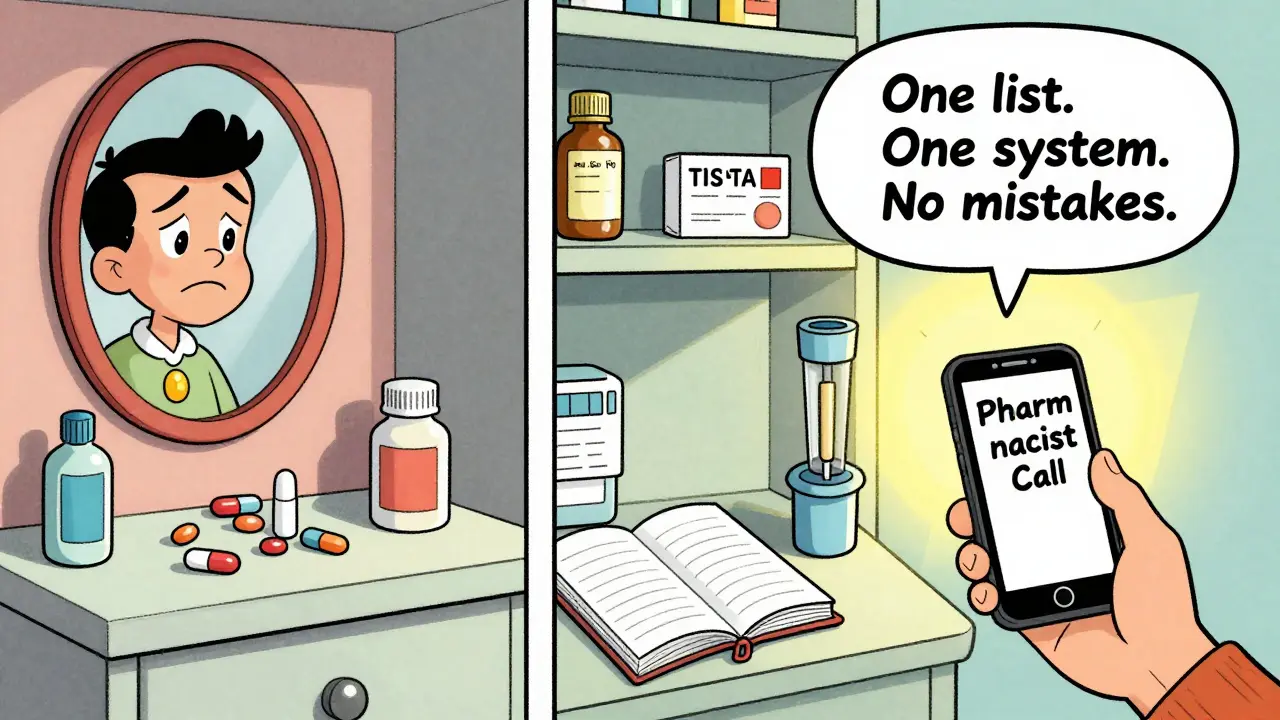
- Make the list. Write down every pill, every supplement. Double-check with your doctor or pharmacist.
- Simplify if you can. Ask: "Can we switch to once-a-day pills?" "Can we combine two into one pill?" Reducing the number of daily doses cuts errors by 23%.
- Choose the right tool. Simple regimen? A pill box with alarms. Complex? A smart dispenser. Family managing it? A digital platform like HomeMeds.
- Set it up with help. Don’t try to do it alone. Call the manufacturer. Ask a home health nurse. Get a 1-hour tech support session.
- Train the user. Practice the routine. Role-play what to do if the device beeps and they don’t understand.
- Involve a caregiver. Someone needs to check in every 30-90 days. Look for missed doses. Check the list. Update changes.
- Plan for changes. Keep a phone number handy: pharmacist, doctor, tech support. When a med changes, don’t wait. Update the system the same day.
What’s next? The future of home medication safety
The tools are getting smarter.
By 2027, most premium dispensers will include AI that checks for drug interactions in real time. By 2028, some will use fingerprint or voice recognition to confirm the right person is taking the right pill.
But the biggest shift? Integration. Right now, only 32% of home systems talk to electronic health records. That means if your doctor updates your chart, your dispenser doesn’t know. That’s dangerous.
The future is seamless: your doctor prescribes a new med → it auto-updates in your dispenser → your caregiver gets a notification → your pharmacy is alerted. No manual steps. No delays.
Until then? Stick to the basics. A clear list. A reliable dispenser. Regular check-ins. And never, ever skip updating the list when things change.
Real talk: It’s not about gadgets. It’s about habits.
The CDC says the single most important step to prevent medication errors? Keeping an accurate, up-to-date list.
That’s it. No app. No device. Just a piece of paper you update every time something changes.
Everything else-smart dispensers, digital platforms, AI alerts-is just support. They help. They reduce errors. They give peace of mind.
But if you don’t have the list? None of it matters.
Start there. Then build from there. One step at a time. No need to buy everything at once. Just get the list right. Then add one tool. Then another. Slowly. Safely.
Because in the end, medication safety isn’t about technology. It’s about care. And care doesn’t need a Wi-Fi signal. It just needs attention.
What’s the cheapest way to improve medication safety at home?
The cheapest and most effective step is creating and maintaining an accurate, up-to-date list of all medications-prescriptions, over-the-counter drugs, and supplements. Use a notebook or a digital note on your phone. Update it every time your doctor changes a dose or adds/removes a pill. This alone cuts error rates by nearly half. A basic pill organizer with alarms costs under $20 and adds a layer of safety, but the list comes first.
Do smart dispensers work for people with dementia or vision problems?
Yes, but only if they’re set up right. Look for devices with large buttons, voice prompts, and simple interfaces. Some models, like Hero, let caregivers program alerts to repeat until the dose is taken. Others include remote monitoring so family members get notified if a dose is missed. For severe vision or cognitive issues, combine the device with weekly check-ins from a home health aide. Technology helps, but human support is still essential.
Can I use a smart dispenser if I take pills at different times each day?
Most smart dispensers are designed for fixed schedules-same time every day. If your regimen changes daily (like pain meds taken as needed), a smart dispenser won’t help. In that case, use a pill organizer with labeled compartments and pair it with a caregiver who tracks changes. Some newer systems allow flexible scheduling, but they require manual input each day, which defeats the purpose. For variable dosing, human oversight is still the best option.
Are there free or low-cost options for seniors on a fixed income?
Yes. Many Medicare Advantage plans now offer free or discounted smart dispensers as part of their benefits. Check with your plan. Local Area Agencies on Aging often provide free pill organizers and medication management education. Some pharmacies (like CVS and Walgreens) offer free medication synchronization services that reduce the number of daily doses. Nonprofits like the National Council on Aging may also help with device subsidies for low-income seniors.
What should I do if I miss a dose?
Don’t double up. Check the medication’s instructions or call your pharmacist. Most pills are safe to take if you’re within a few hours of the scheduled time. But some-like blood thinners, insulin, or seizure meds-can be dangerous if taken late or doubled. Always have your medication list handy. If you’re unsure, call your doctor or pharmacist. Smart dispensers often include a "Call Pharmacist" button for exactly this reason.
How often should I review my medication list?
At least every three months-or every time your doctor changes your prescription. Many people don’t realize they’re taking duplicate medications or outdated drugs. A 2023 CDC review found that 40% of older adults were taking at least one unnecessary medication. A pharmacist can help you trim the list, reduce side effects, and save money. Make it a habit: every January, April, July, and October, sit down with your list and your pharmacist.



13 Comments
Let me tell you-this post is a MASTERCLASS in common sense! I’ve seen my aunt nearly die from mixing blood thinners with St. John’s Wort-because she "thought it was just a vitamin." No, sweetheart-it’s a chemical grenade in your bloodstream! This list? This list is your lifeline. Write it. Update it. Laminated. In triplicate. In your wallet. On your fridge. On your phone. On your forehead if you have to! I’m not saying I’m dramatic-I’m saying I’ve seen the aftermath. And I’m here to tell you: if you skip the list, you’re playing Russian roulette with your meds. Period. End of story. No exceptions. 😤
lol this whole thing is so overengineered. who the fuck has time to write down every pill? just use the pharmacy app. if u forget ur meds u r dumb. also smart dispensers r $300? my grandma uses a $8 plastic box with AM/PM labels and shes fine. stop selling fear. people arent dying from meds-theyre dying from bad doctors and insurance. fix that. not buy another gadget. 🤷♂️
Hey-I just want to say this is one of the most thoughtful, practical guides I’ve read in ages. Seriously. You cut through the noise. I helped my dad set up his Hero dispenser last year, and honestly? It saved us. He’s 82, has 7 meds, and used to take his blood pressure pill at breakfast… then again at dinner. Twice. Every day. We thought it was forgetfulness. Turns out he was confused by the labels. The dispenser didn’t just help-it gave him back his independence. And yeah, it cost money. But it’s cheaper than an ER trip. Just start with the list. It’s free. And it changes everything. 💪
Love this. The list is everything. I’ve worked in home care for 15 years. The biggest killer isn’t the meds-it’s the chaos. People have 12 bottles, 3 different lists, and no one’s talking. I tell every family: grab a notebook. Write it all. Even the eye drops. Even the peppermint oil. You think it’s silly? Until you find out the oil interacts with their heart med. Then you’ll cry. So do the thing. Start today. No excuses. One page. One list. One life. 🙌
Just wanted to add that for folks in rural areas or with limited internet, the digital platforms won’t work-but the paper list? Still works. I’ve seen community health workers in my town in Tasmania hand out pre-printed med sheets to seniors. They fill them out together. No tech needed. Just time. Just care. And it’s beautiful. Tech helps. But human connection? That’s the real safety net. Don’t underestimate the power of someone sitting with you, asking, "What’s this one for?"
OMG I HATE THIS POST 😭 it’s so condescending. Like, "oh honey, you probably forgot your meds so let me lecture you on laminated lists." I’m 60 and I’ve been on 5 meds for 12 years. I know what I’m doing. I don’t need a robot telling me when to take my aspirin. Also-why is everyone assuming old people are incompetent? I’m not a child. I don’t need a "smart dispenser" to remind me to breathe. 🤦♀️
Okay real talk-I’m a pharmacy tech. I’ve seen 1000s of these mistakes. And the #1 thing people skip? The supplement list. People think "it’s just fish oil" or "it’s just melatonin." But fish oil thins blood. Melatonin messes with diabetes meds. And don’t get me started on turmeric + anticoagulants. I’ve had patients in ICU because they took "natural" stuff and didn’t tell their doctor. So yes-write it all down. Even the weird stuff. Even the ones you think "nobody cares about." They care. I care. Your life matters. 💊
Interesting how we treat meds like they’re magic bullets. But they’re not. They’re chemicals. And our bodies? They’re ecosystems. I love the idea of the list-it’s like keeping a diary of your internal world. And yeah, tech helps. But I wonder… if we spent less time optimizing systems and more time talking to our elders, would we even need the gadgets? Maybe the real solution is listening. Not just to alarms. But to stories. To fears. To silence. 🌿
While the emotional tone of this post is compelling, the data-driven approach is even more critical. The CDC’s 22% hospital readmission statistic is well-documented, and the 60% error rate in self-reported lists is corroborated by multiple peer-reviewed studies, including those from JAMA Internal Medicine (2023) and the Annals of Internal Medicine (2022). The key insight is not the device-it’s the verification process. A written list is only as good as its validation. That means cross-referencing with pharmacy records, physician notes, and insurance claims. The system must be auditable. Not just emotional. Not just aspirational. Evidence-based. That’s the standard.
Thank you for writing this. I’m a geriatric nurse. I’ve seen too many patients lose their autonomy because their med system collapsed. I don’t care if it’s a $10 organizer or a $300 smart device. I care that the person understands it. That they’re not afraid of it. That someone checks in. That’s the real innovation: dignity. Not gadgets. Not apps. Just someone who says, "Let me help you with this." That’s what saves lives. And it costs nothing but time. And that’s worth more than any machine.
As a healthcare administrator, I can confirm that the cost-benefit analysis of smart dispensers is overwhelmingly positive. A single avoidable hospitalization covers the cost of 10 devices. Moreover, Medicare Advantage plans now reimburse for these systems under chronic care management codes. If you’re caring for someone with 5+ meds, you are eligible for financial assistance. Contact your local Area Agency on Aging-they have case managers who can help you apply. This isn’t a luxury. It’s a covered benefit. Don’t let cost stop you. Ask. Advocate. Access.
Just wanna say-I used to think this was all overkill. Then my brother had a stroke. Now he’s on 11 meds. We tried the pill box. Then the app. Then the smart dispenser. What actually worked? Me. Sitting with him. Every morning. Saying, "Here’s your blue one. This one’s for your heart. Don’t forget the water." He didn’t need tech. He needed me. And if you’re reading this? You’re probably the one who needs to show up. Not the gadget. You. Just be there. That’s the real no-mistake system.
Finally someone gets it! I’ve been screaming this for years! The list is the foundation! But you missed one critical point-NEVER trust the pharmacist’s label alone! I had a cousin who took warfarin for 3 years… and the label said "take one daily"-but the prescription was "take two on Tuesdays and Thursdays." The pharmacy printed it wrong. No one caught it. He bled internally. Took 3 surgeries. And guess what? The pharmacist didn’t even apologize. Just said "it happens." So here’s my advice: always get the original prescription from the doctor. Cross-check it. Then write it down. Then triple-check. Then write it again. Because nobody else is gonna do it for you. You’re the only one who can save your life.
Write a comment