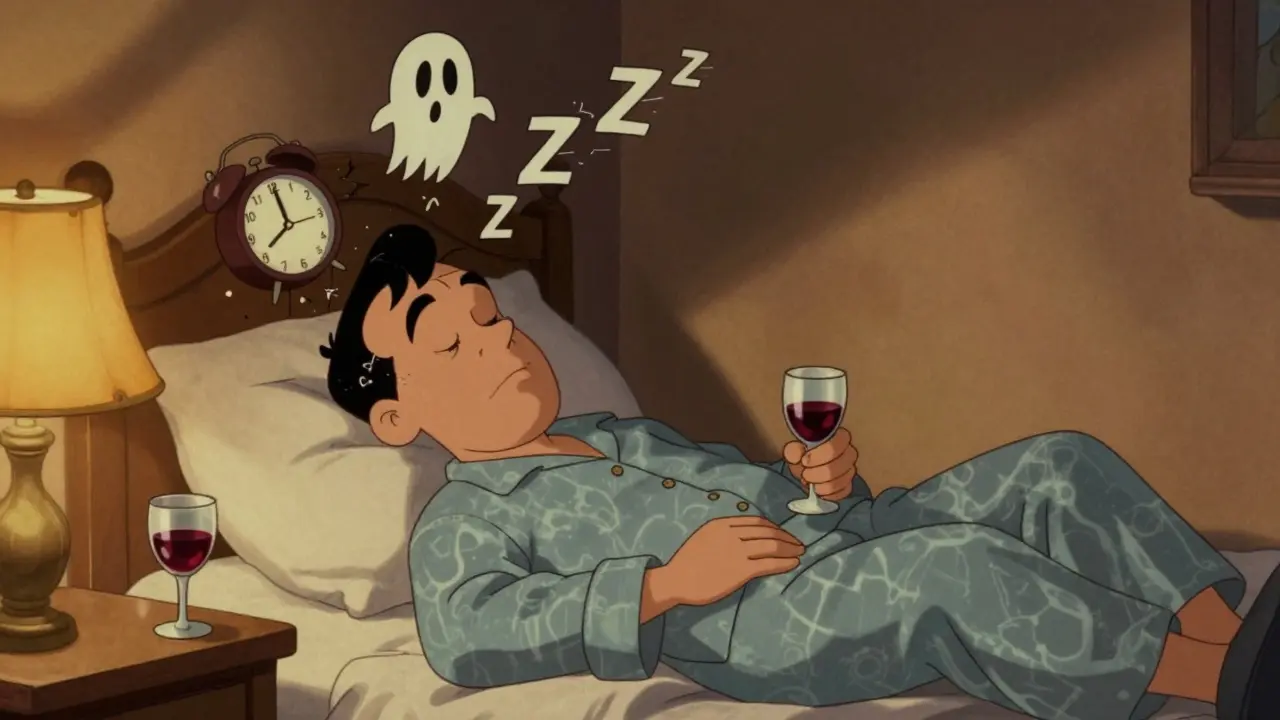
Many people believe that a nightcap helps them sleep better. It feels true - one glass of wine, a beer after dinner, and suddenly you’re out cold. But what you feel as deep sleep is actually a trap. Alcohol doesn’t improve sleep. It fragments it, worsens breathing, and leaves you tired even after a full night’s rest.
How Alcohol Tricks Your Brain Into Thinking You’re Sleeping
When you drink alcohol before bed, it hits your brain like a sedative. It slows down nerve activity, especially in areas that keep you alert. This makes falling asleep faster - sometimes in under 10 minutes. But here’s the catch: that quick sleep isn’t restful. It’s artificial.
Alcohol boosts adenosine, a chemical that builds up during the day and naturally pushes you toward sleep. But it does this too fast and too hard. Your brain gets flooded with it, so you drift off quickly. But once your body starts breaking down the alcohol - usually within an hour or two - adenosine levels crash. That’s when your brain wakes up. Not gently. Not gradually. It jolts you awake, again and again, without you even realizing it.
This is why people say they slept ‘well’ but wake up exhausted. You didn’t get quality sleep. You got interrupted sleep.
The Two-Phase Sleep Disaster
Alcohol doesn’t just mess with sleep. It flips your sleep cycle upside down. Studies show it creates a clear two-phase pattern.
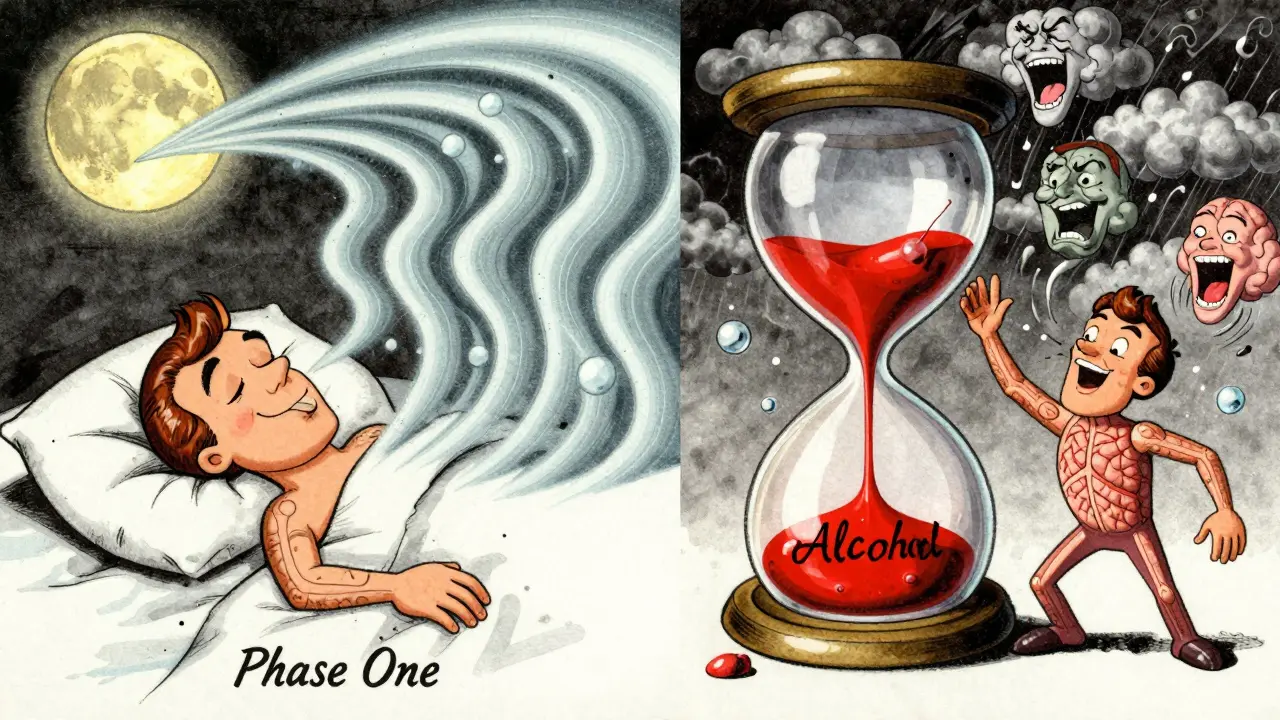
Phase One (First Half of Night): Alcohol pushes your body into deep, slow-wave sleep (N3). This is the stage where your body repairs tissues and strengthens the immune system. On the surface, this sounds good. But here’s the problem: you get too much of it too early. Your brain thinks it’s done its job, so it skips the rest of the cycle.
Phase Two (Second Half of Night): As alcohol leaves your system, your brain scrambles to catch up. REM sleep - the stage where dreams happen and memories are locked in - gets delayed early on. Then, when it finally returns, it comes back hard. You might have vivid dreams, nightmares, or wake up suddenly feeling anxious. This rebound isn’t restorative. It’s chaotic. Your brain is trying to fix what alcohol broke, but it can’t do it right.
One 2023 study found that even a single drink before bed reduced REM sleep by 9.3%. Two drinks? It dropped by 20%. And by morning, your brain hadn’t recovered.
Why You Stop Breathing - Even If You Don’t Snore
Alcohol relaxes muscles. That includes the ones holding your airway open. When those muscles go limp, your throat collapses. This is how obstructive sleep apnea starts - or gets worse.
Even one drink can raise your apnea-hypopnea index (AHI) by 20%. That means more pauses in breathing. More drops in oxygen. More strain on your heart. The American Thoracic Society says people with sleep apnea should avoid alcohol entirely within three hours of bedtime. Why? Because a single drink can lower your blood oxygen by 3-5%. Your brain wakes you up just enough to gasp for air. You don’t remember it. But your heart does.
And it’s not just heavy drinkers. A 2022 meta-analysis in the Chest Journal found that people who drank 2-4 drinks daily had a 25% higher risk of moderate-to-severe sleep apnea. Those who drank five or more? Risk jumped 51%.
If you snore, feel tired during the day, or wake up with a dry mouth, alcohol is likely making it worse.
The Next-Day Fog You Don’t Notice
You wake up. You had eight hours. You feel fine. But your brain isn’t.
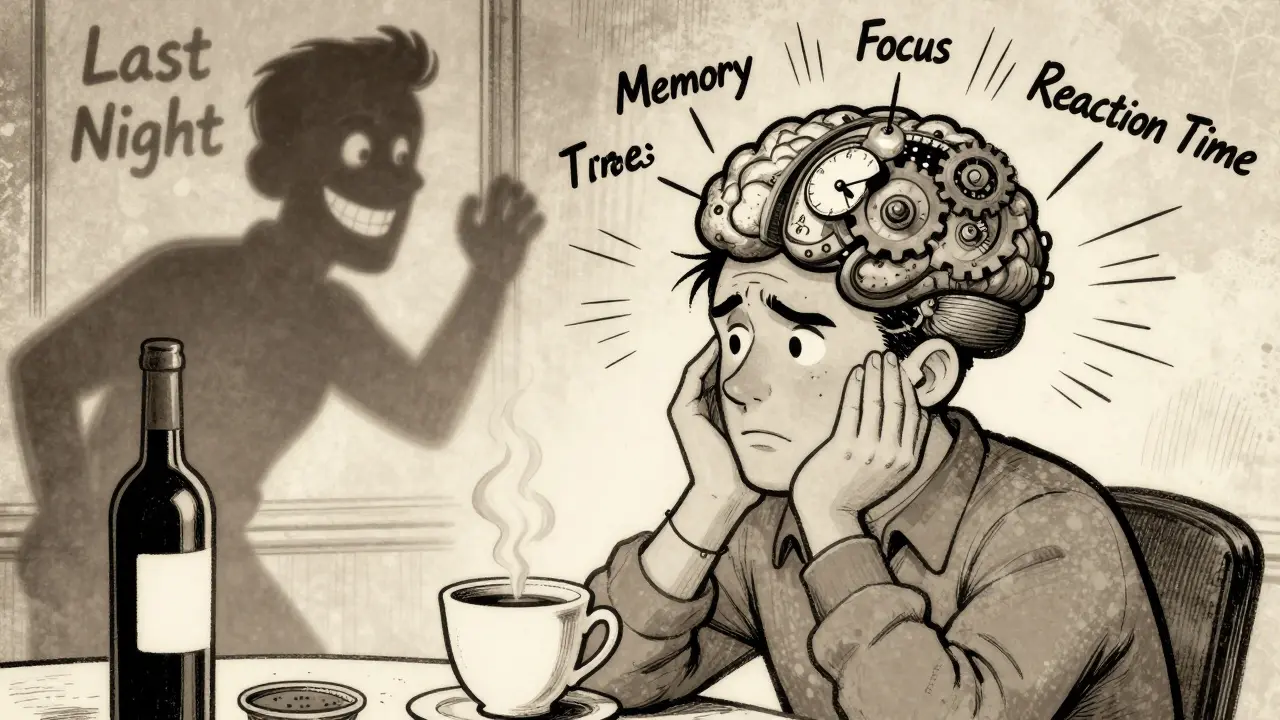
Slow-wave sleep - the deepest, most restorative stage - drops by 15.3% after alcohol. That’s not just a number. It means your brain didn’t clean out toxins. It didn’t reset its memory systems. It didn’t recharge its processing power.
Studies show that after drinking before bed:
- Cognitive processing speed slows by 12.7%
- Working memory drops by 9.4%
- Reaction time increases by 18%
- Emotional reactivity spikes by 31.2%
You might not feel sluggish. You might think you’re fine. But your brain is running on fumes. You’re more likely to snap at coworkers, forget where you put your keys, or make poor decisions. And you won’t connect it to last night’s drink.
One 2023 study found that people who drank alcohol before bed performed 8.7% worse on cognitive tasks the next morning - even though they slept the same number of hours as those who didn’t drink.
Why You Keep Drinking to Sleep - And Why It Gets Worse
Here’s the dangerous loop:
You drink to fall asleep. You wake up tired. You blame your sleep. You drink again. And again. Each time, your brain gets better at tolerating the sedative effect. Within 3-7 days, you need more alcohol to feel the same drowsiness. But your sleep keeps getting worse.
By day 9, your body adjusts. Your deep sleep returns. Your REM sleep rebounds. But your sleep architecture is permanently damaged. You’re not sleeping better. You’re just less aware of how bad it is.
And here’s the worst part: research from the University of Missouri shows that sleep deprivation after drinking increases your urge to drink more. It’s not coincidence. It’s biology. Your brain thinks alcohol is the fix. So it pushes you back toward it.
This is how dependence starts - not with binges, but with one glass a night to help you sleep.
Alcohol and Long-Term Brain Health
One drink tonight might seem harmless. But what about 10 years from now?
A 2023 study from the American Academy of Neurology tracked cognitive decline in adults over five years. Those who regularly drank before bed declined 23% faster than those who didn’t. Their memory, attention, and processing speed dropped quicker. Their brains aged faster.
Why? Because sleep is when your brain flushes out toxins like beta-amyloid - the same protein linked to Alzheimer’s. Alcohol disrupts that cleanup. Every night you drink, you’re letting more gunk build up.
And it’s not just older adults. Middle-aged people who drink before bed are 38% more likely to develop chronic insomnia, according to a 2023 study in Sleep Medicine Reviews. That’s not a small risk. That’s a major warning.
What Actually Helps Instead
Forget the nightcap. Try this instead:
- Stop drinking at least 3 hours before bed - longer if you’re sensitive
- Keep your bedroom cool, dark, and quiet
- Get sunlight in the morning - it sets your body clock
- Try a warm, non-alcoholic drink like chamomile tea or warm milk
- If you’re stressed, write down your thoughts before bed - don’t let them circle in your head
There’s no magic fix. But your sleep will improve without alcohol - and you’ll notice it in your energy, mood, and focus.
What If You’re Trying to Quit?
If you’re recovering from alcohol dependence, sleep problems are common. In fact, 50-70% of people in early recovery struggle with insomnia. It’s not weakness. It’s biology.
Your brain spent years relying on alcohol to trigger sleep. Now that it’s gone, it’s confused. It takes 3-6 months for sleep patterns to normalize. Be patient. Don’t give up. Talk to your doctor. Sleep therapy, light exposure, and routine can help rebuild your natural rhythm.
And remember: poor sleep is one of the biggest triggers for relapse. Fixing sleep isn’t optional - it’s part of recovery.
Does even one drink affect sleep quality?
Yes. Even one standard drink reduces REM sleep by 9.3% and increases sleep fragmentation by 11.7%. It doesn’t matter if you’re a light drinker - any alcohol before bed disrupts your sleep cycle. The myth that a small amount helps is not supported by objective sleep studies.
Why do I wake up sweating after drinking alcohol?
Alcohol causes your blood vessels to widen, increasing blood flow to your skin. As your body metabolizes the alcohol, your core temperature drops, and your body tries to warm itself up - leading to night sweats. This is part of the body’s effort to regulate temperature after alcohol’s initial sedative effect wears off.
Can alcohol cause sleep apnea?
Alcohol doesn’t cause sleep apnea on its own, but it dramatically worsens it. It relaxes throat muscles, making airway blockages more likely. Each drink before bed increases the apnea-hypopnea index (AHI) by about 20%. If you have sleep apnea, even one drink can make your symptoms significantly worse.
How long does alcohol affect sleep after consumption?
Alcohol’s effects on sleep last all night. Even if you stop drinking 4 hours before bed, your body is still processing it during the second half of your sleep cycle. That’s when REM rebound and sleep fragmentation peak. The rule of thumb: wait at least 3 hours after your last drink before sleeping.
Is there a safe amount of alcohol for sleep?
No. A 2023 meta-analysis in Addiction Biology reviewed all available studies and found no dose of alcohol that improved sleep quality. Even small amounts reduce deep sleep, delay REM, and increase awakenings. There is no safe threshold for sleep - only less harmful.
Why do I feel more tired after drinking, even if I slept 8 hours?
Because alcohol steals your most restorative sleep stages. You may get 8 hours, but you miss out on 15% of slow-wave sleep and have disrupted REM cycles. Your brain never fully recovers. That’s why you wake up feeling foggy, irritable, or achy - even after a full night’s rest.
15 Comments
Alcohol doesn't help you sleep - it hijacks it. You think you're crashing hard, but your brain is just stuck in a glitchy loop. Deep sleep gets overdone early, then REM gets kicked to the curb. Wake up tired? Not your bed. It's the booze. Cut it out. Your brain will thank you in a week. No magic, just biology.
They say one drink’s fine. Bullshit. My uncle drank a glass of wine every night for 30 years. Died at 68 with dementia. Sleep ain’t a luxury - it’s the foundation. Stop lying to yourself.
I used to swear by my nightcap 🍷... until I started waking up at 3 a.m. like a startled raccoon. Then I realized - I wasn’t sleeping. I was being sedated. Now I drink chamomile tea and actually REMEMBER my dreams. 🌿✨
This is so true. I didn’t realize how much my mood swings and forgetfulness were linked to that glass of wine before bed. I quit for two weeks and I swear I’m a different person. Less anxious, more focused. My partner noticed. I didn’t even know I was being a zombie.
i read this and thought wow i need to change my habits. i’ve been drinking 2 beers before bed for years. never thought it was a problem. now i see why i’m always tired. thanks for the wake up call 😅
There’s a deeper layer here. We don’t drink to sleep - we drink because we’re afraid of the silence. The quiet mind. The thoughts we avoid. Alcohol doesn’t fix sleep. It fixes avoidance. And that’s the real addiction. What are you running from when you reach for the bottle?
One drink. That’s all. Just one. But it’s the gateway. Your brain doesn’t know the difference between one and five. It just knows: ‘alcohol = sleep.’ So it starts demanding more. And before you know it, you’re not sleeping - you’re detoxing. Don’t let it creep up on you.
I’ve been sober for 6 months. Sleep got worse before it got better. Took 11 weeks to stop waking up at 2 a.m. But now? I dream. I sleep deep. I wake up refreshed. This isn’t a myth. It’s science. And it’s worth it.
The neurophysiological disruption of sleep architecture via ethanol-mediated GABAergic potentiation and subsequent adenosine rebound is a well-documented phenomenon. The REM suppression is particularly critical for emotional memory consolidation. You’re not just tired - you’re neurocognitively compromised.
It is an established fact that the consumption of alcohol, even in minimal quantities, adversely affects the circadian rhythm and the homeostatic sleep drive. The notion that alcohol aids sleep is a fallacy propagated by cultural norms and anecdotal misinterpretations. One must adhere to evidence-based sleep hygiene practices.
Oh wow, a 9.3% drop in REM? That’s like losing 30 minutes of your life every night. And you’re out here thinking you’re a functional adult? 😂 I used to brag about my ‘wine and chill’ routine. Now I’m just embarrassed.
i just read this and i swear i cried. i thought i was just a bad sleeper. turns out i was just drunk. i quit last week. still wake up at 3 a.m. but i dont feel like crap. weird. like my brain is finally on vacation. 🤷♀️
This is the kind of post that changes lives. I’ve been telling people for years: if you’re using alcohol to sleep, you’re not sleeping - you’re sedating. And it’s not just about tiredness. It’s about your long-term mental health. Please, for your future self - stop. 💪🌙
Honestly, it’s almost comical how many people think they’re ‘in control’ when they’re just chemically dependent. You don’t need a glass of wine to ‘wind down.’ You need therapy. Or a hobby. Or a goddamn hobby. But not alcohol. That’s just a crutch for people who don’t want to face their lives.
To the person who said they cried - I felt that. My wife left me for 3 months because I was always ‘tired’ and ‘irritable.’ I thought it was stress. Turns out it was one glass of Merlot. I didn’t even realize I was becoming a ghost.
Write a comment