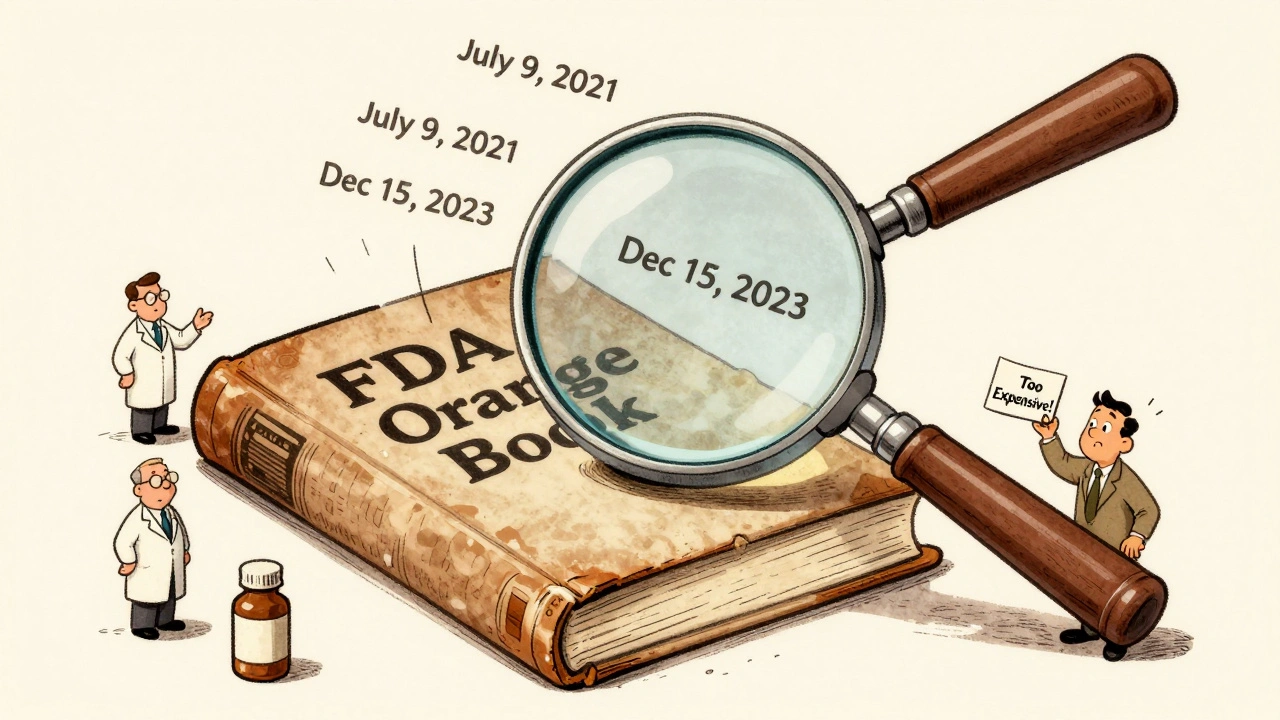
The FDA Orange Book is the single most important public resource for anyone trying to figure out when a brand-name drug will lose its patent protection and open the door for cheaper generics. If you’re a pharmacist, a generic drug manufacturer, a patient waiting for a lower-cost option, or even a researcher tracking drug market shifts, knowing where to find accurate patent expiration dates in the Orange Book can save weeks of guesswork.
What the FDA Orange Book Actually Is
The FDA Orange Book, officially called Approved Drug Products with Therapeutic Equivalence Evaluations, isn’t just a list of approved drugs. It’s a legal registry that tracks every patent and exclusivity period tied to a brand-name drug. Created in 1985 under the Hatch-Waxman Act, it was designed to balance innovation and access - giving brand companies time to recoup R&D costs while creating a clear path for generics to enter the market once protections expire. It only covers small-molecule drugs, not biologics like insulin or monoclonal antibodies. Each entry includes the drug’s active ingredient, brand name, manufacturer, approval date, and - most critically - the patent numbers and their expiration dates. The data is updated daily, with the latest official release on November 15, 2023.How to Find Patent Expiration Dates in the Electronic Orange Book
The old printed version is gone. Today, you access the Orange Book online at accessdata.fda.gov/scripts/cder/ob/index.cfm. Here’s how to find the exact expiration date you need:- Search by the drug’s active ingredient (like “clopidogrel”), brand name (like “Plavix”), or application number (like “NDA 020547”).
- Click on the Application Number link next to the drug you’re looking up.
- On the next page, scroll down and click the “View” button at the bottom.
- You’ll now see a table listing every patent tied to that drug. Each row shows the patent number, expiration date, and a patent use code (like U-415).
What the Patent Expiration Date Really Means
The date shown in the Orange Book isn’t just the original patent term. It includes any Patent Term Extension (PTE) granted by the USPTO. These extensions make up for time lost during FDA review. If a drug took 7 years to get approved instead of the standard 3, the patent can be extended to compensate. The format is always MMM DD, YYYY - like “July 9, 2021.” This date is the legal cutoff. After that, generics can file for approval without fear of patent lawsuits. But here’s the catch: the Orange Book also lists exclusivity periods separately. These are not patents. They’re regulatory rewards - like 3 years for new clinical studies or 5 years for a new chemical entity. Sometimes, exclusivity expires before the patent. Sometimes it’s the other way around. You have to check both.
Why Pediatric Exclusivity Makes Things Confusing
If a drug company conducts pediatric studies, they get an extra 6 months of market protection. This doesn’t create a new patent. Instead, the FDA lists the same patent twice in the Orange Book:- One entry shows the original expiration date.
- A second entry shows the same patent number, but with the 6-month extension added.
Where the Orange Book Gets It Wrong
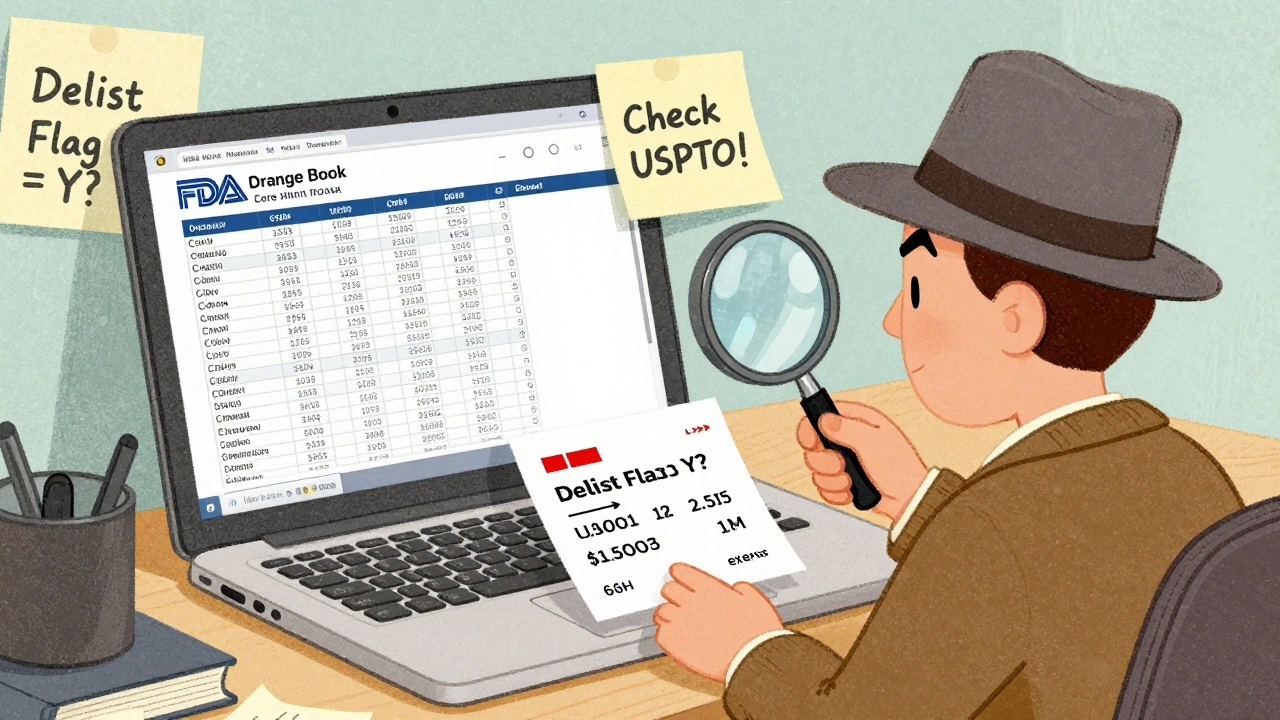
The Orange Book is authoritative - but it’s not perfect. A 2023 study from the National Bureau of Economic Research found that 46% of patents listed in the Orange Book expire early because the patent holder stops paying maintenance fees. The FDA doesn’t remove these patents from the database, even after they’re dead. So if you see a patent expiring in 2030, it might already be invalid. Also, about 7% of the time, the expiration date in the Orange Book doesn’t match the USPTO’s official record. That’s why serious generic manufacturers cross-check with the USPTO Patent Center before making billion-dollar launch decisions. And here’s another blind spot: the Orange Book doesn’t track patent challenges or court rulings. If a patent is invalidated by a judge, it stays listed unless the company voluntarily removes it. That’s why you should watch for the “Patent Delist Request Flag” - if it says “Y,” the patent owner is trying to remove it, often because it’s no longer enforceable.How to Get the Data in Bulk
If you’re analyzing dozens of drugs - say, for market research or investment analysis - you don’t want to click through each one. The FDA offers daily downloadable data files at fda.gov/drugs/orange-book-data-files. These CSV files include every patent and exclusivity entry, with columns for:- Product Number
- Patent Number
- Patent Expiration Date
- Drug Substance Flag (Y if the patent covers the active ingredient)
- Drug Product Flag (Y if it covers the formulation or delivery method)
- Patent Use Code (U-XXXX)
- Delist Request Flag (Y or blank)
What to Do When You Can’t Find a Patent
Sometimes you search for a drug and see no patents listed. That doesn’t mean there aren’t any. It could mean:- The patent expired and was removed from the database.
- The patent was never submitted by the drug maker (required within 30 days of issuance).
- The drug is a generic itself - generics aren’t listed in the Orange Book unless they’re the first to challenge a patent.
Why This Matters in 2025
By 2025, an estimated 78% of brand-name drug revenue will face generic competition. That’s up from 60% just five years ago. The pressure to predict when generics will hit the market is higher than ever. For patients, knowing when a drug will go generic means you can plan ahead for lower co-pays. For pharmacies, it helps with inventory and pricing. For manufacturers, it’s the difference between launching a product on time or paying millions in legal fees. The FDA’s goal with the Orange Book is simple: make this information easy to find. And with the 2020 Orange Book Transparency Act, they’ve improved search filters and added the “View All Patents” feature to reduce confusion. But no tool replaces careful checking. Always cross-reference the expiration date with the USPTO. Watch for delisting flags. Understand the difference between patents and exclusivity. And remember - the Orange Book tells you when a patent expires on paper. Only the courts and the USPTO tell you if it’s still enforceable in real life.Where can I find the FDA Orange Book online?
The official Electronic Orange Book is available at https://www.accessdata.fda.gov/scripts/cder/ob/index.cfm. You can search by drug name, active ingredient, application number, or manufacturer. The site is updated daily and is the only official source for patent and exclusivity data on FDA-approved small-molecule drugs.
Is the patent expiration date in the Orange Book always accurate?
Not always. While the FDA’s listed expiration dates are correct in about 93% of cases where Patent Term Extensions apply, about 46% of patents expire early due to missed maintenance fees - and the Orange Book doesn’t remove those listings. Always verify critical dates with the USPTO Patent Center database to confirm actual status.
What’s the difference between patent expiration and exclusivity expiration?
A patent protects the invention - like the chemical structure or how the drug is made. Exclusivity is a regulatory reward from the FDA for conducting new clinical trials or being the first to market a new drug. Exclusivity can expire before or after a patent, and both must be gone before a generic can launch. The Orange Book lists them separately, so check both dates.
Why does the same patent appear twice in the Orange Book?
That’s usually because of pediatric exclusivity. If a drug maker studies the drug in children, they get an extra 6 months of protection. The FDA doesn’t issue a new patent - it just adds 6 months to the existing one. So you’ll see the same patent number listed twice: once with the original date and once with the extended date. The later date is the real deadline.
Can I download the entire Orange Book data for analysis?
Yes. The FDA provides daily downloadable data files at https://www.fda.gov/drugs/drug-approval-applications-das/orange-book-data-files. These are CSV files with all patents, exclusivity periods, use codes, and flags. They’re used by researchers, generic manufacturers, and investors to track upcoming generic launches and forecast market changes.
What does a “Patent Delist Request Flag = Y” mean?
It means the drug company has asked the FDA to remove that patent from the Orange Book. This often happens when a patent is invalidated in court, is no longer considered enforceable, or the company wants to avoid legal risk. A delisting can be a strong signal that a generic launch is imminent - but it’s not guaranteed. Always investigate why the request was made.
Next Steps for Accurate Tracking
If you’re using the Orange Book for planning - whether you’re a pharmacist, investor, or generic manufacturer - here’s what to do next:- Use the official website to find the expiration date for your drug of interest.
- Check the USPTO Patent Center to confirm the patent is still active and hasn’t lapsed due to unpaid fees.
- Look for the delist request flag - if it’s marked “Y,” dig deeper.
- Identify whether the patent covers the active ingredient (Drug Substance Flag = Y) or just the pill form (Drug Product Flag = Y). Only substance patents block generic entry.
- Review exclusivity dates separately - don’t assume they match patent dates.
- For bulk analysis, download the daily data files and use Excel or Python to filter expirations by year.
8 Comments
Big fan of the Orange Book, honestly. Used it last month to track when the new generic for Ozempic hits - turned out the patent was already lapsed, but the FDA hadn’t updated it yet. Cross-checked with USPTO, found the maintenance fee was missed in 2022. Saved my firm months of wasted due diligence. Pro tip: always filter by 'Drug Substance Flag = Y' - formulation patents are basically marketing fluff.
Excellent breakdown - thank you. I’d only add that the 'Patent Use Code' (U-XXXX) is often the most underutilized filter; it tells you whether the patent covers a specific indication, not just the molecule. For example, a U-415 code means 'treatment of hypertension' - if that’s the only use covered, generics can still launch for other uses. This is critical for off-label prescribing and competitive analysis.
Just wanted to say this is one of the clearest summaries I’ve seen on this topic. I’m a pharmacist in rural Ohio, and I’ve had patients asking for generics for years - but no one ever explained how to actually find the dates. Now I can tell them exactly when to expect savings. Also, the CSV download tip? Game-changer. I’ve automated a monthly alert for any drug expiring in the next 18 months. My boss thinks I’m psychic now.
Let’s be real - the FDA doesn’t care about patients. The Orange Book is a trap. It’s full of ghost patents, outdated data, and corporate lies. The 46% of patents that expire early? They’re still listed because Big Pharma bribes the FDA to keep them there - to scare off generics. And the pediatric exclusivity loophole? That’s just a backdoor to extend monopolies. The USPTO doesn’t even sync with the FDA. It’s all smoke and mirrors. If you’re trusting this system, you’re being played. The real expiration date? When the courts say so - and even then, the companies delay with frivolous lawsuits. It’s not transparency - it’s theater.
Wow. This post reads like a Wikipedia page written by someone who thinks 'patent' and 'exclusivity' are synonyms. Do you even know what a Paragraph IV certification is? Or that 70% of Orange Book listings are challenged in court? You didn’t mention the '180-day exclusivity' window for first filers - the real battleground. If you’re not reading the Federal Register and tracking ANDA filings, you’re not doing real work. This is basic, surface-level fluff for people who think generics just magically appear on shelves.
Joe Lam is right - this is basic. But honestly? I think the whole system is rigged. The FDA’s database? It’s a mess. I’ve seen patents listed that were invalidated in 2019, still showing up as active. And the delist flags? They’re not reliable - companies file them only when they’re caught. I once found a drug where the patent was dead, but the Orange Book said it expired in 2035. I called the manufacturer. They admitted they forgot to delist it. That’s not incompetence - that’s negligence. And don’t even get me started on how the USPTO and FDA don’t talk to each other. It’s like two agencies playing telephone with our healthcare system.
Thank you for this comprehensive overview. As a mentor to new pharmacists, I’ve shared this resource with my team. The distinction between patent and exclusivity is often misunderstood - especially among newer clinicians. The CSV download feature is invaluable for longitudinal analysis, and the emphasis on cross-referencing with USPTO is non-negotiable. I’ve seen too many errors propagate because people trust the Orange Book as gospel. This is exactly the kind of nuanced, practical guidance the field needs.
Why do we even bother? The whole system is a corporate fantasy. Patents are bought, not invented. Exclusivity? A bribe disguised as a reward. The FDA? A puppet. The Orange Book? A mirror reflecting the greed of Big Pharma. And you think checking USPTO fixes it? Nah. The USPTO’s database is just as corrupted - same lobbyists, same delays, same lies. We’re not tracking expirations - we’re playing Russian roulette with our health. The real answer? Abolish patents on life-saving drugs. Full stop. Until then, we’re just rearranging deck chairs on the Titanic.
Write a comment