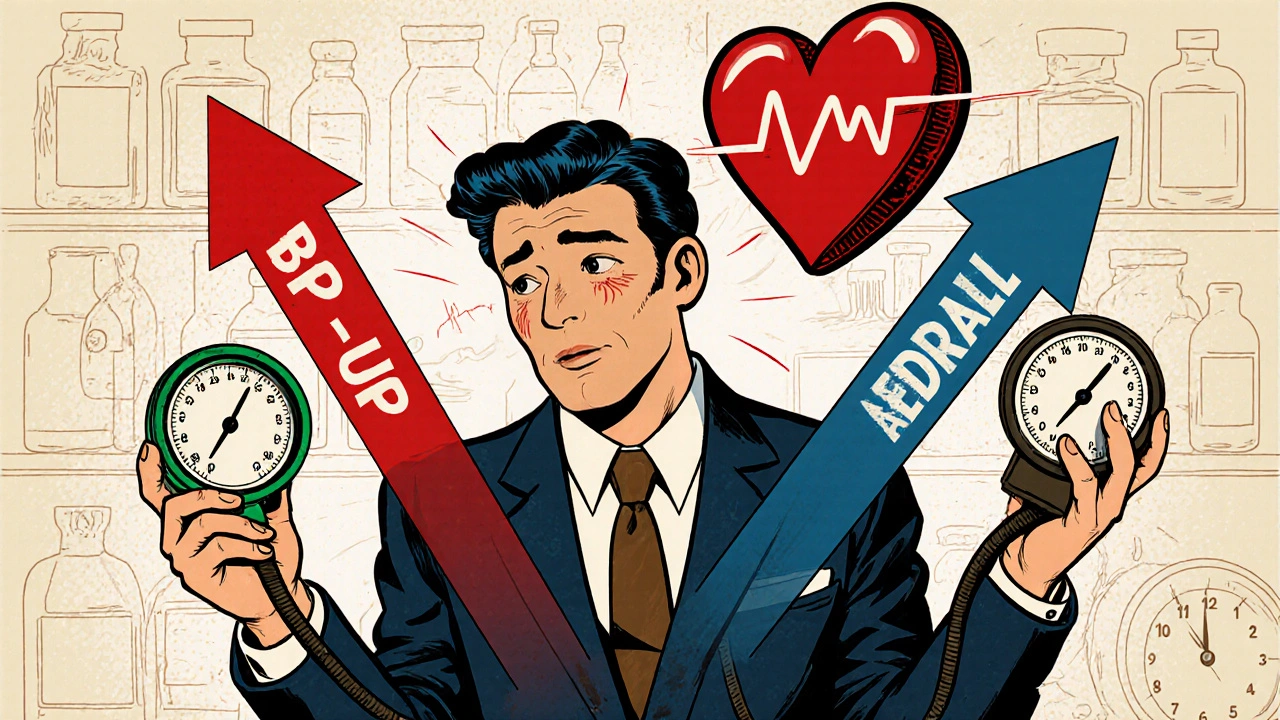
Blood Pressure Interaction Calculator
How This Tool Works
This calculator estimates potential blood pressure fluctuations when combining stimulant medications with green coffee extract. It shows the expected net effect based on clinical data about each substance. Important: This is for informational purposes only. Do not make medical decisions based solely on this tool. Consult your doctor before changing any medication.
Potential Blood Pressure Effect
Stimulant Effect: +0 mmHg systolic
Green Coffee Effect: -0 mmHg systolic
Net Effect: 0 mmHg systolic
If you're taking stimulant medication for ADHD-like Adderall, Vyvanse, or Ritalin-and you've started using green coffee extract for weight loss or energy, you might be unaware of a hidden risk: blood pressure instability. This isn't theoretical. People are reporting wild swings in their readings, dizziness, and heart palpitations. And doctors are starting to see a clear pattern.
What Exactly Is Green Coffee Extract?
Green coffee extract comes from unroasted coffee beans. Unlike your morning brew, which is roasted and loses most of its chlorogenic acids, this supplement keeps them intact. These acids are what give green coffee extract its reputation for lowering blood pressure. But it also contains caffeine-anywhere from 5% to 20% by weight. A typical 400 mg capsule might have 20 to 80 mg of caffeine, sometimes more.
Studies show that at standard doses (93-185 mg per day), green coffee extract can reduce systolic blood pressure by about 5 mmHg and diastolic by 3-4 mmHg. That’s not a huge drop, but it’s consistent. The mechanism? Chlorogenic acids block enzymes that raise blood pressure, like ACE and 11β-HSD1. It’s not caffeine doing the heavy lifting here-it’s the other compounds.
How Stimulant Medications Affect Blood Pressure
Stimulants like methylphenidate and amphetamines are designed to increase alertness and focus. But they also trigger your sympathetic nervous system. That means your heart beats faster, your blood vessels tighten, and your blood pressure rises.
According to FDA data, Adderall can raise systolic pressure by up to 13 mmHg and diastolic by 8 mmHg. Ritalin? Up to 11 mmHg systolic. These aren’t minor changes. That’s why the American Heart Association says all patients on these meds need regular blood pressure checks.
For someone with normal blood pressure, this might not matter much. But if you already have borderline high blood pressure-or if you're sensitive to stimulants-those small increases can pile up. And that’s where green coffee extract comes in.
The Conflict: One Lowers, One Raises
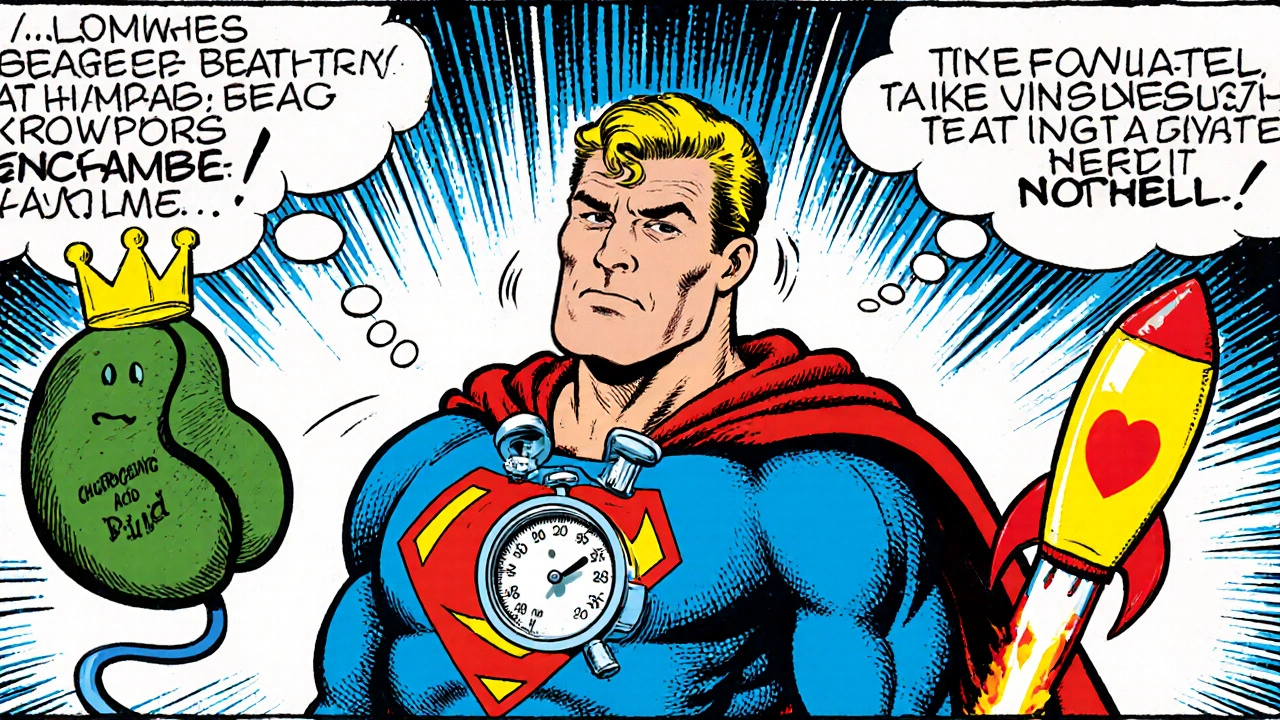
Here’s the problem: green coffee extract lowers blood pressure. Stimulants raise it. When you take both, your body gets mixed signals. It’s like stepping on the gas and the brake at the same time.
No direct clinical trial has studied this exact combo. But we don’t need one to see the danger. We’ve got real-world cases.
A 34-year-old man on Adderall XR 30 mg daily started taking a green coffee extract supplement with 180 mg of caffeine. His blood pressure started swinging between 118 and 156 mmHg systolic. He ended up needing a medication adjustment. His doctor told him to stop the supplement.
Another case: a 29-year-old woman on Adderall 20 mg took green coffee extract for energy. She got dizzy and felt her heart race. Her doctor linked it directly to the combo. She stopped the supplement-and her symptoms vanished.
ConsumerLab’s 2023 safety report found 17 blood pressure-related adverse events tied to green coffee extract. Nine of those involved people also taking stimulant meds.

Why This Isn’t Just About Caffeine
Many people think, “It’s just caffeine.” But that’s misleading. Yes, caffeine raises blood pressure. But green coffee extract’s main active ingredients aren’t caffeine-they’re chlorogenic acids. And those acids lower blood pressure.
The issue isn’t just additive caffeine. It’s the opposing effects. Your body tries to balance both forces. That creates instability. Your blood pressure doesn’t just go up or down-it fluctuates. And those swings are dangerous. They stress your heart, your arteries, your kidneys.
Plus, green coffee extract products vary wildly. One brand might have 28% chlorogenic acid and 3% caffeine. Another might have 51% chlorogenic acid and 18% caffeine. That’s a 6x difference in caffeine content. You can’t assume your supplement is “safe” just because it’s labeled “natural.”
What Experts Are Saying
Dr. James Lane from Duke University says combining stimulants with green coffee extract creates “unpredictable hemodynamic responses.” That’s medical speak for: your body doesn’t know what to do.
The American Society of Hypertension warns that chlorogenic acids can interact with both stimulants and blood pressure meds. That means even if you’re not on stimulants, but you’re on lisinopril or losartan, green coffee extract could make your meds work too well-or not at all.
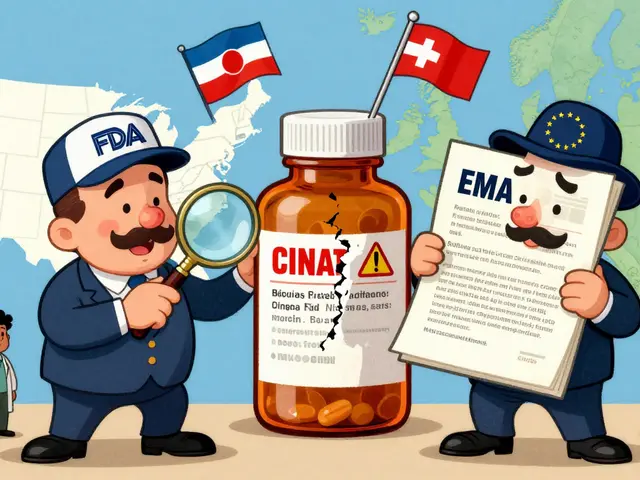
And it’s not just theoretical. A 2024 survey of 1,200 pharmacists found that 68% now routinely warn patients about this interaction. That’s up from 32% in 2021. The FDA has added green coffee extract to its draft guidance on supplement-drug interactions. The European Medicines Agency added a specific warning in February 2024.
What Should You Do?
If you’re on stimulant medication and thinking about trying green coffee extract: don’t start without talking to your doctor.
If you’re already taking both:
- Stop the supplement immediately and monitor your blood pressure for 48 hours.
- Write down your readings-morning and night.
- Bring those numbers to your doctor. Don’t just say, “I feel fine.” Show them the data.
- Ask if your stimulant dose needs adjusting.
Don’t assume your doctor knows about green coffee extract. Most don’t. They’re trained on pharmaceuticals, not supplements. Bring the product label. Point out the caffeine and chlorogenic acid content.
Alternatives to Green Coffee Extract
If you’re using green coffee extract for weight loss or energy, there are safer options:
- For energy: Get more sleep. Move more. Cut added sugar. These work better long-term than supplements.
- For weight loss: Focus on protein intake, fiber, and resistance training. No supplement replaces this.
- If you need a mild stimulant: Try black tea. It has less caffeine than coffee, and L-theanine helps smooth out the jitters.
There’s no supplement worth risking your blood pressure stability.
The Bottom Line
Green coffee extract isn’t dangerous on its own. Stimulant medications aren’t dangerous on their own. But together? They create a tug-of-war inside your body. And your cardiovascular system pays the price.
There’s no proven benefit to taking them together. But there are documented risks: erratic blood pressure, dizziness, palpitations, and even long-term strain on your heart.
Until more research is done-expected in 2026-the safest choice is clear: avoid combining them. Your heart will thank you.
Can green coffee extract lower blood pressure enough to cancel out stimulant meds?
No. Green coffee extract may lower blood pressure by about 5 mmHg systolic, but stimulant medications can raise it by 10 mmHg or more. The result isn’t cancellation-it’s instability. Your body struggles to maintain balance, leading to unpredictable swings that can be dangerous, especially for people with heart conditions.
Is it safe to take green coffee extract if I’m on a low dose of Adderall?
Even low doses of stimulants can raise blood pressure enough to create conflict. A 20 mg dose of Adderall can still increase systolic pressure by 4-7 mmHg. Combined with green coffee extract’s variable caffeine and chlorogenic acid content, that’s enough to cause fluctuations. It’s not worth the risk. Talk to your doctor before combining them.
How much caffeine is in green coffee extract supplements?
It varies widely. Some products contain as little as 3.2% caffeine (about 15 mg per 400 mg capsule), while others have up to 18.7% (over 75 mg). Some brands don’t even list caffeine content. Always check the label-and if it’s not listed, assume it’s high. The average is around 50-100 mg per serving.
Should I stop green coffee extract if I have high blood pressure and take stimulants?
Yes. If you have high blood pressure and are on stimulant medication, green coffee extract increases your risk of dangerous blood pressure swings. The American Heart Association and European Society of Cardiology both recommend avoiding it in this group. The potential for harm outweighs any unproven benefits.
Are there any supplements that are safe to take with stimulant medications?
Most supplements that affect blood pressure or heart rate-like green coffee extract, yohimbine, ephedra, or high-dose ginseng-are risky. Safer options include magnesium, omega-3s, and vitamin D, which don’t interfere with cardiovascular function. But always check with your doctor before starting anything new, even if it’s labeled “natural.”

19 Comments
Ugh, I can't believe people still take this green coffee nonsense. I mean, if you're on Adderall, you already have enough jitters. Why add a supplement that's basically caffeine in a fancy bottle? I stopped mine after my heart felt like it was trying to escape my chest. 🙄
I find this entire topic fascinating-though I must admit, I misread 'chlorogenic acids' as 'chlorine goblins' for a solid 30 seconds. 😅 The idea that two opposing forces are fighting inside your body like a tiny sci-fi war is both terrifying and oddly poetic. Also, why do supplement labels lie so much? I once bought a 'pure' green coffee extract that had more fillers than my ex's excuses.
Hey, I tried this combo for a week and I swear I lost 3 pounds! But then I got dizzy during yoga and thought I was gonna pass out. My roommate said I looked like a cartoon character spinning in circles. I stopped it. Worth it? Not even close.
OMG I JUST REALIZED I’M TAKING THIS 😱 I’M SO SCARED NOW. MY BP WAS 158/92 LAST WEEK AND I THOUGHT IT WAS JUST STRESS. I’M DELETING THE BOTTLE RIGHT NOW. 🙏💔 #greencoffeeisnotyourfriend
This is why America’s getting weak. You take a perfectly good stimulant designed by science, then you go and mix it with some hippie bean water? That’s not health, that’s treason. I don’t care what some ‘pharmacist survey’ says-I’ve got a 100-year-old grandpa who drank black coffee and lifted boulders. We don’t need your fancy supplements. Back to the gym, losers.
You got this! 🙌 Seriously, listening to your body is the ultimate hack. If you feel weird, stop. No shame in that. I used to do the same thing-thinking ‘natural’ meant ‘safe.’ Nope. Natural can still wreck you. Now I just drink water, sleep 8 hours, and move daily. My focus is better, my BP is stable, and I’m not chasing pills. You’re not broken-you just need better habits. You got this!
I live in a country where green coffee is sold as a traditional remedy for ‘heat in the blood.’ Funny how culture shapes what we think is medicine. But honestly, I’m glad someone’s putting this out there. My cousin took it with Ritalin and ended up in the ER with tachycardia. We didn’t connect the dots until months later. Always ask your pharmacist. They know more than your doctor thinks they do.
The scientific rigor presented here is commendable. The inclusion of clinical data, pharmacological mechanisms, and regulatory updates provides a comprehensive overview. One might argue that the anecdotal evidence, while compelling, lacks statistical generalizability; however, the consistency across case reports and pharmacist surveys suggests a clinically relevant interaction. I would recommend further longitudinal studies.
I appreciate the depth of this post. It's clear, well-referenced, and avoids alarmism while still conveying urgency. I've seen too many patients self-prescribe supplements without understanding interactions. This is exactly the kind of information that should be more widely disseminated. Thank you.
Let’s deconstruct this at a systems level. The chlorogenic acids inhibit ACE and 11β-HSD1, modulating renin-angiotensin-aldosterone and glucocorticoid pathways respectively-while stimulants trigger norepinephrine release via VMAT2 and TAAR1 agonism, causing vasoconstriction and increased cardiac output. The result is not merely antagonism but dynamic instability in baroreceptor feedback loops, particularly in individuals with preexisting autonomic dysregulation. This isn't 'a tug-of-war'-it's a chaotic resonance in cardiovascular homeostasis. The FDA’s draft guidance is overdue, but the real issue is the regulatory vacuum around nutraceuticals. Until supplements are held to the same bioequivalence standards as pharmaceuticals, this will keep happening. Also, 50-100mg caffeine per serving? That’s a full espresso. People think they’re getting ‘light’ energy. They’re not.
I’ve been on Vyvanse for 8 years and tried green coffee extract last winter. Felt fine at first. Then one day I was walking to the fridge and my heart just… stopped. Like, paused. Then pounded. Scared the crap out of me. Stopped it. No regrets. Honestly? The energy boost wasn’t even that good. Just made me jittery and thirsty.
The data is cherry-picked. Case reports ≠ evidence. Where’s the RCT? Where’s the control group? How many people actually take both? The 68% pharmacist stat is meaningless without sample size or methodology. This reads like fearmongering dressed as science. Also, black tea? Really? That’s your alternative? Next you’ll say ‘just breathe’.
I want to say thank you for writing this. I’ve been on Adderall since college and I’ve tried every ‘natural energy booster’ out there. Green coffee extract was the worst. I thought I was being smart-natural, plant-based, no chemicals. But my body wasn’t fooled. After I stopped, I felt calmer, slept better, and my focus didn’t depend on a pill or a powder. It’s not about willpower-it’s about listening. And honestly? The real power is in sleep, movement, and real food. You don’t need magic beans. You just need to be kind to yourself.
This is so important. I’ve been seeing more people my age (early 30s) on stimulants trying to ‘optimize’ themselves with supplements. It’s like we’ve forgotten how to rest. I’m glad someone’s speaking up. I’ll be sharing this with my ADHD support group. No one should feel pressured to ‘do more’ with pills and powders. Rest is revolutionary.
So you’re telling me the government lets companies sell something that can literally mess with your heart but won’t regulate it because it’s ‘natural’? Sounds like a corporate scam. I bet the same people who sell this also sell ‘quantum healing bracelets’ and ‘anti-radiation stickers’. Wake up people. They’re not your friends. They’re your wallet’s worst enemy.
I read this while sitting in my kitchen, holding a cup of black tea (no caffeine, just chamomile). I used to take green coffee extract because I thought it was ‘clean’. Now I feel a little guilty for ever believing that. I’m not mad at the supplement industry-I’m sad. We’ve been sold a lie that health is something you buy, not something you cultivate. This post made me pause. And that’s rare.
This is all a psyop. The FDA and Big Pharma don’t want you to know that natural remedies can balance stimulants. They make billions off your dependence. Green coffee extract is nature’s way of saying ‘I got you’. They’re scared because it’s cheap and effective. They’re covering it up with ‘risk’ scare tactics. Your BP swings? That’s your body detoxing. They want you to stay on Adderall forever. Wake up. The truth is hidden. Always is.
The absence of randomized controlled trials precludes definitive causal inference. While the pharmacodynamic antagonism is theoretically plausible, the clinical significance remains uncertain without population-level data. The anecdotal cases cited, though concerning, do not constitute epidemiological evidence. One might reasonably argue that the observed adverse events are confounded by concomitant lifestyle factors or undiagnosed hypertension. Caution is warranted, but alarmism is unwarranted.
i just found out i’ve been taking this for 6 months and my bp is kinda high now… i didn’t even know it had caffeine. i’m so dumb. i’ll stop tomorrow. thanks for posting this. 🙏
Write a comment