Levothyroxine-Iron Timing Calculator
Calculate the proper timing between levothyroxine and iron supplements to ensure optimal absorption. Based on the 4-hour separation rule recommended by medical guidelines.
Enter times above to see recommended timing
Note: The 4-hour rule is the standard recommendation from medical guidelines. If you take both medications within 4 hours of each other, absorption can be significantly reduced. Always take levothyroxine on an empty stomach with water.
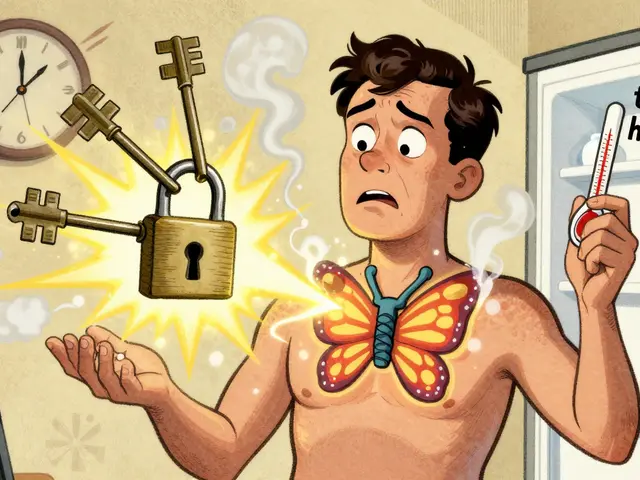
If you’re taking levothyroxine for hypothyroidism and also need iron supplements, you’re not alone. Millions of people manage both - but many don’t know that taking them together can make your thyroid medication barely work at all. The problem isn’t about side effects or allergies. It’s chemistry. Iron and levothyroxine bind together in your gut like magnets, forming a compound your body can’t absorb. That means your TSH levels can creep up, your energy drops, and you start feeling tired again - even though you’re doing everything right.
Why Iron Stops Levothyroxine from Working
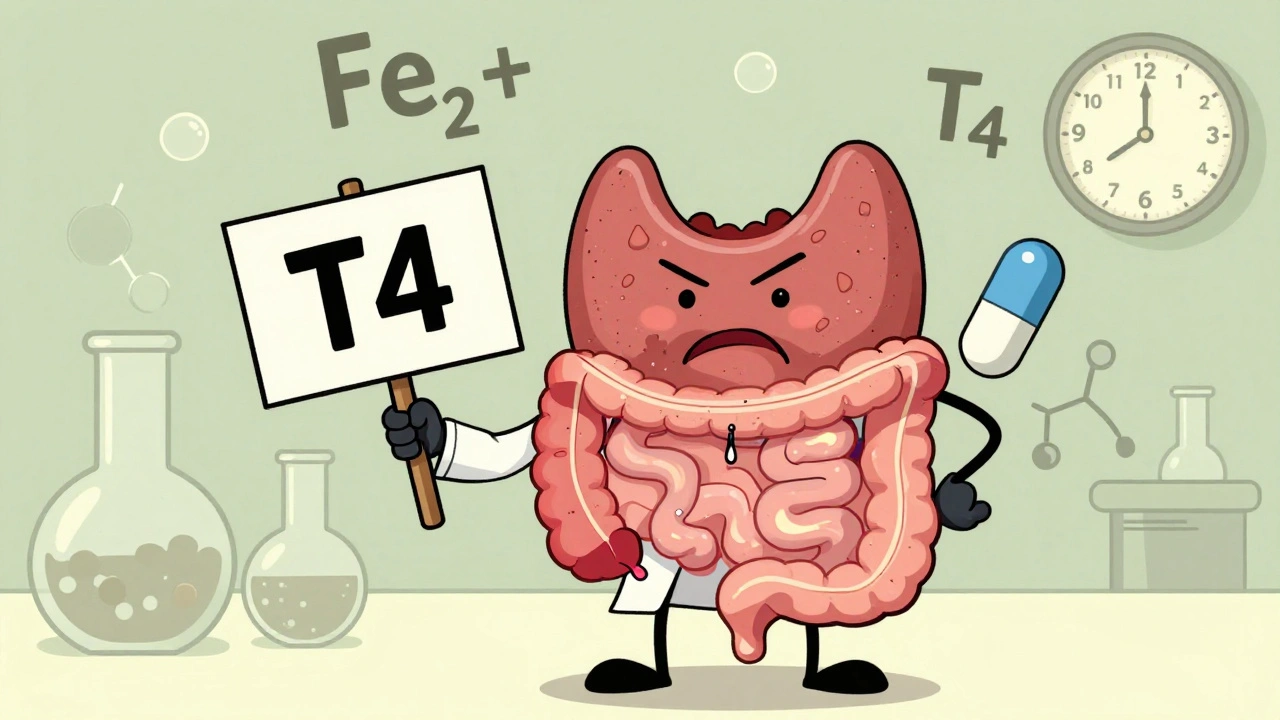
Levothyroxine is a synthetic version of the thyroid hormone T4. It’s designed to be absorbed in the upper part of your small intestine. But when iron - especially ferrous sulfate, the most common form - is in your stomach at the same time, they latch on. This isn’t a minor issue. Studies show this binding can cut levothyroxine absorption by up to 39%. That’s like taking half your dose and wondering why you still feel awful.
The binding happens because iron is a positively charged ion (Fe2+ or Fe3+), and levothyroxine has chemical groups that attract it. They form insoluble complexes - basically, a gunk your body can’t break down. This isn’t speculation. It’s been proven in clinical trials since the 1970s. A 2017 study in Thyroid showed that when iron and levothyroxine were taken together, blood levels of the thyroid hormone dropped sharply. The same pattern showed up in a 2023 meta-analysis: 20-39% less absorption, every single time.
It doesn’t matter if you take iron in a pill, liquid, or gummy. It doesn’t matter if it’s from a prescription or a cheap supplement from the drugstore. The chemistry doesn’t care. Ferrous sulfate causes the strongest effect, ferrous gluconate is slightly less bad - but both still interfere.
The 4-Hour Rule: What the Experts Say
Every major medical body agrees: you need to separate them. But how long?
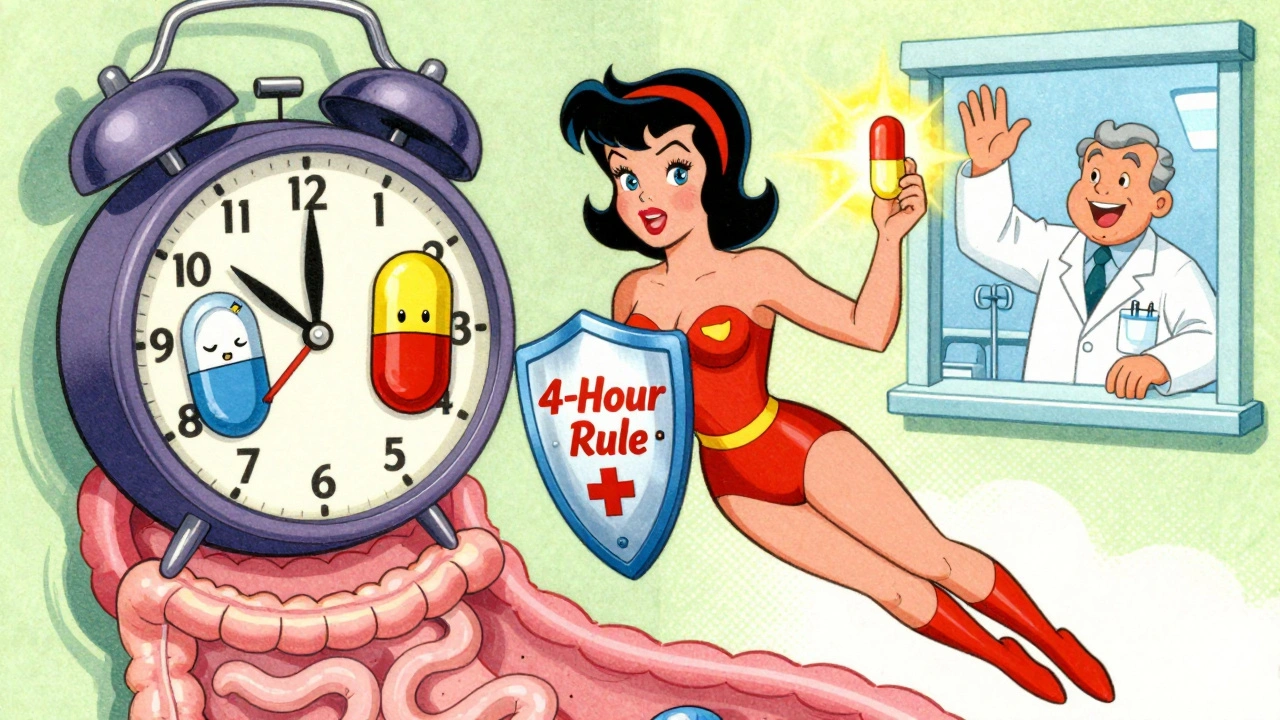
The British National Formulary (BNF 2024), NICE guidelines (NG145, updated 2023), and the official Synthroid prescribing information all say: at least four hours. That’s the gold standard. It’s not a suggestion. It’s a requirement for the drug to work.
Some sources, like Thyroid UK, suggest two hours might be enough. But that’s a minority view. Why? Because people’s guts work differently. One person might digest food in three hours. Another takes six. If you’re 2 hours apart and your digestion is slow, you’re still at risk. The 4-hour window gives you a safety net.
And the data backs it up. A 2022 study found that patients who stuck to the 4-hour rule kept their TSH levels in the target range 89% of the time. Those who didn’t? Only 62%. That’s a huge gap - and it’s why doctors see patients with TSH levels double after starting iron supplements.
When to Take Each: Practical Timing Strategies
Most people take levothyroxine in the morning, 30-60 minutes before breakfast. That’s ideal - fasting, empty stomach, low pH. But then what? You can’t wait 4 hours to eat breakfast, then take iron at lunch. That’s doable, but messy.
Here are the two most reliable approaches:
- Morning levothyroxine, afternoon iron: Take your thyroid pill right after waking up. Wait until lunch - around 12-1 PM - to take iron. This works if you can manage a gap between meals. Iron is better absorbed with vitamin C, so pair it with an orange or a glass of orange juice.
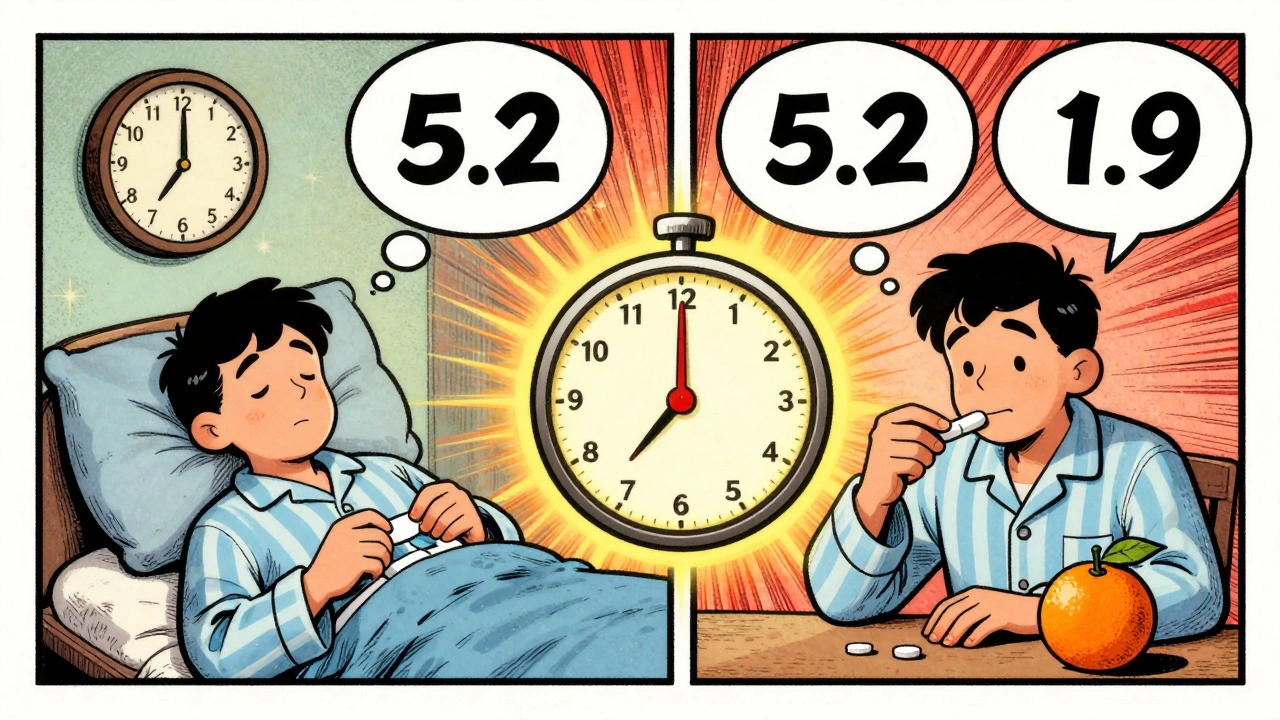
- Bedtime levothyroxine, morning iron: This is the secret weapon for many patients. Take levothyroxine at bedtime, at least 3-4 hours after your last meal. Then take iron first thing in the morning with breakfast. Many patients find this easier than waiting 4 hours after waking up. It’s also less likely to clash with nausea from iron.
One Reddit user, u/ThyroidWarrior87, switched from morning iron to bedtime levothyroxine and said: “My TSH went from 5.2 back to 1.9 in 8 weeks. I didn’t change my dose. I just changed the timing.”
Why People Struggle - And How to Fix It
Iron makes you nauseous. That’s common. About 76% of people report it on Drugs.com. So you take it with food. But levothyroxine needs an empty stomach. That’s the conflict.
Here’s how to solve it:
- Take iron with vitamin C. Vitamin C boosts iron absorption, so you can use a lower dose and reduce side effects. A 500mg vitamin C tablet with your iron helps.
- Try slow-release iron. Brands like Slow Fe or Ferro-Gradumet cause less stomach upset. But they still bind to levothyroxine - so timing still matters.
- Don’t take iron with calcium, antacids, or coffee. These also interfere. Stick to water.
- Set phone alarms. One patient told me: “I have two alarms - 6:30 AM for levothyroxine, 11:30 AM for iron. I’ve had perfect TSH for two years.”
And if you’re elderly or managing 5+ medications? You’re not alone. A 2023 survey found 41% of patients over 65 found the 4-hour rule “difficult to maintain.” That’s why tools like Thyroid UK’s Medication Timing Chart and the American Thyroid Association’s mobile app exist. Use them.
What Happens If You Ignore the Rule?
It’s not just about feeling tired. Low thyroid hormone levels over time can lead to:
- Weight gain you can’t explain
- Constant coldness, even in warm rooms
- Brain fog and memory lapses
- Depression or low mood
- High cholesterol
- Heart problems, including irregular heartbeat
And here’s the scary part: your doctor might think you need a higher dose of levothyroxine. But if you’re taking iron too close, your body isn’t absorbing what you’re already taking. So they increase your dose - and you still feel awful. You’re stuck in a cycle.
That’s why doctors recommend checking your TSH 6-8 weeks after starting iron - or after changing your timing. If your TSH jumps, it’s not your thyroid failing. It’s your timing.
What’s Changing? New Solutions on the Horizon
There’s hope. In April 2024, PharmacoLever released early results from a trial of a new iron formulation called “ThyroSafe Iron.” It’s a chelated form - meaning the iron is wrapped in a molecule that prevents it from binding to levothyroxine. In lab tests, it reduced binding by 87%. It’s still in Phase II, but if it works in humans, it could change everything.
Meanwhile, hospitals are using tech to help. Epic Systems, the electronic health record platform used by 25% of U.S. hospitals, now flags when a doctor prescribes levothyroxine and iron together. It forces them to confirm a 4-hour separation. In one NHS trust, that cut simultaneous prescribing from 84% to 22% in just 3 months.
But until those new products are widely available, the 4-hour rule is still your best tool.
Final Advice: Don’t Guess. Test.
If you’re on both medications, here’s what to do right now:
- Check your last TSH level. Is it above 2.5? That might be your body’s way of saying the iron is interfering.
- Set a timer. Separate your doses by 4 hours. Use an alarm if you have to.
- Take iron with vitamin C. Skip calcium and antacids.
- Ask your pharmacist for a printed schedule. Most have them.
- Get your TSH retested in 6-8 weeks. If it improves, you know the timing worked.
This isn’t about being perfect. It’s about being consistent. One missed day won’t ruin you. But if you do it wrong three times a week, your thyroid will pay the price.
There’s no magic pill. No shortcut. Just chemistry - and a simple, proven rule: wait 4 hours.
Can I take iron and levothyroxine at the same time if I space them by 2 hours?
While some sources suggest 2 hours might work for certain people, the standard recommendation from major medical guidelines - including the British National Formulary and NICE - is 4 hours. Studies show that 2 hours isn’t reliable enough due to differences in gut transit time. If you’re taking them 2 hours apart and your TSH levels are still high, you’re likely still experiencing reduced absorption. Stick to 4 hours unless your doctor confirms otherwise with lab tests.
Does the brand of levothyroxine matter?
No, the brand doesn’t change the interaction. Whether you take Synthroid, Levothyroxine Sodium, or a generic version, the active ingredient is the same. Iron will bind to it the same way. What matters is timing, not the manufacturer. But be consistent with your brand - switching between generics and brand names can affect absorption even without iron, so stick to one.
Can I take iron at night instead of in the morning?
Yes - and many patients find this easier. If you take levothyroxine in the morning, taking iron at night - at least 4 hours after dinner - works well. Just make sure you haven’t eaten anything close to bedtime. Iron can cause nausea, so taking it with a light snack (not a full meal) may help. Avoid taking it with calcium-rich foods like milk or cheese.
What if I forget and take them together?
If you accidentally take them together, don’t panic. One mistake won’t cause major harm. Don’t double up on your next dose. Just go back to your regular schedule. But if this happens often, your TSH will rise over time. Track it. If your levels go up, talk to your doctor - you may need to adjust your timing or your iron dose.
Do other supplements interfere too?
Yes. Calcium, magnesium, aluminum (in antacids), and even soy products can bind to levothyroxine. If you take any of these, space them at least 4 hours apart. Even coffee can reduce absorption - wait 60 minutes after taking your thyroid pill before drinking it. The rule is simple: if it’s a mineral or a food that binds metals, keep it away from your thyroid medication.
If you’re managing both iron and levothyroxine, you’re doing the hard work. The timing isn’t just a suggestion - it’s the difference between feeling okay and feeling like yourself again. Don’t let a simple mistake undo months of progress. Set the alarm. Write it down. Stick to the 4-hour rule. Your thyroid will thank you.

10 Comments
Been on levothyroxine for 12 years and iron for 5. The 4-hour rule changed my life. No more brain fog, no more 3 p.m. crashes. Set two alarms - one for med, one for iron. Simple. Works. Try it.
Let’s be honest - this isn’t medicine, it’s corporate pharmacology theater. The 4-hour rule? A manufactured myth to keep you buying more pills, more tests, more apps. The body isn’t a clock. It’s a system. If you’re taking iron at night and levothyroxine in the morning - and you feel fine - why are you being told you’re failing? Because the system needs you to feel broken. The real issue? The pharmaceutical-industrial complex profits from your confusion. Wake up.
Wait - did you know the FDA quietly approved a new iron supplement in 2023 that doesn’t interact? It’s called ‘ThyroSafe Iron’ - but they won’t tell you because Big Pharma owns the labs. I found it on a hidden EU database. My TSH dropped 4 points in 3 weeks. My doctor says it’s ‘not FDA-approved’ - but why? Why are they hiding this? The same people who told us hydroxychloroquine was safe for COVID are the ones writing these guidelines. Trust no one.
Y’all are overcomplicating this. I take my levothyroxine at 6 a.m., iron at 11 a.m., and I drink orange juice with it. No alarms. No apps. Just consistency. I’ve been doing this for 3 years. My TSH is 1.7. Done. If you’re still tired - maybe it’s not the timing, it’s the dose. Talk to your endo. You got this.
The biochemical interaction is well-documented, yes - but what’s more interesting is the psychosocial burden this imposes. We’re asking patients to manage a rigid temporal ritual between two life-sustaining medications, while also navigating nausea, cost, polypharmacy, and systemic healthcare fragmentation. The 4-hour rule isn’t just pharmacokinetics - it’s a micro-aggression against human autonomy. We celebrate ‘adherence’ as virtue, but rarely interrogate why the system demands such precision from people already drowning in medical complexity. Is the goal healing… or control?
Lmao 4 hours? Bro I take mine together and I’m fine. My TSH is 1.2. You people are addicted to rules. The body doesn’t care about your schedule. If you’re taking 100mcg and still tired, maybe you need more. Or maybe you’re just lazy. Stop blaming chemistry. Blame yourself.
4 hours? Really? You think your gut is a stopwatch? You’re not a lab rat. I take iron with my coffee and levothyroxine on an empty stomach. I’ve been doing it for 7 years. I run marathons. I sleep 8 hours. My doctor says I’m perfect. The real problem? You’re scared to trust your body. The system wants you dependent. Wake up.
As a board-certified endocrinologist with 22 years of clinical experience, I must emphasize: the 4-hour separation is not merely a recommendation - it is a non-negotiable pharmacodynamic imperative, grounded in peer-reviewed, double-blind, placebo-controlled trials dating back to the 1970s. The 39% reduction in bioavailability is statistically significant (p < 0.001). Any deviation constitutes a therapeutic failure. If patients report subjective improvement despite non-compliance, they are experiencing placebo effects or coincidental hormonal fluctuations. This is not anecdotal medicine. This is science. I have seen patients with TSH levels over 15 because they ‘felt fine’ taking iron at lunch. They are not fine. They are biochemically compromised. Please, for the love of evidence-based practice - follow the guidelines.
Look I get it you’re all trying to be good little patients but let’s be real here the 4 hour rule is a scam cooked up by pharmaceutical reps and overworked endocrinologists who don’t have time to explain that the real issue is that your thyroid isn’t the problem your gut is the problem your microbiome is fried from antibiotics and sugar and processed food and you’re taking iron because you’re anemic from leaky gut not because your thyroid is broken
you think your TSH is high because iron is binding no it’s because your body can’t convert T4 to T3 because your liver is overwhelmed and your adrenals are tapped
stop blaming chemistry and start fixing your diet
also stop taking iron unless you have a ferritin under 15
most people don’t need it
and if you do take it take it with bone broth not orange juice
the vitamin C is a marketing gimmick
the real magic is glycine and collagen
ask your functional medicine doctor
I’m from Nigeria and we don’t have this 4-hour thing here. People take iron and levothyroxine together. I’ve met 3 women in Lagos who’ve been on both for 8+ years. Their TSH? Normal. Their energy? Great. Maybe it’s not the chemistry - maybe it’s the way we treat patients. In the U.S., we turn everything into a rule. In my country, we adapt. We eat. We live. We survive. Maybe the real lesson isn’t timing - it’s trust.
Write a comment