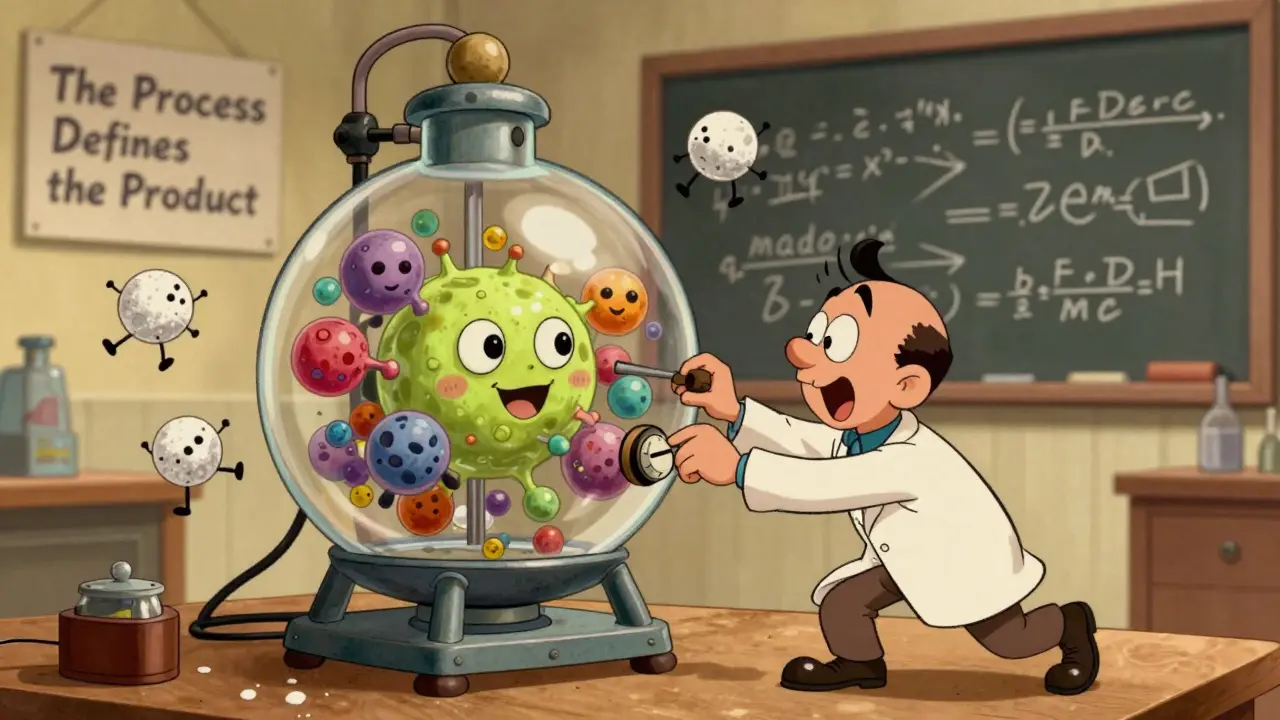
When you think of a generic drug, you probably picture a small, cheap pill that does the same thing as the brand-name version. It’s simple: same chemistry, same effect, lower price. But biosimilars aren’t like that. They’re not copies-they’re highly similar versions of complex biologic drugs made from living cells. And that difference turns manufacturing into one of the most difficult tasks in modern medicine.
Why Biosimilars Can’t Be Made Like Regular Generics
Generic drugs are made by chemically synthesizing small molecules. If you know the formula, you can reproduce it exactly, every time. Biosimilars? They’re proteins-sometimes bigger than a virus-grown inside living cells like Chinese hamster ovary cells. These cells are finicky. Even tiny changes in temperature, pH, or nutrient levels can alter the final product. That’s why experts say, “The process defines the product.” It’s not just about the molecule. It’s about how it’s made.Take insulin or a monoclonal antibody like Humira. The originator company spent years perfecting its cell line, feeding strategy, and purification steps. Biosimilar makers don’t get access to that recipe. They have to reverse-engineer it-like trying to recreate a Michelin-star dish without knowing the ingredients, the cook’s technique, or even the stove used. And they have to prove it’s nearly identical to the original, down to the last sugar molecule attached to the protein.
The Glycosylation Problem: Tiny Sugars, Big Consequences
One of the biggest headaches in biosimilar production is glycosylation. That’s the process where sugar chains (glycans) attach to the protein part of the drug. These sugars aren’t just decoration-they control how long the drug lasts in your body, how well it binds to its target, and whether your immune system reacts to it.Change the cell culture temperature by just 1°C? The glycan profile shifts. Swap out a batch of feed media? Different sugars show up. Even the oxygen level in the bioreactor matters. The reference product has a very specific glycosylation pattern-say, 72% of molecules have a certain type of sugar at position 297. The biosimilar must match that within a narrow range, or regulators won’t approve it.
And it’s not just one spot. A single biologic can have dozens of glycosylation sites. Each one must be analyzed and controlled. That’s why biosimilar developers need advanced mass spectrometers and chromatography systems-tools most small labs can’t afford. Without them, you’re flying blind.
Scaling Up: What Works in a Lab Doesn’t Work in a Factory
Getting a biosimilar to work in a 10-liter lab bioreactor is one thing. Getting it to work in a 2,000-liter commercial tank is another. The physics change. Mixing becomes uneven. Oxygen doesn’t dissolve the same way. Cells feel different. They grow slower. They produce less protein. Or worse-they make a slightly different version of it.Imagine stirring a pot of soup on a stove versus stirring a giant industrial vat. The flow patterns are totally different. In a small tank, you can control everything by hand. In a big one, you need automated systems, precise sensors, and complex models to predict how cells will behave. Many companies fail at this stage. They get promising lab results, then hit a wall when trying to scale. The cost? Millions of dollars and years of lost time.
And it’s not just the bioreactor. The pipes, filters, and storage bags all matter. A tiny change in tubing material can adsorb proteins. A slight delay in filling after purification can cause degradation. Time is money-and the product is alive. It doesn’t sit still.

Cold Chain Nightmares and the Cost of Failure
Biosimilars are fragile. They can’t be left out in the sun. They can’t be shaken. They can’t sit in a warehouse for weeks. Every step-from the bioreactor to the syringe-must stay cold, sterile, and untouched. One broken refrigerated truck, one mislabeled container, one torn bag, and you could lose an entire batch worth hundreds of thousands of dollars.That’s why cold chain logistics are a make-or-break part of biosimilar manufacturing. Unlike a tablet that can survive a hot delivery van, a biosimilar needs constant 2-8°C conditions. That means special packaging, real-time temperature trackers, and trained handlers at every point. In developing countries, this is a huge barrier. Even in the U.S. and Europe, supply chain errors have caused shortages.
And if a batch fails quality checks? You don’t just scrap it. You investigate why. Was it the cell line? The media? The filter? The cleaning protocol? The answer could take months. Meanwhile, patients are waiting. Hospitals are scrambling. And regulators are watching.
Regulatory Hurdles: Proving You’re Similar Enough
Getting approval for a biosimilar isn’t like filing a quick generic application. You need to show analytical, preclinical, and clinical data proving you’re highly similar to the original. That means:- Over 100 different analytical tests comparing structure, purity, and function
- Animal studies to show similar pharmacokinetics
- One or more clinical trials to prove comparable safety and effectiveness
The FDA and EMA don’t just want you to say you’re similar. They want you to prove it-down to the last amino acid modification. And the rules keep changing. In 2023, the FDA updated its guidance to demand more data on post-translational modifications and impurity profiles. Companies that thought they could cut corners are now caught off guard.
Plus, each country has its own rules. The EU is stricter on clinical data. The U.S. allows extrapolation of indications. China has its own pathway. If you want to sell globally, you need to navigate all of them. That means multiple regulatory submissions, different testing protocols, and huge legal and compliance teams.

How Manufacturers Are Fighting Back
The challenges are real-but so are the solutions. Leading companies are turning to new technologies to stay ahead:- Single-use bioreactors eliminate cleaning validation, reduce contamination risk, and let manufacturers switch between products faster.
- Process Analytical Technology (PAT) uses real-time sensors to monitor pH, temperature, dissolved oxygen, and even glycan levels during production. If something drifts, the system adjusts automatically.
- Automation and closed systems reduce human error. Robots handle filling, labeling, and packaging-cutting contamination risk and improving consistency.
- AI and machine learning are being used to predict how changes in culture conditions will affect product quality. One company reduced failed batches by 40% in 18 months using predictive models.
- Continuous manufacturing is emerging as the next frontier. Instead of making one batch at a time, some companies are running production non-stop, like a factory line. This reduces variability and lowers costs over time.
These aren’t just nice-to-haves. They’re survival tools. The cost to build a biosimilar manufacturing facility? At least $200 million. Without automation, real-time monitoring, and single-use systems, you’re already behind.
The Market Is Growing-but Only for the Strong
The global biosimilars market was worth $7.9 billion in 2022. By 2030, it’s expected to hit $58.1 billion. That’s huge. But the growth isn’t for everyone. Only companies with deep expertise in biologics, access to advanced labs, and the capital to invest in single-use tech can compete.Smaller players? Many have walked away. The barriers are too high. The failure rate is too steep. Even big pharma companies are partnering or acquiring biosimilar specialists instead of building from scratch. Consolidation is coming.
And the next wave of biosimilars? Even harder. Bispecific antibodies. Antibody-drug conjugates. Fusion proteins. These aren’t just complex-they’re multi-layered puzzles. Each one adds steps: extra purification, refolding, conjugation. One mistake, and the whole thing falls apart.
The future belongs to those who treat biosimilar manufacturing not as a copy job-but as a precision engineering challenge. It’s not about making a similar drug. It’s about mastering biology at scale.
What’s Next for Biosimilar Manufacturing?
The next five years will see more focus on:- Standardizing analytical methods across regions
- Reducing reliance on animal testing through better in vitro models
- Building modular, flexible manufacturing sites that can adapt to new products
- Using digital twins-virtual replicas of production lines-to test changes before implementing them
One thing’s clear: biosimilars won’t replace originator biologics because they’re cheaper. They’ll replace them because they’re better engineered, more reliable, and more scalable. And the companies that master this won’t just save money-they’ll save lives by making life-saving drugs accessible to millions more people.

12 Comments
Okay but why are we even pretending biosimilars are affordable? The real cost isn't the lab work-it's the legal battles every single time a company tries to launch. Big pharma buys off regulators, patents loopholes, and stretches exclusivity for decades. This isn't science-it's corporate theater.
glycosylation is the real villain here.
they say its hard but i think its just big companys dont want small ones to make it. they control evrything. even the machines. even the data. its all rigged. i saw a video once where a lab got shut down for trying to use cheaper media. they said it was unsafe. but the results were fine. they just didnt want competition.
Hey I work in biologics logistics and let me tell you-this is the tip of the iceberg. Did you know some biosimilars get rerouted through three different countries just to avoid customs fees? And the cold chain? One time a shipment got delayed because the truck’s AC broke and the driver didn’t know the temp needed to be 4.2°C, not 4.5°C. The whole batch got scrapped. They called it ‘human error.’ I call it a system designed to fail.
And don’t get me started on the ‘single-use’ hype. Those bags? Made in China. The plastic leaches compounds into the product. You think the FDA tests for that? Nope. They test for protein structure, not microplastic contamination. So we’re giving people drugs with nano-plastic particles. And no one’s talking about it.
Also, AI models? Trained on proprietary data from Big Pharma. So the ‘predictive models’ that cut failures by 40%? They’re basically just copying the originator’s secret sauce. It’s not innovation-it’s reverse-engineering with a fancy name.
And the ‘modular facilities’? Yeah, right. They’re built in Texas. But if you’re in India or Nigeria? Good luck getting the parts shipped without them melting or freezing. The whole system is built for the Global North. The rest of us just pay the price.
It’s wild how we treat biology like it’s a software bug we can patch. We want perfect consistency in something grown by living cells-something that evolved over millions of years-and we act surprised when it doesn’t behave like a factory-made widget.
Maybe the real problem isn’t the science. Maybe it’s that we’re trying to industrialize life itself. We’re not just manufacturing drugs-we’re trying to control nature’s poetry with spreadsheets and sensors.
And yet, despite all this, biosimilars still save lives. They make insulin accessible. They let people with rheumatoid arthritis live without bankruptcy. So maybe the answer isn’t to make it easier to produce-but to make it easier to afford. To stop treating medicine like a luxury and start treating it like a right.
We can engineer proteins. But can we engineer compassion into the system? That’s the real challenge.
As someone who’s watched the UK’s NHS struggle to bring biosimilars online, I’ve seen firsthand how the brilliance of the science gets buried under bureaucracy. The EU’s regulatory framework is technically brilliant-so rigorous it’s almost poetic-but the cost of compliance eats up 70% of the budget before a single vial is even filled.
And the cold chain? In rural Wales, we once had a delivery delayed because a village bridge had ice buildup and the refrigerated van couldn’t cross. The biosimilar sat in a temporary fridge at a pharmacy for 14 hours. It passed all tests. But the paperwork? A three-week nightmare. Meanwhile, a woman with Crohn’s was on the verge of a flare-up.
It’s not just about technology. It’s about human infrastructure. We have the tools. We have the knowledge. But do we have the will to make sure the last mile-literally-doesn’t break the chain?
And let’s not romanticize ‘single-use’ tech. Those plastic bags? They’re polluting rivers in India and Ghana where recycling doesn’t exist. We’re solving one crisis by creating another. The future needs circular systems-not disposable miracles.
Maybe the real innovation isn’t in the bioreactor. Maybe it’s in rethinking who gets to benefit from this science. Not just the wealthy nations. Not just the patent holders. But the grandmother in Lagos who needs her biologic, not the one that costs $10,000 a year.
China is stealing our biotech. They copy everything. They don’t care about patents. They don’t care about safety. They just make it cheaper and dump it on the market. This isn’t innovation. This is economic warfare. We need tariffs. We need bans. We need to protect American science.
Let’s be real-the whole glycosylation thing is a distraction. The real issue is that Big Pharma doesn’t want biosimilars to succeed. They fund the studies that make them look risky. They lobby regulators to demand impossible data. They pay off the FDA reviewers. And then they patent every tiny tweak to the original drug just to extend exclusivity. It’s not about science. It’s about control.
And don’t get me started on the ‘AI models’-they’re trained on data from the originator company. So the ‘predictive analytics’ that supposedly reduce failures? They’re just copying the original’s secret sauce. It’s not innovation. It’s surveillance capitalism with a lab coat.
The real breakthrough would be open-source biologics. Share the cell lines. Share the protocols. Let the world build this together. But no-profit over people. Again.
Just saw a biosimilar plant in Indiana open last month-used AI to optimize glycosylation and cut waste by 60%. 🤯 The team even built a digital twin of their bioreactor and simulated 5000 scenarios before flipping the switch. This is what progress looks like. We’re not just making drugs-we’re mastering biology. And it’s beautiful. 💪🧬
It’s amusing how everyone treats biosimilars as some revolutionary breakthrough. The truth is, they’re barely different from the originators in clinical outcomes. The entire regulatory framework is a performance designed to justify higher prices under the guise of ‘complexity.’ If the product is ‘highly similar,’ why does it cost 80% of the original? Why not 50%? The math doesn’t add up. This isn’t science-it’s financial engineering dressed in lab coats.
And let’s not forget: the clinical trials for biosimilars are often underpowered, with tiny patient cohorts. The FDA’s ‘extrapolation’ policy lets them approve for 10 indications based on data from one. That’s not science. That’s a loophole. And it’s being exploited.
The real innovation isn’t in the manufacturing. It’s in the accounting department. That’s where the magic happens.
I’ve worked in biotech labs in Bangalore and Boston. The truth is, biosimilar manufacturing isn’t about who’s smarter-it’s about who’s patient. The Indian teams I’ve seen don’t have the same machines, but they have the same grit. They tweak media by hand. They monitor pH with thermometers and instinct. They don’t have AI, but they have experience.
Maybe the future isn’t in billion-dollar factories. Maybe it’s in small, flexible labs that adapt instead of automate. We don’t need to replicate the West. We need to reimagine it.
And yes, glycosylation matters. But so does human ingenuity. Sometimes the best sensor is a tired scientist staring at a chromatogram at 3 a.m.
That’s exactly what I was thinking. The real breakthrough isn’t in the machine-it’s in the mindset. If we stop trying to control biology like it’s a machine, and start working with it like it’s a living system, we might actually get somewhere. Not with more sensors. But with more humility.
Write a comment