Why "Gold Standard" is a Misleading Term for Generic Drug Testing
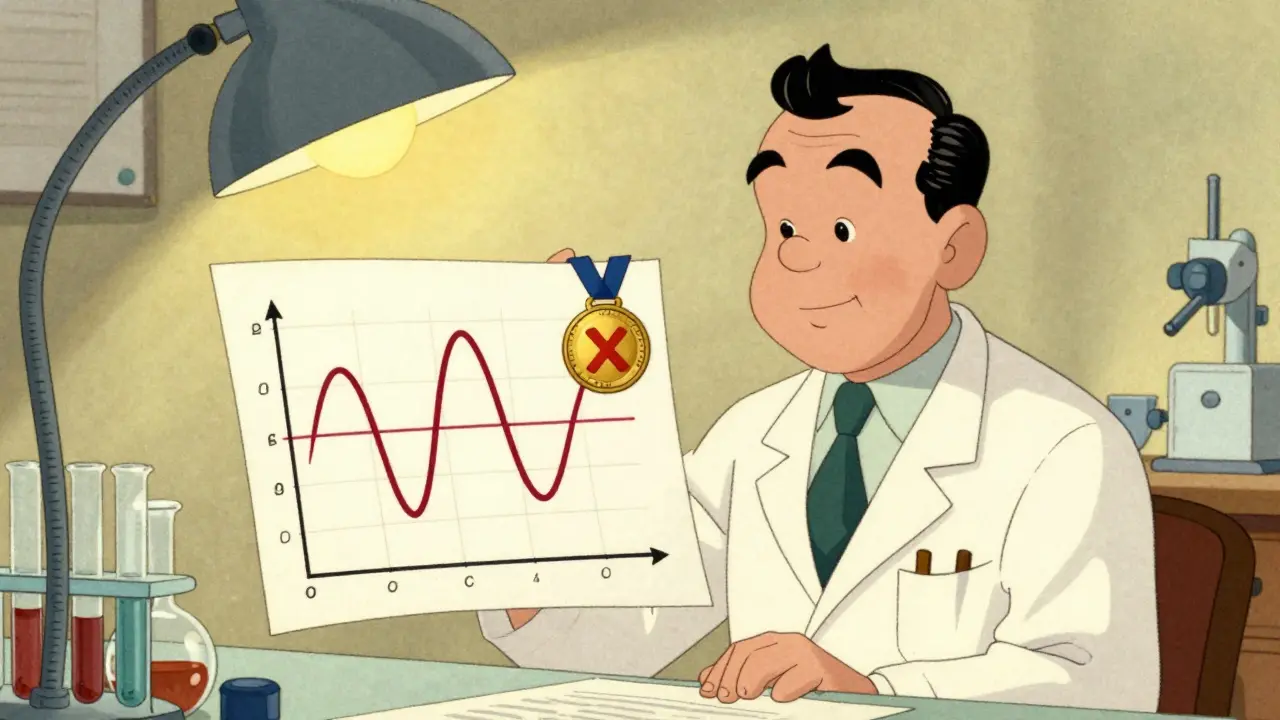
Many people hear pharmacokinetic studies and assume they're the ultimate proof that generic drugs work just like brand-name versions. But the U.S. Food and Drug Administration (FDA) explicitly states this isn't true. In their 2017 guidance document, the FDA wrote: "Bioequivalence is not a gold standard but rather a fundamental principle that generic drugs must be the same as the innovator in all significant respects; substitutability depends on similarity in all ways." This isn't just semantics-it's a critical clarification that affects how drugs are tested and approved worldwide.
What Pharmacokinetic Studies Actually Measure
Pharmacokinetic studies track how a drug moves through the body. They measure two key numbers: Area Under the Curve (AUC)The total drug exposure in the bloodstream over time, calculated from blood concentration measurements. and Maximum Plasma Concentration (Cmax)The highest concentration of drug reached in the blood after administration.. For a generic drug to be considered equivalent, these measurements must fall within 80% to 125% of the brand-name drug's values. This means the generic delivers the same amount of medicine at the same rate. These studies typically involve 24 to 36 healthy volunteers who take both the generic and brand-name versions in a crossover design. Half take the generic first, then the brand; the other half do the opposite. This helps control for individual differences in metabolism.

When Pharmacokinetic Studies Fall Short
While these tests work well for many drugs, they fail for others. Take topical creams or inhalers-skin or lung absorption doesn't translate well to blood measurements. For example, a 2024 study in Frontiers in Pharmacology found that comparing topical drugs via blood tests was often useless. Instead, they need specialized methods like dermatopharmacokinetic testing. Even for oral drugs, Narrow Therapeutic Index (NTI) drugs like warfarin or digoxin require tighter limits. The FDA now requires a 90% to 111% confidence interval for these drugs, not the usual 80% to 125%. A classic example is gentamicin, an antibiotic. In 2010, PLOS ONE documented cases where generic versions showed identical lab results but failed in real-world use. This proved pharmaceutical equivalence doesn't always equal therapeutic equivalence.
Regulatory Differences Around the World
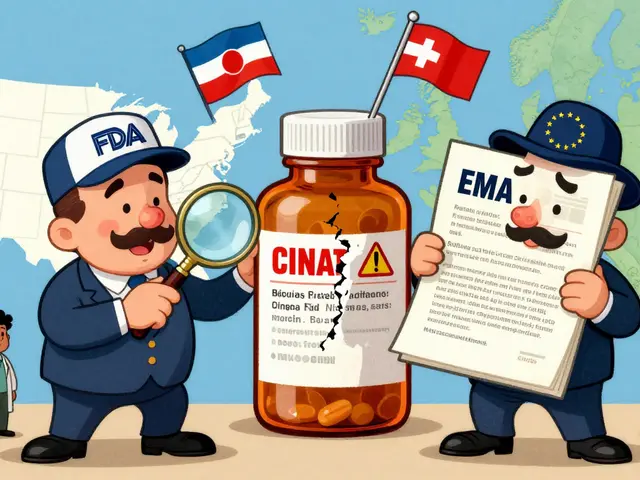
The European Medicines Agency (EMA) takes a more rigid approach than the FDA. While the FDA tailors guidelines to each drug, the EMA uses one-size-fits-all rules. This creates headaches for drugmakers trying to sell products globally. The World Health Organization (WHO) defines therapeutic equivalence as requiring "effects with respect to both efficacy and safety [to be] essentially the same" after administration. But how you prove this varies: for some drugs, clinical trials are needed; for others, in vitro tests suffice. The WHO's guidelines have been adopted by about 50 national regulators, but implementation differs widely. For example, some countries skip bioequivalence studies for certain drugs, relying solely on Dissolution Testing (measuring how quickly a drug releases in a lab setting).

New Approaches to Testing Complex Drugs
Scientists are moving beyond traditional blood tests. Physiologically-Based Pharmacokinetic (PBPK) Modeling uses computer simulations to predict drug behavior. The FDA now accepts PBPK models for certain drugs, like BCS Class I compounds. For topical products, Dermatopharmacokinetic (DPK) methods measure drug levels in skin layers directly. A 2019 study showed DPK could distinguish between formulations with over 90% accuracy-far better than clinical trials. Meanwhile, Dissolution Testing remains a key quality control tool. For immediate-release pills, dissolution profiles must match within 10% of the brand-name product. The Biopharmaceutics Classification System (BCS) helps predict whether a drug might qualify for waived bioequivalence studies based on solubility and permeability.
Practical Impact on Drug Development and Patients
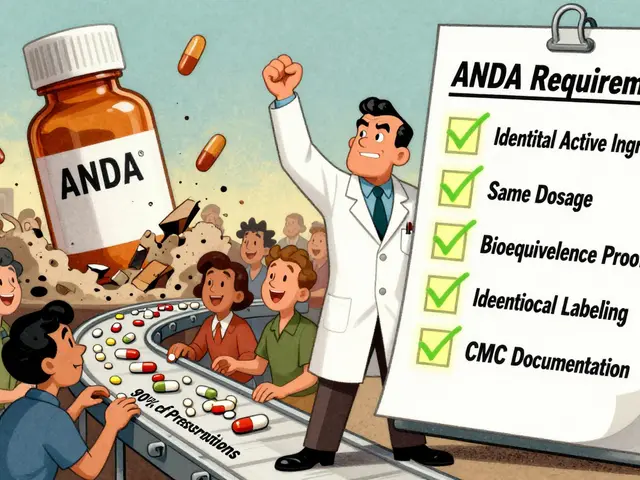
Testing a single generic drug can cost $300,000 to $1 million and take 12-18 months. This is why manufacturers often skip complex drugs-there's little profit. The FDA's Office of Generic Drugs lists 1,857 product-specific guidelines, showing how unique each drug's testing needs are. For example, a modified-release pill might need different tests than a simple tablet. This complexity affects patients too. When a drug has no generic alternative, prices stay high. But when generics are approved, prices drop by 80-90% on average. However, for NTI drugs like levothyroxine, switching between generics can sometimes cause issues. That's why pharmacists often stick with the same brand for these medications. In 2022, the FDA approved 95% of generic applications through pharmacokinetic studies, but the agency has issued specific guidance for 28 NTI drugs due to safety concerns.
Are generic drugs as safe as brand-name drugs?
Yes, when approved through proper testing. The FDA requires generics to meet strict standards for quality, strength, purity, and stability. However, for narrow therapeutic index drugs like warfarin or digoxin, even small differences can matter. This is why doctors often recommend sticking with the same generic manufacturer for these medications.
Why do some generic drugs have different effects than the brand name?
This usually happens with drugs that have a narrow therapeutic index (NTI), like blood thinners or seizure medications. Minor differences in how the drug is absorbed or metabolized can lead to treatment failures or side effects. The FDA now requires tighter bioequivalence limits for these drugs-90% to 111% instead of the standard 80% to 125%-to reduce this risk.
How do regulators handle complex drugs like inhalers or topical creams?
Traditional blood tests don't work well for these drugs because absorption happens locally. For inhalers, regulators use lung function tests or specialized inhalation devices. For topical creams, dermatopharmacokinetic (DPK) methods measure drug levels directly in the skin. The FDA has issued specific guidelines for over 149 complex products since 2018, acknowledging that one-size-fits-all testing isn't possible.
What's the difference between bioequivalence and therapeutic equivalence?
Bioequivalence means two drugs have similar absorption rates and levels in the blood. Therapeutic equivalence goes further-it means they produce the same clinical effect and safety profile in patients. While bioequivalence is usually sufficient for most drugs, therapeutic equivalence requires additional evidence for complex products like biologics or NTI drugs.
Why do some generic drugs cost so much less than brand names?
Generic manufacturers don't repeat expensive clinical trials for safety and efficacy. They only prove bioequivalence through smaller, cheaper studies. This saves billions: a single generic drug typically costs 80-90% less than the brand version. For example, the cholesterol drug Lipitor saved patients over $100 billion in the U.S. after generics entered the market.



8 Comments
The FDA's 2017 guidance clearly states bioequivalence isn't a gold standard but a fundamental principle. For drugs with narrow therapeutic index like warfarin, even small variations matter. That's why they require tighter limits of 90-111% instead of 80-125%. It's important for patients to know this when switching generics. Also, the part about topical creams and inhalers needing different testing methods makes sense-blood tests don't capture local absorption. Real-world effectiveness can differ even if lab results look good.
Nah, the FDA's 'guidance' is just bureaucratic nonsense. They say bioequivalence isn't a gold standard, but then they use it as the de facto standard for approval. It's all smoke and mirrors. Real-world data shows generics often fail for NTI drugs, but the FDA ignores that. They're more interested in saving money than patient safety.
Too much jargon-just give me the bottom line.
Wow, Andre, you really know your stuff. Except you forgot that the FDA has specific guidelines for NTI drugs now. Maybe you should check the 2022 data where 95% of generics were approved via PK studies. But sure, let's all panic about every single generic. Because that's totally reasonable.
Great points. Especially about the topical creams needing different testing methods. It's good to see the FDA adapting to complex drugs. Safety first, always.
so true! 🌟 the FDA's clarification is crucial. for drugs like warfarin, even tiny differences can cause big issues. i love how they use DPK for topical stuff now! 🤓 but sometimes the testing is still too basic. gotta push for more advanced methods like PBPK modeling. #pharma #science
Gregory, you're right about the FDA's guidelines, but the real issue is how they handle complex drugs. Take inhalers-blood tests don't cut it. They need inhaled delivery assessments. And for topical meds, dermatopharmacokinetic testin is way better. But the EMA's one-size-fits-all approach causes problems globally. It's all about context, man. We need more tailored testing protocols.
Jargon-heavy but spot on! 🌍 The WHO's guidelines are a good start, but implementation varies. In India, we use dissoluton testing for many drugs since it's cheeper and faster. But for NTI drugs, stricter tests are needed. It's all about balancing cost and safety. Great discussion!
Write a comment