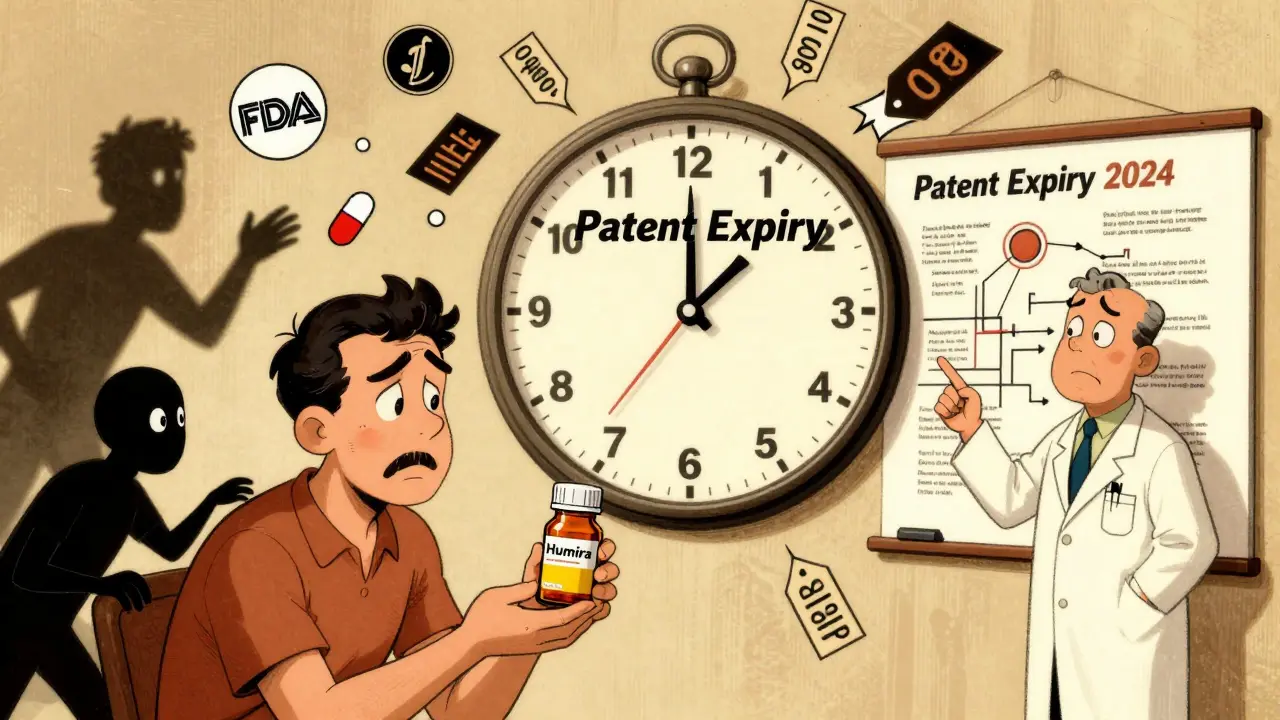
When a drug’s patent runs out, prices don’t just drop-they crash. For patients, that could mean paying 80% less for the same medicine. For hospitals and insurers, it’s a chance to save millions. But none of this happens automatically. If you’re on a long-term medication-or manage care for others-you need to start planning patent expiry at least two years before it happens. Waiting means confusion, disruptions, and higher costs.
Why Patent Expiry Isn’t Just a Business Problem
Most people think patent expiry is something that happens in boardrooms. But it hits real people. Take someone on Humira for rheumatoid arthritis. In 2023, Humira’s patent expired in the U.S., but because of complex patent thickets and legal delays, generic versions didn’t arrive until 2024. Even then, many patients were switched to a biosimilar without understanding the difference. Some reported new side effects. Others couldn’t get the same dosage form. That’s not rare. A 2022 Kaiser Family Foundation survey found 37% of patients on chronic meds had adverse reactions after switching to generics-even though they met FDA bioequivalence standards. The truth is, patent expiry isn’t just about cost. It’s about stability. When a brand-name drug loses exclusivity, multiple generic versions flood the market. Some are identical. Others have different inactive ingredients-fillers, dyes, coatings-that can affect how your body absorbs the drug. If you’re on a narrow-therapeutic-index drug like warfarin or levothyroxine, even small changes can be dangerous.What Happens When a Patent Expires?
The clock starts ticking when a drug is first filed for patent protection. That’s usually years before it hits shelves. By the time it’s approved by the FDA, only 7 to 10 years of market exclusivity remain. That’s why companies use tricks to stretch that time: new formulations, combo pills, micro-dosing, or even changing the delivery method (like switching from a pill to an injection). These are called “evergreening” tactics. Nearly 80% of the top 100 selling drugs have over a dozen secondary patents, according to Evernorth’s 2023 analysis. When the main patent finally falls, generic manufacturers can step in. But they don’t always rush. For small-molecule drugs-like statins or blood pressure pills-generics typically appear within months. Prices drop 70-90% in the first year. But for complex drugs like biologics (used in cancer, autoimmune diseases), it’s different. Biosimilars take years to develop. They’re not exact copies. They’re similar, but harder to make. Only 38% of biologic prescriptions switch to biosimilars within two years, even after patent expiry. And here’s the catch: even when generics arrive, the price you pay doesn’t always drop. In the U.S., rebates, pharmacy benefit manager deals, and formulary restrictions mean you might still be stuck paying high prices-even if the drug now costs $5 a pill wholesale.What Patients Should Do
If you’re taking a medication that’s due to lose patent protection, here’s what to do now:- Find out when your drug’s patent expires. Use the FDA’s Orange Book or ask your pharmacist. Many drugs have public expiry dates listed on sites like GoodRx or Drugs.com.
- Ask if a generic or biosimilar is available. Don’t assume your doctor or pharmacy will bring it up. Bring it up yourself. Say: “Is there a lower-cost version coming soon?”
- Know your options if you’re switched. If your insurer switches you to a generic, ask: “Is this the same as my current drug?” and “Can I stay on the brand if I need to?” Some generics have different dosing or delivery systems.
- Monitor for side effects. If you feel different after switching-more fatigue, nausea, or mood changes-tell your doctor immediately. It’s not “all in your head.” Bioequivalence doesn’t mean identical experience.
- Check your out-of-pocket costs. Sometimes, the generic is cheaper, but your copay stays the same because of how your plan tiers drugs. Ask your insurer for the net cost after rebates.
What Healthcare Systems Must Do
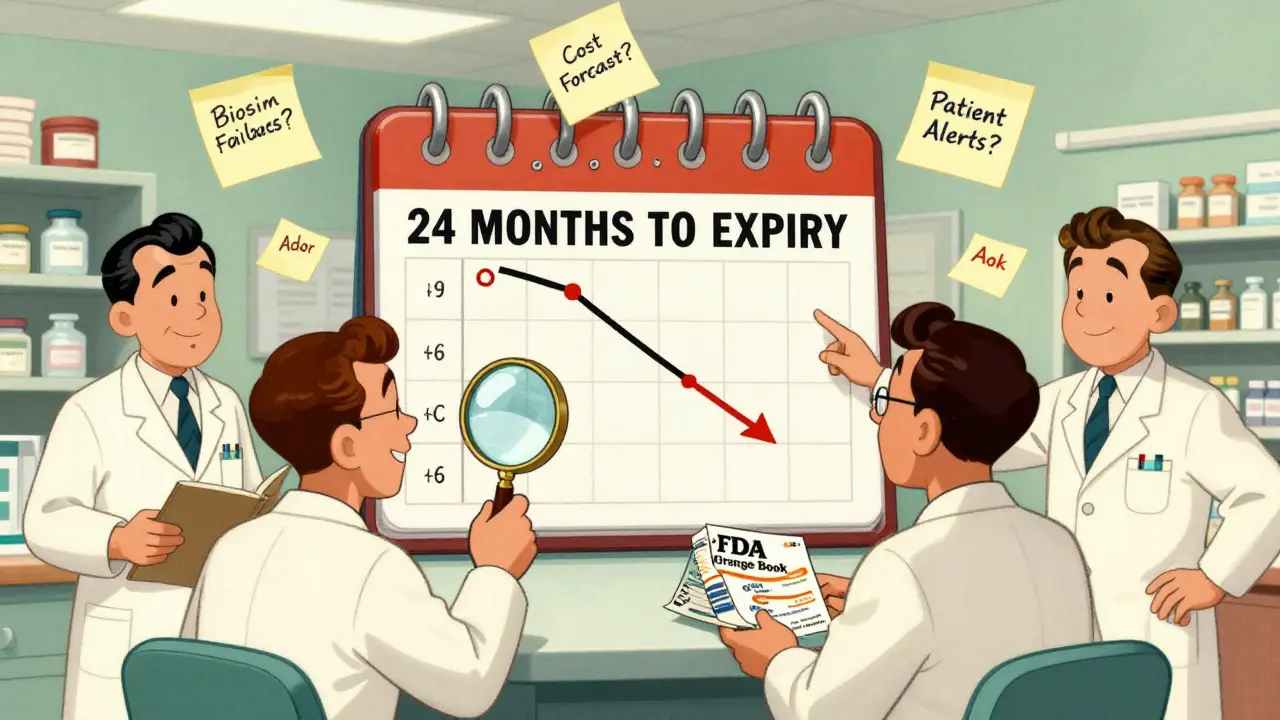
Hospitals, insurers, and clinics can’t wait until the last minute. The most successful ones start planning 24 months ahead. Here’s how:- Build a patent expiry task force. Include pharmacists, clinicians, finance staff, and contract managers. Track every drug with an upcoming expiry-there are over 1,400 in the U.S. each year.
- Forecast the impact. Not all drugs are equal. Cardiovascular drugs see 90% generic adoption. Immune drugs? Less than 50%. Prioritize high-cost, high-volume medications first.
- Negotiate with suppliers early. Generic manufacturers often offer deep discounts before launch. Lock in those prices before the market floods.
- Update clinical guidelines. Don’t let doctors guess what to prescribe. Create clear protocols for switching patients. Include when to avoid substitution (e.g., epilepsy, transplant meds).
- Train staff and educate patients. Create simple handouts. Host Q&A sessions. Use your patient portal to send alerts. People need to understand why the change is happening-and that it’s safe.
The Big Gap: Biosimilars Are Slowing Down Savings
The biggest missed opportunity? Biosimilars. Drugs like Enbrel, Remicade, and Rituxan are losing patents now. These are biologics-expensive, complex, injectable drugs used for cancer, Crohn’s, and psoriasis. They cost $20,000-$50,000 a year. Biosimilars should cut that by 50%. But they haven’t. Why? Because manufacturers use tactics to block them: exclusive contracts with pharmacies, rebates that make biosimilars look more expensive, and even paying insurers to keep the brand on top. Only 27% of biologic prescriptions have switched to biosimilars in the U.S.-compared to over 90% for simple generics. Europe does better. Countries with reference pricing (where all similar drugs are grouped and priced together) see 85% biosimilar use within a year. The U.S. doesn’t have that system. So change has to come from within hospitals and insurers pushing for biosimilar adoption.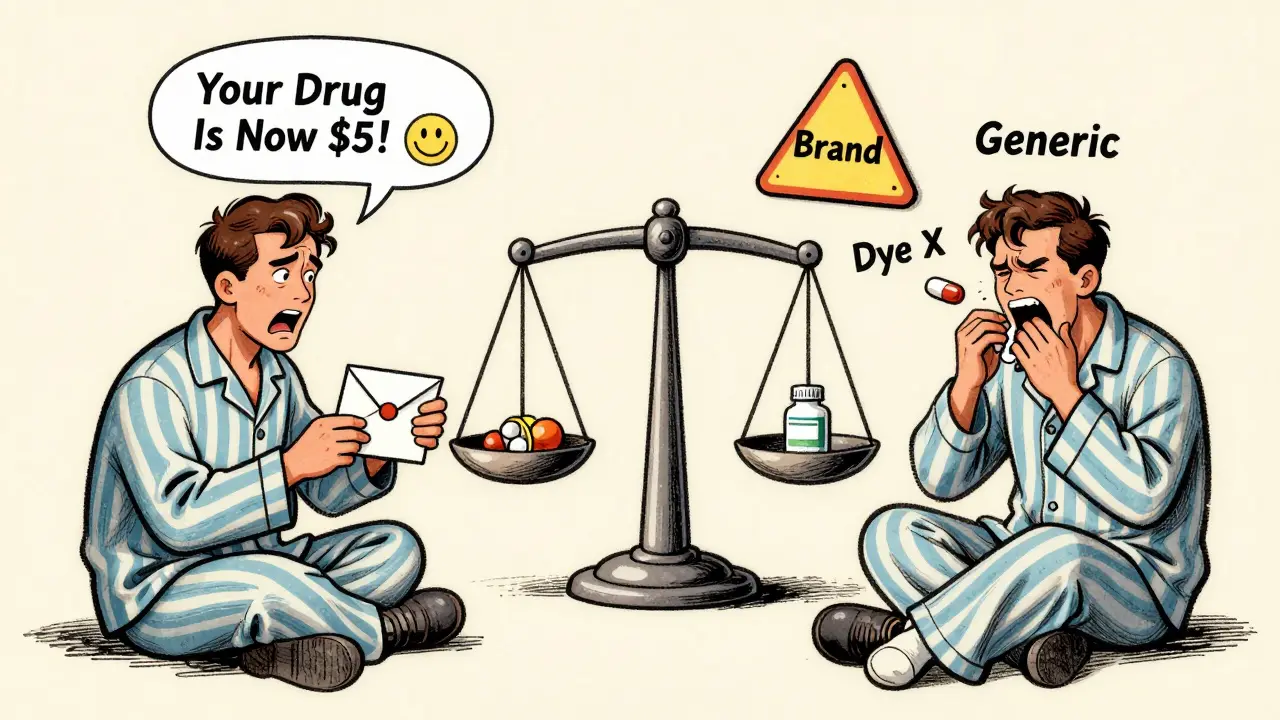
What’s Changing in 2026 and Beyond
The Inflation Reduction Act of 2022 gave Medicare the power to negotiate drug prices-but only for drugs that have been on the market for at least 9 years. That means the first round of negotiated prices kicks in for drugs losing patent protection in 2026. That’s happening right now. Also, the FDA’s new GDUFA III rules are speeding up approvals for complex generics. Some drugs that used to take 18 months to get generics after patent expiry will now get them in 12. And the CREATES Act is cracking down on “product hopping”-where companies tweak a drug just to reset the patent clock. AI tools are helping too. Health systems using AI to predict patent expirations are now forecasting with 89% accuracy-up from 65%. That means fewer surprises.Don’t Wait for the Crash
Patent expiry isn’t a future problem. It’s happening now. In 2025-2029, over $90 billion in U.S. drug sales will lose patent protection. That’s enough to cover free prescriptions for millions. But only if we plan. Patients: Don’t assume your drug will stay the same. Ask questions. Track your meds. Know your rights. Systems: Start planning now. Build teams. Track expirations. Educate. Negotiate. The savings aren’t theoretical-they’re real. One health system saved $4.7 million per drug by starting 24 months early. Those who waited saved less-and lost patients to confusion. The patent cliff isn’t coming. It’s here. The question isn’t whether you’ll be affected. It’s whether you’re ready.What does patent expiry mean for my prescription drug?
When a drug’s patent expires, other companies can legally make and sell generic or biosimilar versions. These are usually much cheaper-often 80% less than the brand-name version. But you might be switched automatically, and not all generics are identical. Some have different fillers or delivery methods that can affect how you feel.
Can I stay on my brand-name drug after the patent expires?
Yes, but it may cost more. Insurance plans often shift coverage to generics after patent expiry. If you want to keep the brand, you might have to pay the full price out-of-pocket or get a prior authorization from your doctor. Talk to your pharmacist or insurer before the switch happens.
Why do some generics make me feel worse than the brand?
Generics must be bioequivalent-meaning they deliver the same amount of active ingredient. But they can have different inactive ingredients like dyes, preservatives, or coatings. For some people, especially those with sensitivities or chronic conditions, those differences can cause side effects. If you notice changes after switching, report them to your doctor.
What’s the difference between a generic and a biosimilar?
Generics are exact copies of small-molecule drugs, like pills for blood pressure or cholesterol. Biosimilars are similar-but not identical-to complex biologic drugs, like injectables for arthritis or cancer. They’re harder to make, take longer to approve, and cost more than generics. They’re not interchangeable unless specifically approved by the FDA.
How far in advance should I plan for patent expiry?
Patients should start asking questions 6-12 months before the patent expires. Healthcare systems need to begin planning 24 months ahead. That’s when they can lock in pricing, update guidelines, train staff, and prepare patient materials. Waiting until the last minute leads to disruptions and higher costs.
Are there tools to track when my drug’s patent expires?
Yes. The FDA’s Orange Book lists patent expiry dates for approved drugs. Websites like GoodRx, Drugs.com, and Lexicomp also track this. Health systems use specialized software like Symphony Health’s PatentSight to monitor hundreds of expirations at once.
Why don’t all countries have the same drug prices after patent expiry?
Countries like Germany and the UK use reference pricing, where all similar drugs are grouped and priced together. That forces generics and biosimilars to compete on price. The U.S. doesn’t have that system. Instead, rebates and pharmacy benefit managers control pricing, which often keeps prices higher longer-even after generics arrive.
Will the Inflation Reduction Act lower my drug prices after patent expiry?
Starting in 2026, Medicare will begin negotiating prices for a small number of high-cost drugs that have been on the market for at least 9 years. These are mostly drugs losing patent protection around that time. It won’t affect all drugs, but it will lower prices for some of the most expensive ones, especially biologics.

11 Comments
Okay but real talk-how many of us have been switched to a generic and then spent weeks wondering why we feel like a zombie? I was on levothyroxine for years, brand name only. Then one day, poof-generic. Suddenly I couldn’t sleep, my heart was racing, and I felt like I was drowning in slow motion. My doctor shrugged and said, 'It’s bioequivalent.' Bro, my body doesn’t care about FDA charts. I had to fight for three months to get back on the original. Now I pay more, but I’m alive. Don’t let them gaslight you into thinking it’s all in your head.
And don’t even get me started on the dye in some generics. I’m allergic to red #40. Found out the hard way when my face swelled up after a switch. Pharmacist didn’t even check the ingredients. Just handed me the pill like it was candy.
Let me just say this: if you think patent expiry is just about cost, you’re living in a 2008 bubble. The real issue is systemic inertia. Hospitals don’t plan because they’re run by accountants who think ‘efficiency’ means cutting staff, not investing in pharmacists who can actually explain biosimilars to patients. And don’t even mention the PBMs-they’re the reason you’re still paying $120 for a $5 pill. They don’t pass on savings; they pocket them. The system is rigged to keep you dependent, confused, and paying more.
Meanwhile, Europe? They’ve got reference pricing. One price for all similar drugs. Boom. Competition. Patients win. In the U.S.? We’ve got a labyrinth of rebates, formularies, and ‘preferred networks’ that make no sense unless you’re a corporate lawyer with a PhD in pharmacy law. We’re not failing because we’re stupid-we’re failing because we’ve designed a system that profits from chaos.
And yes, I’ve seen the AI tools that predict expirations with 89% accuracy. So why aren’t we using them everywhere? Because the people who control the data are the same people who profit when you don’t know what’s coming next. It’s not incompetence. It’s incentive alignment. And until we break that, we’re all just waiting for the next crash.
Also, biosimilars aren’t ‘harder to make’-they’re harder to market because Big Pharma pays pharmacies to bury them. Same old song, different key. We need transparency. Not more ‘education.’ We need to burn the system down and rebuild it with patients at the center. Not as afterthoughts. Not as line items. As people.
Interesting post. But let’s be honest-the real problem isn’t patent expiry. It’s the lack of price regulation. In India, generics hit the market within weeks of expiry and cost 95% less. No drama. No switching trauma. Just pills. Why? Because we don’t have PBMs. We don’t have ‘formulary tiers.’ We don’t have companies paying doctors to keep patients on expensive brands. We have a public health system that says: ‘If it works, it should be cheap.’
Meanwhile, the U.S. spends 18% of GDP on healthcare and still can’t get people to understand that ‘bioequivalent’ doesn’t mean ‘identical experience.’
Also, the FDA’s GDUFA III? Cute. But if you’re still waiting 12 months for a generic after patent expiry, you’re not fast-you’re just less slow. And don’t get me started on the CREATES Act. It’s a Band-Aid on a hemorrhage.
TL;DR: The U.S. healthcare system is a capitalist carnival. Patent expiry is just the next ride. And you’re still paying for the ticket.
😄
From a clinical pharmacy standpoint: if you’re managing a high-risk population-transplant, epilepsy, cardiac-patent expiry isn’t just a logistics issue, it’s a risk mitigation imperative. We’ve seen multiple cases where switching to a generic with different fillers caused subtherapeutic levels in transplant patients. Not because the generic was ‘bad.’ Because the pharmacokinetics shifted just enough to trigger rejection.
That’s why our institution has a ‘Switch Protocol’ for narrow-therapeutic-index drugs. It’s not about cost. It’s about continuity of care. We require a 30-day washout period, therapeutic drug monitoring, and mandatory patient education before any substitution. And we track outcomes-adverse events, ER visits, adherence rates. The data is clear: unplanned switches = higher costs and worse outcomes.
Also, biosimilars? We’re starting to see real traction with rituximab biosimilars. But only because we negotiated a 60% discount upfront and tied it to clinical outcomes. If the patient’s disease activity doesn’t improve? We don’t pay the full price. That’s how you align incentives. Not ‘awareness campaigns.’ Not ‘patient handouts.’ Real contracts with teeth.
Stop treating this like a marketing problem. It’s a clinical governance problem.
Bro, I’m from India and we get generics for $2 a month. Like, literally. My uncle takes warfarin, and he pays $1.50. Here in the US, my cousin pays $120 for the same thing. What is this? 🤡
Also, why do we act like this is new? This has been happening since the 90s. We just stopped paying attention until it hit our wallets.
Just saying. 🙏
Okay but have you ever tried to get your insurance to approve a brand-name drug after the generic came out? I had to submit five forms, get a letter from my rheumatologist, and wait six weeks. Meanwhile, I was in so much pain I couldn’t hold my kid. They said ‘the generic is equivalent.’ Equivalent to what? My suffering? My sleepless nights? My anxiety?
And now they’re trying to switch me to a biosimilar. I don’t even know what that is. I just know I’m scared. And no one explains it. They just hand you a pill and say ‘you’re fine.’
People like me aren’t lazy. We’re exhausted. And no one cares.
It is imperative to underscore that the notion that patent expiry equates to automatic cost savings is not only misleading-it is dangerously fallacious. The structural architecture of the U.S. pharmaceutical supply chain-characterized by opaque rebate systems, anti-competitive formulary placement, and the monopolistic behavior of pharmacy benefit managers-ensures that the theoretical benefits of generic competition are systematically siphoned away from the patient. Furthermore, the FDA’s bioequivalence standard, while statistically rigorous, is clinically insufficient. Bioequivalence does not imply pharmacodynamic equivalence, nor does it account for inter-individual variability in metabolism, absorption, or immune response. To conflate these concepts is not merely negligent-it is ethically indefensible.
Moreover, the assertion that patients should ‘ask questions’ is a cruel illusion. The average patient lacks the linguistic, cognitive, and temporal resources to navigate this labyrinth. To place the burden of systemic failure on the individual is the height of institutional malfeasance.
Therefore, legislative intervention is not merely advisable-it is non-negotiable. Reference pricing, mandatory transparency of rebates, and the prohibition of pay-for-delay agreements must be enacted immediately. Otherwise, we are not merely failing patients-we are complicit in their suffering.
It is absolutely critical-no, it is an ethical imperative-that we recognize the profound inadequacy of the current model of patient education in the context of patent expiry. The notion that patients can be expected to ‘ask their pharmacist’ or ‘check Drugs.com’ is not merely unrealistic-it is a form of structural violence. The average patient, particularly those with chronic illness, cognitive load, or limited health literacy, is not equipped to perform the due diligence required to navigate this complex, deliberately obfuscated system.
Furthermore, the suggestion that ‘monitoring for side effects’ is sufficient as a safeguard is grotesquely inadequate. Side effects are often subtle, delayed, and easily dismissed by clinicians who are overburdened, underpaid, and incentivized to minimize patient contact. The burden of proof is placed entirely on the patient-who is already exhausted, financially strained, and emotionally vulnerable.
What we require is not ‘education’-but systemic redesign. Mandatory pre-switch counseling by a licensed pharmacist. Automatic hold periods for high-risk medications. Transparent, real-time cost comparisons accessible at the point of prescription. And above all-removal of the PBM’s ability to dictate drug access based on rebate structures.
Until then, we are not helping patients. We are merely performing a ritual of false empowerment.
Hey everyone-I’ve been on Humira since 2018. When the biosimilar came out, I was terrified. I thought, ‘This is it. I’m going to flare up.’ But my doctor sat down with me, showed me the data, explained the differences, and let me try it. I didn’t switch right away-I got a sample. Took it for a month. No issues. Now I’m on it, saving $1,200 a month.
But here’s the thing: none of that would’ve happened if my clinic hadn’t had a whole team-pharmacists, nurses, social workers-ready to walk me through it. We had a meeting. They gave me a printed guide. They called me after two weeks. That’s what care looks like.
It’s not about the drug. It’s about the support. If your system doesn’t have people who care enough to hold your hand through this, then no amount of ‘planning’ matters. We need more of that. Not more forms. Not more websites. More humans.
You’re not alone in this. I was scared too. But I made it. And you can too.
My mom is on a biologic for lupus. She cried when they told her they were switching her. She said, ‘I don’t want to risk it.’ She’s 72. She’s been stable for 12 years. Why are we treating her like a lab rat?
I told her, ‘We’ll fight this.’ And we did. We got a letter from her doctor. We called the insurer. We asked for the brand. They said no. So we paid out-of-pocket for three months until the biosimilar was approved under a special exception.
It shouldn’t take this much work to stay healthy.
Thank you for writing this. I’m sharing it with everyone I know.
And here’s the kicker: the FDA’s own data shows that 37% of patients report adverse reactions after switching-even when the generic meets bioequivalence standards. But the FDA doesn’t track long-term outcomes. They don’t care if you feel ‘different.’ They only care if the blood levels are within 80–125%.
That’s not medicine. That’s statistics with a white coat.
Meanwhile, the same companies that make the brand also make the biosimilar. They’re not ‘competing.’ They’re just charging you more for the same thing, just with a different name.
And they wonder why people don’t trust the system?
It’s not conspiracy. It’s capitalism. And we’re the ones paying the price.
Write a comment