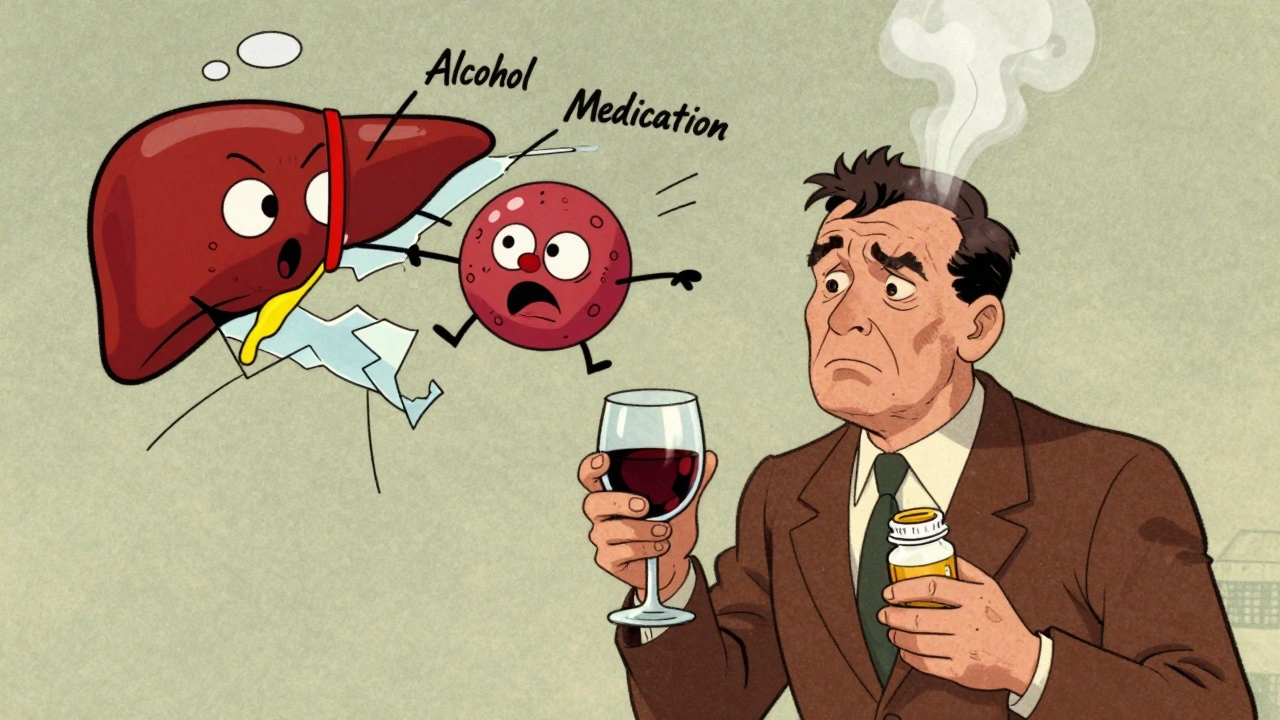
More than 40% of adults taking prescription or over-the-counter medications are at risk of dangerous reactions when they drink alcohol. This isn’t just about feeling sleepy or dizzy-it’s about life-threatening complications like liver failure, breathing problems, and sudden heart issues. If you’re on any kind of medication, whether it’s for anxiety, pain, infection, or high blood pressure, alcohol can turn a safe treatment into a hidden danger.
How Alcohol Changes How Your Medications Work
Your liver doesn’t treat alcohol and medicine like separate tasks. It tries to process them at the same time using the same tools-enzymes called cytochrome P450. When alcohol is in your system, it either slows down or speeds up how quickly your body breaks down your medication. That means your drug could become too strong or not strong enough.
Acute drinking-even just one drink-can block the enzymes that clear your medicine. This causes the drug to build up in your blood. For example, if you take diazepam (Valium) and have a glass of wine, the drug’s effects can last hours longer than normal. That’s why some people wake up groggy, confused, or even fall asleep while driving.
On the flip side, if you drink regularly over weeks or months, your liver starts making more of these enzymes. Now your body clears the medication too fast. Your blood pressure pill might stop working. Your antidepressant might lose its effect. You could end up increasing your dose without realizing why-just to feel the same results.
Medications That Turn Dangerous with Alcohol
Not all medications react the same way. Some are fine in small amounts. Others? Even one drink can land you in the ER.
- Antibiotics like metronidazole (Flagyl): This one is immediate. Mixing it with alcohol causes a toxic buildup of acetaldehyde. Symptoms include flushing, vomiting, rapid heartbeat, and chest pain. In 92% of cases, even one drink triggers this reaction.
- Benzodiazepines (Xanax, Valium, Ativan): These calm your brain. Alcohol does the same thing. Together, they can slow your breathing to dangerous levels. The CDC says this combo causes 32% of all alcohol-medication deaths.
- Opioids (morphine, oxycodone, hydrocodone): Alcohol doubles the risk of respiratory failure. The CDC found the chance of fatal breathing problems goes up 8 times when these are mixed.
- Antidepressants (SSRIs like Prozac, Zoloft): You might think it’s okay to have a beer to relax. But alcohol makes the side effects worse-dizziness, drowsiness, and impaired judgment. It also makes depression harder to treat.
- Antihistamines (Benadryl, Zyrtec): These already make you sleepy. Add alcohol, and you could fall asleep while standing or driving. Studies show sedation triples.
- Acetaminophen (Tylenol): Even a few drinks a day with regular Tylenol use can cause serious liver damage. One 2023 study found 18% of people who mixed them had elevated liver enzymes-even without heavy drinking.
- NSAIDs (ibuprofen, naproxen): These hurt your stomach lining. Alcohol does too. Together, they raise your risk of internal bleeding by 300-500%.
- Warfarin (Coumadin): Alcohol makes your blood thinner or thicker unpredictably. One drink can send your INR levels skyrocketing, increasing bleeding risk.
What “Moderate Drinking” Really Means (And Why It’s Not Safe)
Most people think if they only have one or two drinks, it’s fine. But that’s not how it works with medication.
The government defines moderate drinking as one drink per day for women, two for men. But that’s for healthy people without meds. For someone on a high-risk drug, even one drink can be too much.
A standard drink is:
- 12 oz of beer (5% alcohol)
- 5 oz of wine (12% alcohol)
- 1.5 oz of spirits (40% alcohol)
But here’s the catch: your body doesn’t measure alcohol by the glass. It measures it by how much hits your bloodstream. A glass of wine at dinner? That’s 12 grams of pure alcohol. For someone on metronidazole, that’s enough to cause vomiting, heart palpitations, and emergency care.
Who’s at Highest Risk?
It’s not just older adults-though they’re more vulnerable. As we age, our liver processes alcohol slower. Blood flow to the liver drops by about 35% between ages 25 and 75. That means even small amounts stick around longer.
But the biggest risk group? People between 40 and 59. They’re the most likely to be on multiple prescriptions and still drink socially. A 2021 study found 7.2% of adults in this group were mixing alcohol with high-risk meds.
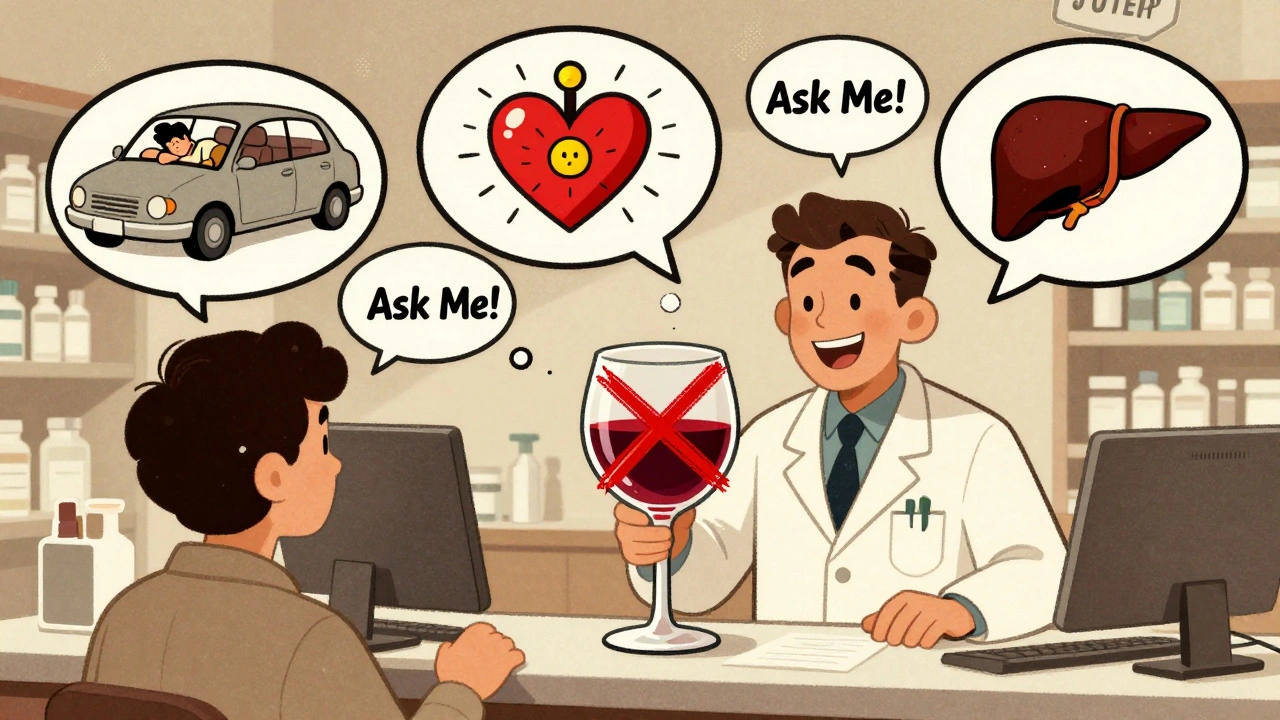
And here’s something most don’t realize: your pharmacist might know more than your doctor. A 2022 Walgreens survey showed 89% of patients changed their drinking habits after a pharmacist warned them. Yet, only 42% of prescription bottles have any alcohol warning on them.
What You Should Do (And What You Shouldn’t)
Here’s what works:
- Ask your pharmacist every time you pick up a new prescription. Don’t assume they’ll tell you. Ask: “Can I drink alcohol with this?”
- Read the medication guide. If it’s not included, ask for one. Only 48% of patients understand what’s in these guides-but if you read them carefully, you’ll catch red flags.
- Use a visual tool. The Injury Matters Foundation’s color-coded chart (red = avoid, yellow = caution, green = safe) improved patient understanding from 48% to 82%.
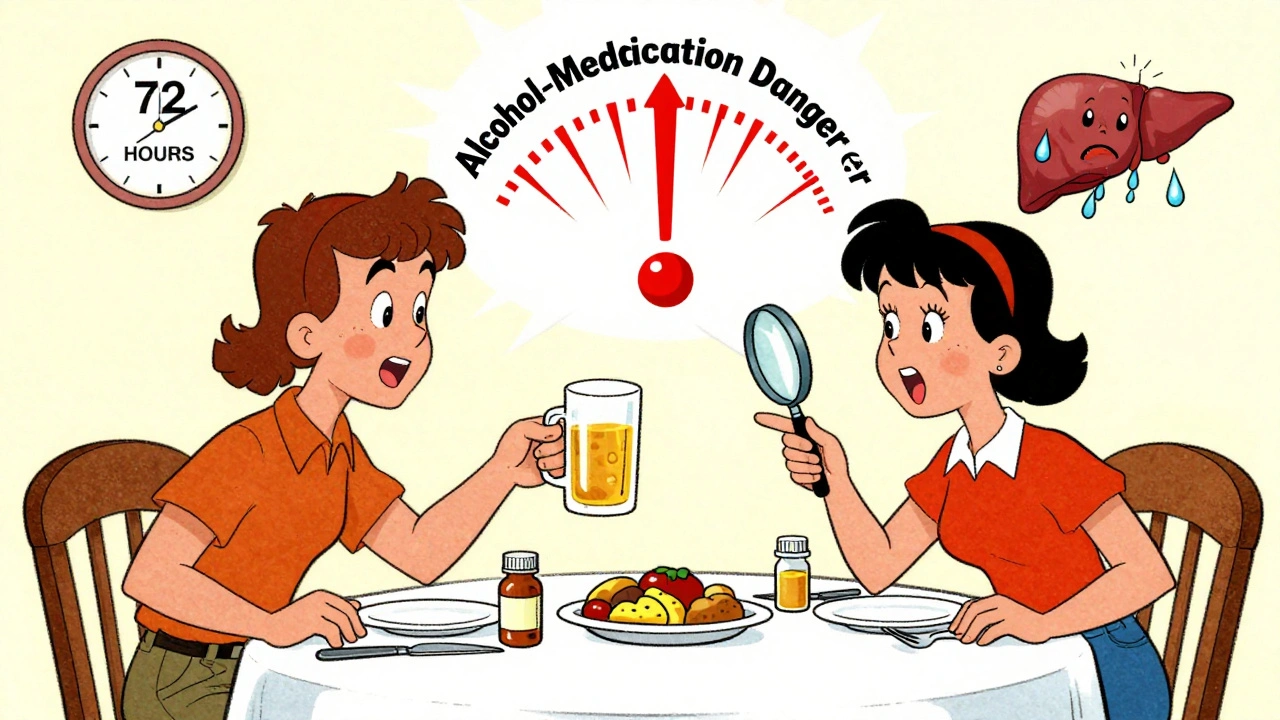
- Wait 72 hours before drinking if you’re starting metronidazole, tinidazole, or disulfiram. That cuts reaction risk from 92% to just 8%.
- If you do drink, wait at least 2-3 hours after taking your medication. Eat food first. It slows alcohol absorption.
- Limit to one drink-and only if your doctor says it’s okay.
What doesn’t work:
- “I only have one drink on weekends.” - Doesn’t matter. One drink is enough for some meds.
- “I’ve done it before and nothing happened.” - You got lucky. Risk builds over time.
- “My doctor didn’t say anything.” - Most don’t bring it up. 68% of patients say they were never warned.
New Rules Are Coming
In January 2024, the FDA started requiring clearer warning labels on high-risk medications. That means you’ll start seeing pictograms-like a glass of wine with a red slash-on your prescription bottles.
Telehealth platforms now ask patients about alcohol use during virtual visits. Medicare Part D plans must flag risky combinations in their systems by December 2024. And Stanford Medicine’s AI system, which scans electronic health records for dangerous combos, cut these interactions by 37% in just six months.
But technology won’t fix this alone. Only 39% of medical schools teach students about alcohol-medication interactions. That means many doctors still don’t know the full risks.
Real Stories, Real Consequences
One Reddit user wrote: “Took one beer with my metronidazole and ended up in the ER with vomiting and a heart rate of 180.”
Another said: “My pharmacist warned me about hydroxyzine and wine. Saved me from passing out at my sister’s wedding.”
These aren’t rare cases. Drugs.com has over 78,000 user reports of bad reactions. The most common? Extreme drowsiness, nausea, and loss of coordination.
And it’s not just about the ER. Many people just feel “off” for days-headaches, fatigue, mood swings-and never connect it to their last drink.
Bottom Line: Don’t Guess. Ask.
If you take any kind of medication, alcohol isn’t just a social choice-it’s a medical decision. There’s no universal rule. What’s safe for one person could be deadly for another.
Don’t rely on internet forums, old habits, or assumptions. Talk to your pharmacist. Read the label. Use a trusted tool like the NIAAA’s Alcohol-Medication Interaction Risk Calculator (AMIRC). And if you’re unsure-skip it.
Your body doesn’t handle alcohol and medicine the way you think it does. When in doubt, leave the drink behind. Your health isn’t worth the risk.
Can I have one glass of wine with my antidepressant?
It depends on the specific drug. Some SSRIs like sertraline may allow one drink occasionally, but others like fluoxetine can make you feel more intoxicated and increase side effects like dizziness and nausea. Even if you’ve had wine before without issues, your body’s response can change. Always check with your doctor or pharmacist before drinking.
Does alcohol make painkillers less effective?
It can. Chronic alcohol use speeds up liver enzymes, causing medications like opioids or NSAIDs to clear from your system faster. This means you might need higher doses to feel relief-but that increases your risk of overdose or stomach bleeding. If you drink regularly and your pain meds aren’t working, alcohol could be why.
Is it safe to drink the night before taking medicine?
No. Alcohol stays in your system longer than you think. Even if you feel sober, your liver is still processing it. For high-risk drugs like metronidazole, you need at least 72 hours without alcohol before starting. For others, like benzodiazepines, waiting 24 hours isn’t enough-alcohol’s effects can linger and combine unpredictably.
What should I do if I accidentally mixed alcohol with my medication?
If you feel dizzy, nauseous, have a rapid heartbeat, trouble breathing, or extreme drowsiness, seek medical help immediately. Call poison control or go to the ER. Don’t wait. Some reactions happen within minutes. Keep your medication bottle and alcohol container handy for medical staff.
Why don’t doctors always warn patients about alcohol interactions?
Many doctors don’t bring it up because they assume patients won’t drink, or they’re unaware of the full risks. Only 42% of prescription labels include alcohol warnings. A 2022 survey found 68% of patients were never told about these dangers. It’s not negligence-it’s a system gap. That’s why you need to ask.

13 Comments
It's wild how we treat alcohol like it's just a social thing when it's basically a drug that hijacks your liver's to-do list. I used to think 'one glass' was harmless until my mom ended up in the hospital after mixing her blood pressure med with wine. She didn't even know it was dangerous. We need to stop normalizing this. It's not about being judgmental-it's about survival.
And why do pharmacies still not print warnings on bottles? It's 2024. If your pill can kill you with a sip, the label should scream it, not whisper it.
Also, the part about pharmacists being the real MVPs? 100%. My pharmacist caught my interaction before my doctor even knew I was on that med. We need to shift the culture. Ask your pharmacist. Always.
And yes, even if you 'always drink and never had an issue'-that's like saying you've never gotten into a car crash because you've driven 20 years. You're just lucky. Luck isn't a medical plan.
My grandma died from liver failure after 10 years of Tylenol and a daily glass of sherry. No one told her. No one told anyone. That's systemic failure, not personal choice.
Let's stop pretending moderation is safe when the science says otherwise. It's not about willpower. It's about biology. And biology doesn't care how 'responsible' you think you are.
OH MY GOD I JUST REALIZED I DID THIS LAST WEEK. I took my Zoloft and had a glass of wine after dinner. Felt like I was underwater. Thought I was just tired. Now I’m panicking. I’m going to call my pharmacist tomorrow. This article just saved me from a nightmare.
Why does no one talk about this?! I’ve been on SSRIs for 5 years and never once was I warned. My doctor just smiled and said ‘you know yourself best.’ WELL NO I DON’T. I NEED A MANUAL.
Also-why is it that the only time we get real info is from Reddit or a pharmacist? Why isn’t this on the TV? On the news? On every prescription box? This is public health 101. Someone’s dying because of silence. I’m angry. I’m scared. I’m sharing this everywhere.
OMG I’M SO GLAD I READ THIS BEFORE MY WEDDING 😭 I was gonna have a glass of champagne to chill but then I remembered my hydroxyzine. THANK YOU TO THE PERSON WHO WROTE THIS. I’m not drinking. I’m not even close. I’d rather be sober and not pass out in front of my bridesmaids than risk a blackout. 🙌
Also-metronidazole?? I had that once and drank one beer and felt like I was being stabbed in the chest. I thought I was having a heart attack. Turned out it was just alcohol + Flagyl. I didn’t even know that was a thing. 🤯
PS: Why are we still letting Big Pharma get away with silent labels? This is criminal. #AlcoholIsNotASocialDrinkWhenYoureOnMeds
People think they're being responsible by having 'just one' but that's the exact mindset that gets you in the ER. I'm a nurse and I've seen this too many times. A guy on warfarin had a beer after his knee surgery. INR spiked to 8. He bled internally. Survived. But now he's on lifelong anticoagulants because he thought 'it was fine last time.'
And yes, pharmacists are your best friend. They see your full script. They know every interaction. Don't be shy. Ask. Even if they don't volunteer it. Say 'Can I drink alcohol with this?' and mean it.
Also-Tylenol and wine? I had a patient who drank two glasses a night and took 1000mg Tylenol four times a day for back pain. Liver enzymes tripled. No symptoms. No warning. Just silent damage. That's the scariest part.
Don't wait for a crisis. Read the label. Ask. Wait 72 hours if it's metronidazole. Simple. But no one does it.
And if you're one of those people who says 'I've never had a problem'-you're just not dead yet.
Don’t drink. Ask your pharmacist. Wait 72 hours if needed. That’s it.
Stop overthinking it. Your liver doesn’t care how ‘responsible’ you are.
Bro, in India we don't think much about this. My uncle took painkillers and drank whiskey every night for years. He got sick last year. Doctors said liver damage. He said 'I always did this.' Now he is on medicine for life. This article is true. Even one drink can hurt. Ask your doctor. Read the small print. Your body is not a lab experiment. Be smart.
How quaint. A populist alarmist tract masquerading as medical advice. The very notion that alcohol and medication interact is not novel-it is biochemistry 101. What is novel is the moral panic surrounding a substance that has been consumed with pharmaceuticals since the dawn of pharmacopeia.
The CDC statistics cited are cherry-picked. The 92% metronidazole reaction rate? That’s in controlled trials, not real-world consumption. And yet, we are to believe that one glass of wine with sertraline is equivalent to Russian roulette?
The real issue is the infantilization of the patient. We are not children who must be shielded from the complexities of our own physiology. We are adults who, if we choose to consume alcohol with our medications, ought to be trusted to weigh the risks ourselves-without being lectured by pharmacists and Reddit algorithm curators.
And while we’re at it, why is the FDA suddenly so concerned? Because they need to justify regulatory expansion. This isn’t about safety. It’s about control.
Don’t be a sheep. Think for yourself. Or don’t. But don’t pretend your fear is wisdom.
It is deeply concerning that the general populace continues to treat alcohol as a benign social lubricant, despite overwhelming empirical evidence demonstrating its synergistic toxicity with pharmaceutical agents. One must question the ethical responsibility of healthcare providers who fail to adequately inform patients of these lethal interactions. The fact that 68% of patients report never being warned is not merely a failure of communication-it is a failure of medical ethics.
Moreover, the normalization of 'moderate drinking' in the context of pharmacotherapy is a cultural pathology. The concept of 'one drink' is a statistical fiction when applied to individual metabolic variance. To suggest that such behavior is acceptable is to abdicate the Hippocratic Oath.
Furthermore, the reliance on pharmacists as primary educators is symptomatic of a broken system. Physicians, as the principal prescribers, bear the primary duty to counsel. Their omission is not negligence-it is complicity.
One must ask: if we allow patients to self-administer lethal combinations based on convenience, what moral framework remains? The answer is none. And that is the true tragedy.
Let me be crystal clear: if you're taking metronidazole and you drink alcohol, you are not 'being reckless'-you are committing a form of self-harm that borders on suicidal negligence. The reaction isn't 'unpleasant'-it's a chemical war inside your body. Acetaldehyde poisoning isn't a hangover. It's a biological emergency.
And to those who say 'I've done it before and nothing happened'-you're not special. You're just statistically overdue. Your liver doesn't keep a tally of your 'luck.' It just keeps metabolizing until it breaks.
The FDA’s new pictograms? Long overdue. But they won't fix the root problem: doctors who don't ask, pharmacists who don't yell, and patients who assume silence means safety.
One drink. One time. One mistake. That's all it takes. And then you're in the ER. Or worse. Don't be the statistic. Don't be the headline. Don't be the 'I didn't know' story.
Know. Ask. Wait. Or don't drink. It's not complicated. It's not a debate. It's science.
lol this is such a fearmongering article. you think people don’t know alcohol messes with meds? of course they do. but most of us don’t care. i’ve had wine with my antidepressants for 7 years. i feel fine. my liver is fine. my doctor never said anything. so why should i change?
and metronidazole? yeah, i know that one’s bad. but i read the leaflet. i know the risks. i still did it once. threw up for 2 hours. lived. no big deal.
the real problem? people who think they’re doctors because they read a reddit post. you’re not saving lives. you’re just making people feel guilty for having a glass of wine after a long day.
grow up. life’s not a medical pamphlet.
Ugh I’m so tired of this moralizing. Like, I get it, alcohol + meds = bad. But why does everyone act like I’m some irresponsible child if I have one glass of wine with my Zyrtec? I’m not drinking every day. I’m not bingeing. I’m just… living.
And honestly, the ‘wait 72 hours’ rule? That’s ridiculous. My mom had a glass of wine 24 hours after her antibiotic and she’s fine. Why are we turning this into a cult? 😒
Also, the FDA pictograms? Cute. But I’ll just ignore them. I’ve got a PhD. I can read the tiny print. Or not. It’s my body.
Stop shaming people for enjoying life. 🙄🍷
Wow. So the person who says 'I've done it for 7 years and I'm fine' is now the moral compass? That’s like saying 'I’ve smoked for 30 years and never got cancer, so it’s fine.' Your body isn't a lab, it's a house of cards. One knock and it collapses.
And to the 'I have a PhD' comment-congrats. You’re educated. But you’re not a pharmacologist. You’re not a hepatologist. You’re not a toxicologist. You’re a person who read a Reddit thread and decided you know better than 12 years of medical research.
Let me ask you this: if your child took alcohol with their asthma inhaler, would you say 'it’s their body'? Or would you scream, 'STOP!'?
Why is it okay to risk your life but not okay to protect someone else’s? That’s not freedom. That’s arrogance wrapped in a PhD.
Exactly. This isn't about shaming. It's about survival. You don't get to opt out of biology because you think you're smarter than the data.
And for the record-'I've never had a problem' is the most dangerous phrase in medicine. Because the moment you have a problem? It's too late to un-drink the wine.
People don't die from 'accidents.' They die from 'I didn't think it would happen to me.' That's not bravery. That's ignorance with a side of privilege.
Read the science. Not the comments.
Write a comment