Medication Side Effect Decision Tool
Side Effect Assessment
Enter details about your side effect to get personalized guidance based on FDA and CDC guidelines
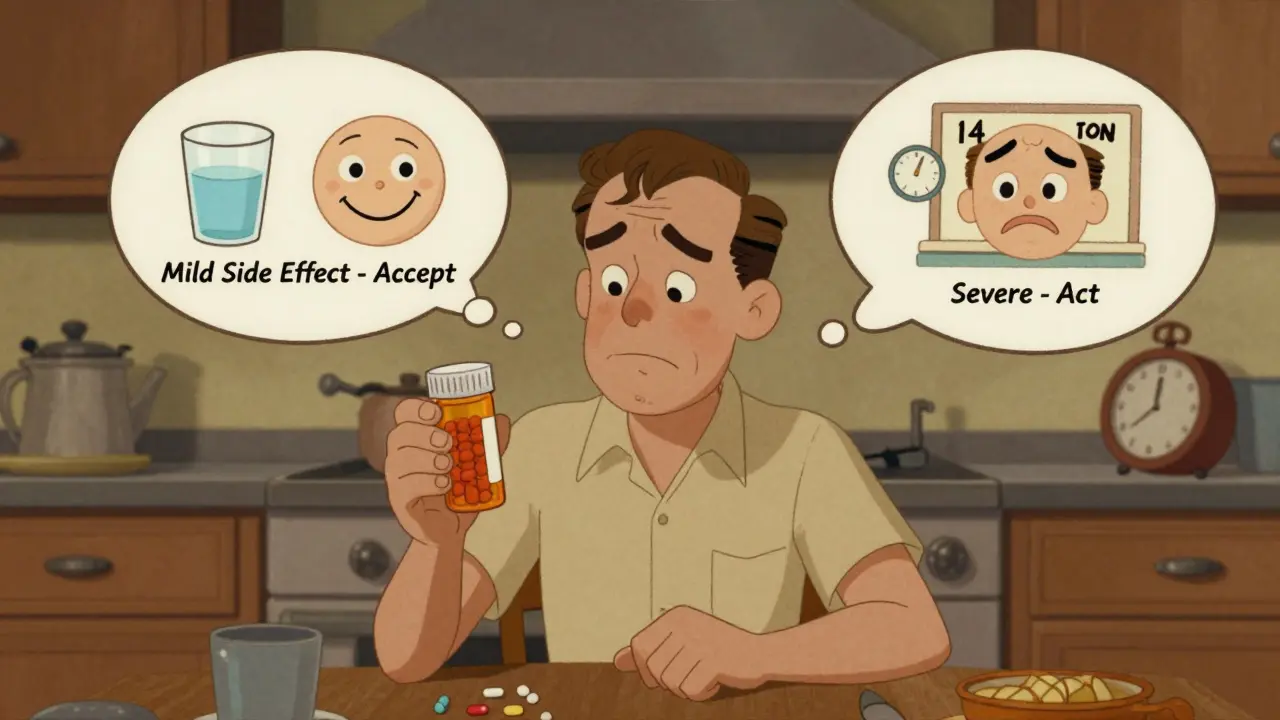
Every year, millions of people start a new medication with the hope of feeling better. But then comes the side effect - dry mouth, drowsiness, nausea, dizziness. Some fade away. Others stick around. And many people are left wondering: should I accept this, or do I need to act?
Not All Side Effects Are Created Equal
Side effects aren’t all scary. Some are mild, temporary, and actually mean the drug is working the way it should. The Food and Drug Administration (FDA) defines side effects as unintended responses that happen at normal doses. That’s different from an adverse reaction - something harmful and dangerous. Understanding this difference is the first step to making smart choices.
Take SSRIs, a common type of antidepressant. About 35-40% of users report drowsiness in the first week. For many, it fades after 7-10 days. Dry mouth? That’s even more common - up to 60% of antipsychotic users deal with it. These aren’t signs the medication is wrong. They’re just part of the adjustment period.
But here’s the catch: if that drowsiness doesn’t go away after two weeks, or if it’s making you fall asleep at your desk or behind the wheel, that’s no longer acceptable. Same with dry mouth. If it’s so bad you can’t sleep or chew food, it’s time to talk to your provider. Mild? Maybe wait. Severe or lasting? Don’t ignore it.
When to Accept: The Three Rules
There are times when it’s smarter to ride out a side effect than to rush to change your treatment. The beMedWise program, backed by the National Council on Patient Information and Education, lays out clear guidelines:
- It’s mild and temporary. Think: slight nausea for the first 3 days after starting metformin. Many patients find it fades as their body adjusts.
- The benefit outweighs the discomfort. If you’re on medication for treatment-resistant depression and gaining 5-10 pounds is the trade-off for finally feeling like yourself again, that’s a calculated choice.
- You can manage it without medical help. Dry mouth? Drink more water. Use sugar-free gum. Drowsiness? Take the pill at night. These simple fixes work for 30-40% of people, according to FDA data.
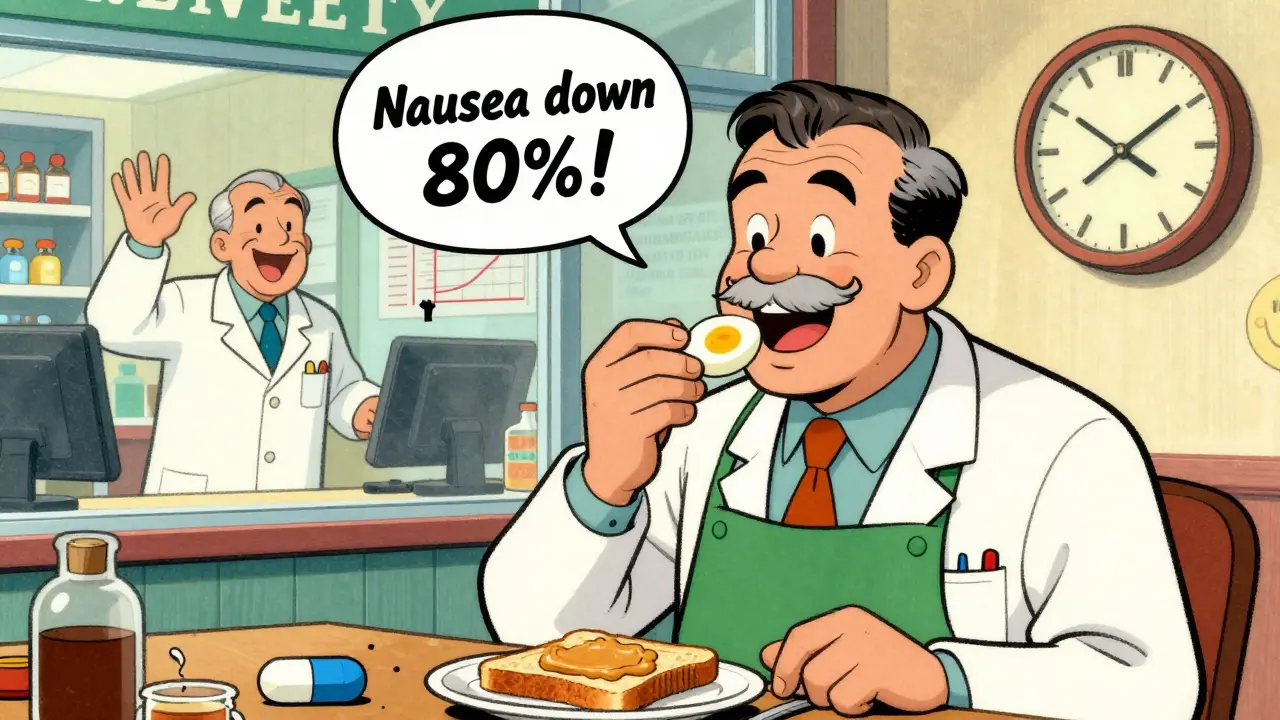
One real example: a 62-year-old man in Exeter started a new antibiotic and had nausea 5-6 times a day. His pharmacist suggested taking it with a small high-protein snack - like a boiled egg or a spoonful of peanut butter. Within a week, his nausea dropped to once a day. No dosage change. No new prescription. Just a simple tweak.
When to Act: The Red Flags
Some side effects aren’t just annoying - they’re warning signs. The CDC and FDA have clear red flags that demand immediate attention:
- Difficulty breathing, swelling of the face or throat. This is an allergic reaction. Call 999 or go to A&E. This isn’t something to wait on.
- Black stools or vomiting blood. This could mean internal bleeding - especially if you’re on NSAIDs like ibuprofen. The National Institute on Aging says this affects 0.5-1% of users annually, but it’s serious enough to warrant urgent care.
- Confusion, memory loss, or trouble walking. Especially in older adults on multiple medications. The CDC’s 2022 alert says these neurological symptoms can lead to falls, hospitalization, or even permanent damage if not addressed.
- A rash that spreads or blisters. Certain drugs, like allopurinol, carry a “black box warning” for severe skin reactions. Even a small rash can be the first sign. Stop the medication and call your doctor immediately.
- Side effects that last more than two weeks. If dizziness from blood pressure meds keeps you from standing up without wobbling after 14 days, it’s not “just adjusting.” It’s a sign the dose or drug might be wrong.
How to Talk to Your Doctor - The Right Way
Too many people go to their doctor and say, “I feel weird.” That’s not helpful. You need to give them data.
Dr. Michael Chen from Johns Hopkins says patients who track side effects with specifics are 4.2 times more likely to get the right fix. So before your appointment, write down:
- What exactly you’re feeling. Not “I feel bad.” Say: “I get dizzy when I stand up, especially 30 minutes after taking my pill.”
- How bad it is on a scale of 1-10. Is it a 2 or a 7?
- When it happens. Right after taking the pill? An hour later? At night?
- How it affects your day. Can you still work? Drive? Sleep? Cook?
The National Institute on Aging also recommends asking three key questions:
- Is this side effect expected with this medication?
- How long should I expect it to last?
- What should I do if it gets worse?
A 2023 study in JAMA Internal Medicine tracked 1,200 patients. Those who asked these questions and tracked their symptoms resolved their side effects 32% faster than those who didn’t.
What People Do Wrong (And How to Avoid It)
Analysis of 782 Reddit threads from the r/medication community showed a troubling pattern: 65% of users tried to handle side effects alone. Of those, 42% ended up suffering longer than they needed to.
The biggest mistake? Stopping the medication without talking to a provider. The CDC found that 28% of people quit their drug entirely because of side effects. And in 73% of those cases, the condition got worse - depression returned, blood pressure spiked, seizures came back.
Another mistake: assuming cost means you have to suffer. A Kaiser Family Foundation study found that 37% of people keep taking meds with bad side effects because they can’t afford to switch. But there’s often a cheaper alternative. Your doctor might be able to switch you to a generic version or a different class of drug with fewer side effects.
Successful cases? They didn’t quit. They adapted. In 31% of resolved cases, changing the time of day helped. In 24%, switching to another drug in the same class worked. In 19%, adding a simple lifestyle fix - like taking meds with food - made all the difference.

Your Personal Risk Matters
There’s no one-size-fits-all answer. What’s acceptable for one person isn’t for another.
For someone with cancer, nausea and hair loss might be a trade-off they’re willing to make. For someone managing mild high blood pressure, even a small amount of dizziness that affects daily life might be enough reason to switch medications.
The American Heart Association’s 2023 guidelines say: if side effects interfere with more than 20% of your daily activities - like walking to the store, playing with kids, or working - it’s time to reconsider.
And if you’re over 65? You’re more likely to have side effects because of how your body processes drugs. The National Institute on Aging recommends extra caution and more frequent check-ins.
Bottom Line: Track, Talk, Adjust
You don’t have to suffer through side effects. But you also don’t have to panic the moment you feel something odd.
Start by tracking. Write down what you feel, how bad it is, and when it happens. Then, use that info to have a smart conversation with your doctor. Most side effects can be managed - not just ignored or stopped.
Remember: the goal isn’t to eliminate all discomfort. It’s to get the benefit of the medicine without letting the side effects take over your life. And with the right information and communication, that’s absolutely possible.


11 Comments
Life's just a series of trade-offs really. You take a pill to feel less broken, and you get dry mouth or drowsiness in return. But if you're not sleeping or functioning, then yeah, it's not a trade-off anymore-it's a surrender. I've been on three different SSRIs. Each one had its own flavor of weird. The key isn't to suffer through it. It's to notice when the cost outweighs the benefit. And most docs don't ask the right questions. They just say 'give it time.' Time doesn't fix everything. You do.
Wait... so you're telling me the FDA has a list of 'acceptable' side effects? Like, what's next? A pamphlet called 'Mild Nausea: A National Service'? I've been on 7 meds in 5 years. Every single one 'faded' after two weeks... until it didn't. And then I was in the ER. You think this is science? It's a gamble with your body and a corporate balance sheet.
I must express my profound concern regarding the conflation of 'mild' and 'temporary' as objective clinical metrics. The FDA's operational definitions are not diagnostic criteria, and the assertion that '35-40% of users report drowsiness' implies a statistical normalization of physiological deviation. This is not merely anecdotal-it is a systemic failure of pharmacovigilance. Furthermore, the recommendation to 'take the pill at night' ignores circadian pharmacokinetics and the potential for nocturnal respiratory depression in vulnerable populations. This article is dangerously oversimplified.
I'm from Nigeria, and I've seen people stop meds because they can't afford to see a doctor. We don't have access to specialists. So when someone says 'drink more water' or 'take with food,' that's not just advice-it's survival. My cousin had dizziness on blood pressure meds. His pharmacist told him to sit for 30 seconds before standing. No new script. No extra cost. Just movement. That’s the real win here: simple, cheap, human solutions. Don't overcomplicate it.
In India, we have a saying: 'The medicine is not the cure, the patient is.' This article is deeply thoughtful, but it assumes a level of access and literacy that doesn't exist everywhere. For many, the real barrier isn't ignorance-it's cost, stigma, or lack of a doctor who listens. The tracking method you describe? Brilliant. But if you can't afford a notebook, or your clinic closes at 4 PM, what then? We need systems that meet people where they are-not just educate them.
I work in pharmacy. I’ve seen people die because they didn’t speak up. You think dry mouth is bad? Try kidney failure from an untreated NSAID reaction. You think drowsiness is annoying? Try a car crash because you nodded off at the wheel. This isn’t 'personal preference.' It’s a public health crisis. Stop being passive. Track it. Document it. Send it to your doctor with a subject line that says 'URGENT: SIDE EFFECTS IMPAIRING FUNCTION.' If they don’t respond in 48 hours, go to urgent care. Your life isn’t a suggestion box.
I’ve helped over 200 patients adjust to meds over the years. The ones who win? They don’t just tolerate side effects-they adapt. They change the time of day. They add ginger tea for nausea. They switch from tablets to liquid. They ask, 'What’s the next option?' Not 'Is this normal?' but 'What else can we try?' You’re not weak for needing help. You’re smart for seeking it. And you’re not alone. I’ve got your back.
I think the biggest thing missing here is the emotional toll. It’s not just about dizziness or dry mouth. It’s the shame of feeling like you're failing because you can't 'just push through.' I was on an antidepressant that made me feel like a ghost. I didn't tell anyone. Thought I was being weak. Took 6 months to say anything. Then we switched. I felt like me again in 10 days. You’re not broken for needing help. You’re human.
lol so if u feel weird for 2 weeks u gotta call ur doc? what if u dont have one? or u dont trust em? or u just dont wanna deal? i mean like... maybe i just dont wanna be a patient anymore
I’ve been on 4 different meds for anxiety. Each one had its own version of hell. The one that worked? I took it at night. With a banana. And I journaled how I felt each morning. Took 3 weeks. No panic. No drama. Just quiet adjustments. You don’t need to be a scientist. You just need to be consistent. And kind to yourself. 💛
My mom had dizziness on blood pressure meds. She stopped taking it. Ended up in the hospital. We didn’t know what else to do. Then her pharmacist sat with her for 20 minutes and said, 'Try taking it after breakfast, not before.' It worked. No new script. No cost. Just someone who listened. This article? It’s everything. But real help? It’s still rare.
Write a comment