FDA Drug Label Focus Guide
This tool helps you identify the most critical sections of FDA drug labels based on your personal health situation. Understanding these sections can help prevent adverse drug events and improve medication safety.
Important: This tool doesn't replace professional medical advice. Always consult with your doctor or pharmacist about your specific medications.
Critical Sections to Review
Most Critical Section:
Here are the specific sections you should prioritize based on your situation:
Why These Sections Matter
Every time you or a loved one gets a new prescription, there’s a document hidden in the packaging or online that holds the full story of that medication. It’s not the patient leaflet. It’s the FDA drug label - the official, legally binding guide used by doctors, pharmacists, and regulators to make life-or-death decisions. Most people never see it. But if you’re taking multiple medications, managing a chronic condition, or just want to understand what you’re really being told, learning how to read this label can change everything.
What Is the FDA Drug Label, Really?
The FDA drug label isn’t just a sheet of paper. It’s called the United States Prescribing Information (USPI), and it’s the only source that contains all the data the FDA has reviewed before approving a drug. This document isn’t meant for patients to read casually - it’s written for healthcare professionals. But that doesn’t mean you can’t understand it. In fact, knowing how to navigate it helps you ask better questions and spot red flags.Since 2006, the FDA has required every prescription drug label to follow the same 17-section format. Before that, labels were messy, inconsistent, and often left out critical warnings. Now, everything is organized the same way, whether it’s a new cancer drug or a generic blood pressure pill. The goal? Reduce errors. And it’s working. Studies show that standardized labeling cut dosing mistakes by nearly 40% in the first five years after implementation.
The Three Parts You Need to Know
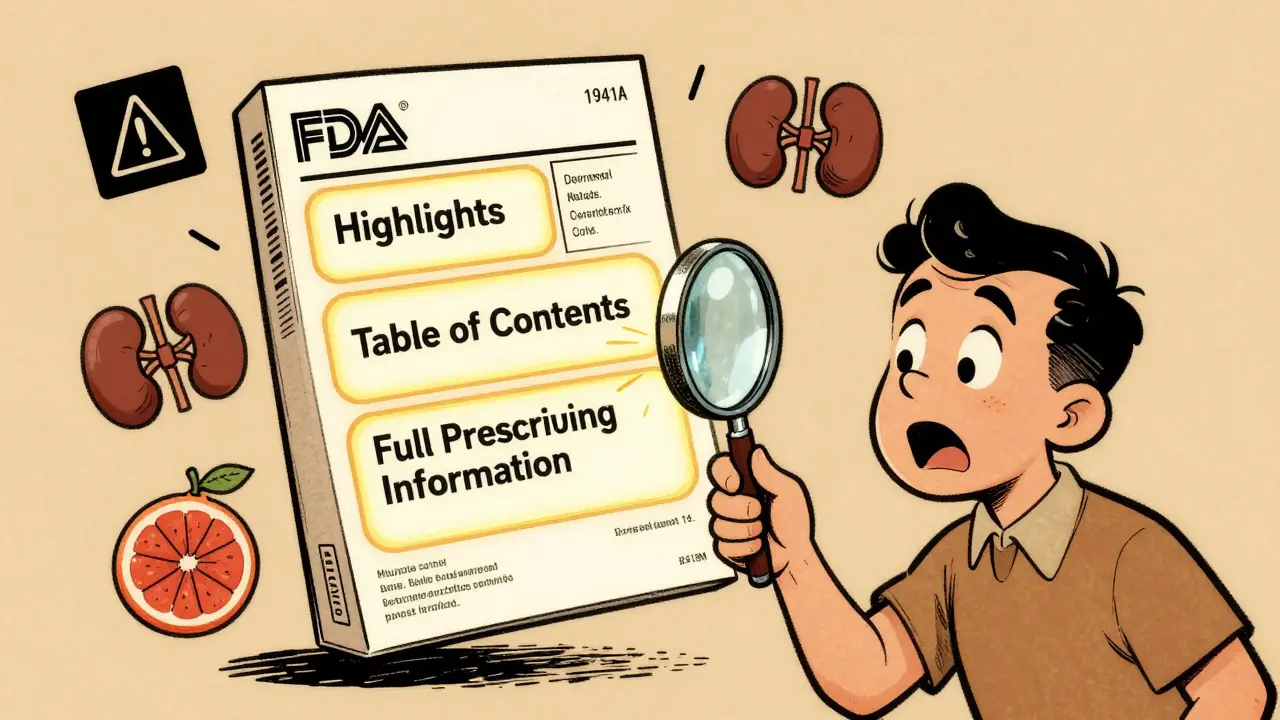
The full label has three main layers. You don’t need to read all of them every time - but you should know where to find what matters.- Highlights: A half-page summary at the top. It’s designed for quick scanning. This section includes the most serious risks, key dosing info, and the drug’s main uses. But here’s the catch: it’s incomplete. The FDA requires it to say, "This is not the full prescribing information." Don’t stop here.
- Table of Contents: Just below the Highlights, this lists all 17 sections with page numbers. Think of it as a map. If you’re looking for something specific - like "Can I take this while pregnant?" - go straight to Section 8.
- Full Prescribing Information (FPI): This is the real deal. All 17 sections, in order. This is where the details live. It’s dense, but it’s also where the truth is.
Section 1: Indications and Usage
This is where you find out what the drug is actually approved to treat. Don’t assume it works for everything your doctor says. For example, a drug might be approved only for Type 2 diabetes - not for weight loss, even if your doctor prescribes it off-label. The label will say "indicated for" and list the exact condition. It might also include the drug’s pharmacologic class - like "SGLT2 inhibitor" - which tells you how it works in the body. If you’re unsure what that means, look it up. This section is your first clue about whether the drug matches your diagnosis.Section 2: Dosage and Administration
This is where most mistakes happen. It tells you how much to take, how often, and how to take it - but it also has hidden details. For instance, it will specify if the dose changes for people with kidney or liver problems. It might say: "Reduce dose by 50% in patients with creatinine clearance below 30 mL/min." If you have kidney disease and don’t know this, you could overdose. It also tells you whether to take the drug with food, on an empty stomach, or at bedtime. These details matter. A 2023 study found that 31% of adverse drug events were linked to incorrect timing or dosing.Section 3: Dosage Forms and Strengths
This section lists every version of the drug available. A pill? A liquid? A patch? Each has a different number. The label will show strengths like "10 mg tablet," "50 mg/mL oral solution," etc. This is critical if you’re switching brands or if your pharmacy runs out. If your prescription says "10 mg tablet," but the bottle says "20 mg," you need to stop and ask. Also, look for the NDC code - a 10-digit number that uniquely identifies the drug, manufacturer, and packaging. It’s not just for pharmacists. If you’re ever in a hospital or emergency, having this number helps them verify what you’re taking.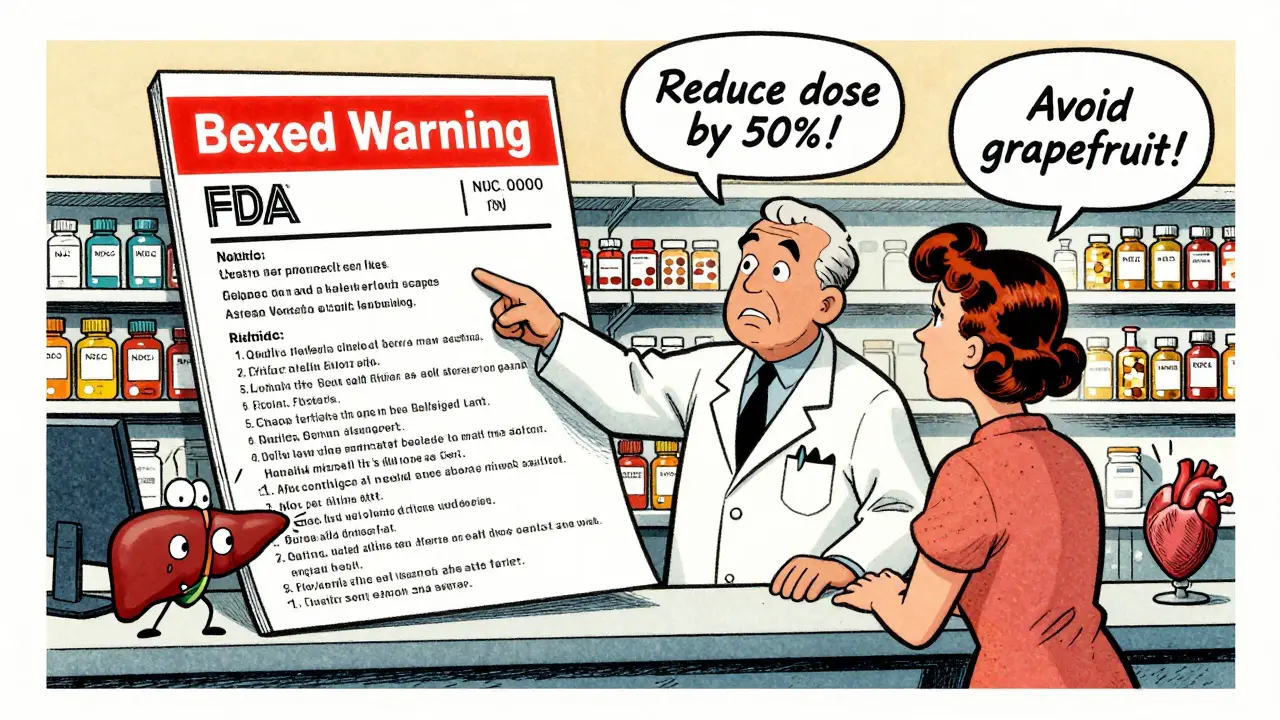
Section 4: Contraindications
This is where the label says, "Don’t use this drug if..." It’s not a suggestion. It’s a hard rule. For example, a drug might say, "Contraindicated in patients with active liver disease." If you have hepatitis, this drug could kill you. These are rare but deadly. If you’ve ever been told "this drug isn’t for you," this section is why.Section 5: Warnings and Precautions (Including Boxed Warning)
This is the most important section after dosage. The FDA requires the most serious risks to appear in a black box at the top - the Boxed Warning. It’s bold, it’s hard to miss, and it’s the only section legally required to be printed in a box. Common Boxed Warnings include: risk of liver failure, sudden death from irregular heartbeat, or severe allergic reactions. Below the box, you’ll find more warnings - like "may cause suicidal thoughts," "risk of osteoporosis with long-term use," or "avoid alcohol." These aren’t just fine print. They’re your warning signs.Section 6: Adverse Reactions
This section lists side effects - but not just any side effects. It gives you the frequency based on clinical trials. You’ll see categories like:- Very common (≥1/10)
- Common (≥1/100 to <1/10)
- Uncommon (≥1/1,000 to <1/100)
- Rare (≥1/10,000 to <1/1,000)
Don’t panic if you see "rare" side effects. But if you’re getting something listed as "common," and your doctor says it’s "just a side effect," you now have data to push back. For example, if a drug says "dizziness in 15% of patients," and you’re dizzy every day, that’s not normal for you - it’s a signal to talk to your provider.
Section 7: Drug Interactions
This is where you find out what else you can’t take with the drug. It lists interactions with other medications, foods, and even supplements. For example: "Avoid grapefruit juice," or "May increase bleeding risk when taken with warfarin." This section is often overlooked - but it’s a major cause of hospitalizations. A 2022 Johns Hopkins study found that 18% of emergency visits for drug reactions were due to unreported interactions.Section 8: Use in Specific Populations
If you’re pregnant, breastfeeding, over 65, or under 18, this section is essential. It tells you what’s known - and what’s not. For example: "Use only if clearly needed during pregnancy," or "Safety and effectiveness not established in children under 12." If you’re in one of these groups, this section tells you whether the drug was tested on people like you - or if it’s being used based on guesswork.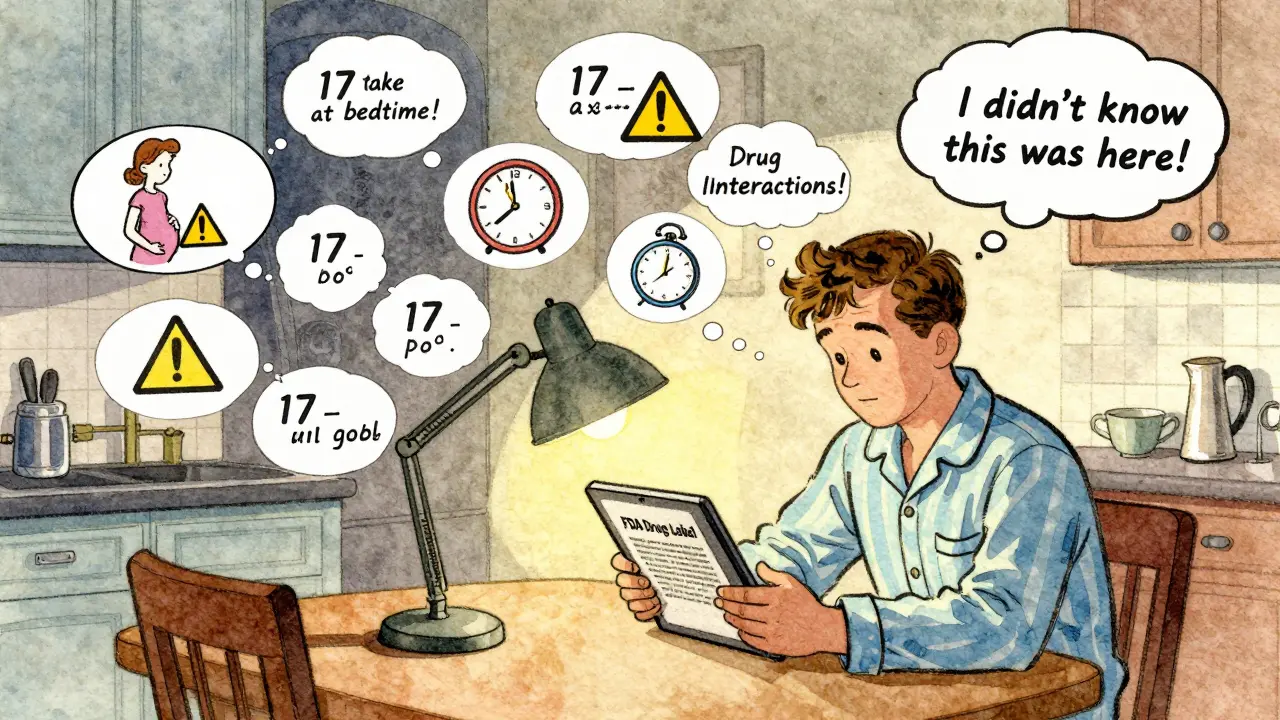
Section 16: How Supplied/Storage and Handling
This sounds boring, but it’s practical. It tells you how the drug is packaged - blister packs, bottles, syringes - and how to store it. Some drugs must be refrigerated. Others must be kept away from light. If you leave a drug in a hot car or bathroom cabinet, it might lose potency. This section also lists the NDC code again, broken into three parts: labeler code (who made it), product code (what it is), and packaging code (how many pills). If you’re ever in a crisis, this code helps emergency responders identify your medication instantly.Section 17: Patient Counseling Information
This is the FDA’s attempt to bridge the gap between doctor and patient. It gives providers exact phrases to use when talking to you. For example: "Take this medication at the same time each day," or "Do not stop taking this suddenly - it may cause seizures." If your doctor or pharmacist doesn’t mention these points, ask. Only about 38% of providers use this section as intended - but you can demand it.What About the "Recent Major Changes" Section?
Since 2018, every label must include a section that lists what changed in the last six months. Did the dosage change? Was a new warning added? Did a drug interaction get updated? This section is your early warning system. If you’ve been on a drug for years and suddenly your doctor says "the label changed," this is why. Always check this section before refilling a prescription.Why This Matters for You
You don’t need to be a doctor to understand this. But you do need to know where to look. Most people rely on the patient leaflet - which is helpful, but simplified. The FDA label is the source. If you’re on five medications, have a chronic illness, or are caring for an elderly parent, this knowledge isn’t optional - it’s protective.Here’s a quick habit: Before taking any new drug, go to the FDA’s website, search the drug name, and open the full label. Spend five minutes on Sections 1, 2, 5, and 7. If something doesn’t make sense, write it down. Bring it to your next appointment. You’ll be surprised how often providers say, "I didn’t realize you were looking at the full label." That’s your power.
What’s Changing in 2025 and Beyond
The FDA isn’t done. In March 2024, they updated guidelines for Section 2 (Dosage) to make kidney and liver dose adjustments clearer. In 2025, they’re testing interactive digital labels - think clickable sections, pop-up explanations, and video summaries - while keeping the official SPL format as the legal standard. By 2027, most new drugs will come with both a traditional label and a digital version. The goal? Reduce confusion. Make safety easier. But until then, the paper label - and your ability to read it - is your best defense.Where can I find the official FDA drug label online?
Go to the FDA’s Drugs@FDA database at https://www.accessdata.fda.gov/scripts/cder/daf/. Search by brand or generic name. Every approved drug has a full label available as a PDF. You can also search by NDC code if you have the number from your pill bottle.
Is the patient leaflet the same as the FDA drug label?
No. The patient leaflet is a simplified version meant for consumer understanding. The FDA drug label is the full, legally approved document used by healthcare professionals. It’s more detailed, more technical, and includes critical data like clinical trial results, drug interactions, and boxed warnings that are often left out of the patient handout.
Why do some drugs have a Boxed Warning and others don’t?
A Boxed Warning is only required if the FDA determines the drug carries a risk of death or serious injury. It’s not about how common side effects are - it’s about how severe. For example, some antibiotics have no boxed warning because their risks are manageable. But drugs that can cause liver failure, sudden cardiac arrest, or severe birth defects must have one. If your drug has a boxed warning, it doesn’t mean it’s unsafe - it means you need to understand the risk and monitor for it.
Can I trust the "Adverse Reactions" section if I’m not in a clinical trial?
Yes - but with context. The data comes from clinical trials, which involve healthy volunteers and carefully selected patients. Real-world use can bring out side effects not seen in trials. That’s why the FDA requires ongoing monitoring after approval. If you experience something not listed, report it to the FDA’s MedWatch program. Your experience helps update the label.
What should I do if I find an error in the FDA drug label?
Contact the FDA’s MedWatch program directly. You can file a report online or by phone. If the error is in the prescribing information (not the patient leaflet), the FDA will investigate. If it’s a labeling mistake - like a wrong NDC code or outdated dosage - the manufacturer may be required to issue a correction. You’re not just speaking up - you’re helping improve safety for everyone.