
Giving liquid medicine to a child isn’t as simple as pouring it into a spoon. One wrong milliliter can mean the difference between relief and harm. Every year, thousands of children end up in emergency rooms because of dosing mistakes - not because parents are careless, but because they’re using the wrong tools or the wrong technique. The good news? Using a dosing syringe correctly cuts medication errors by more than half. And it’s easier than you think.
Why Dosing Syringes Are the Only Safe Choice
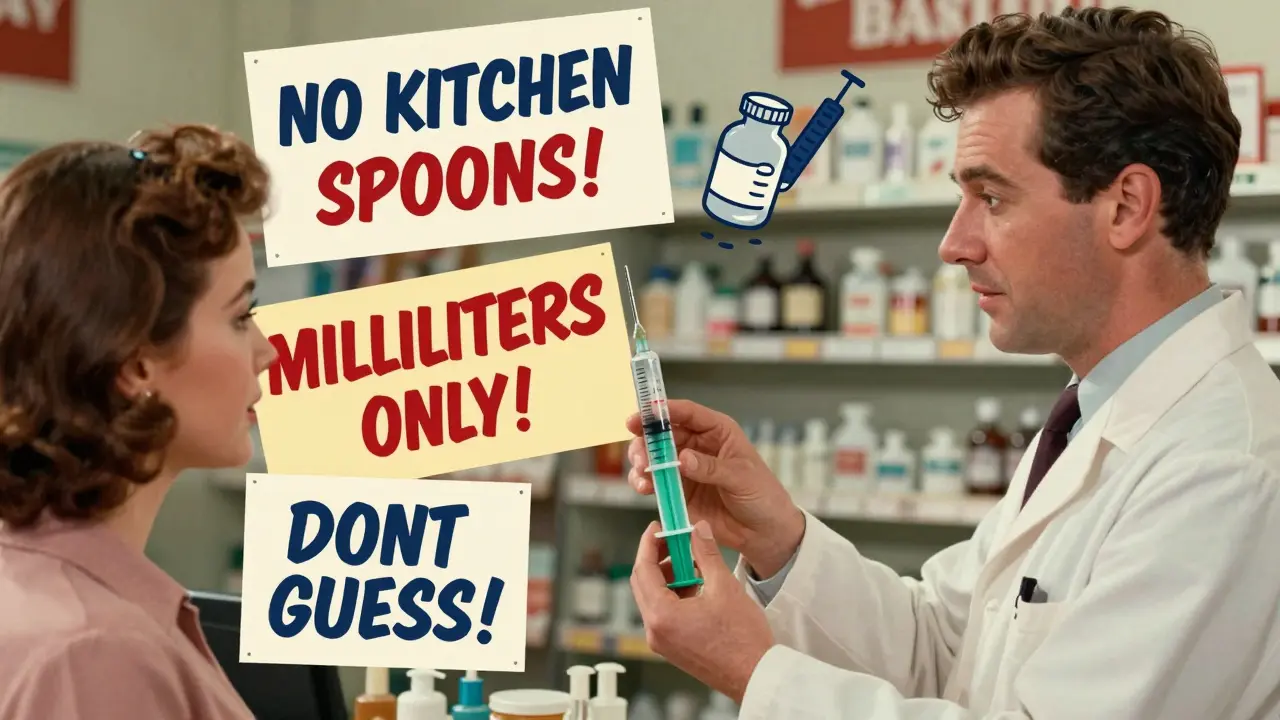
Kitchen spoons, medicine cups, and even the little plastic spoons that come with the bottle? They’re not accurate. A 2016 study found that household teaspoons vary from 2.5 to 10 milliliters - that’s a 400% difference. Even the dosing spoons included with medicine have a 22% error rate when parents aren’t trained. That means if your child needs 5 mL, you might be giving them 4 mL or 6 mL - enough to cause side effects or make the medicine ineffective. Oral syringes, on the other hand, are designed for precision. They’re marked in 0.1 mL increments for smaller doses and are tested to stay within 5% of the correct amount. The American Academy of Pediatrics and the FDA both say oral syringes are the gold standard for kids under 5, and they’re recommended for all children taking liquid medicine. Since 2018, all prescription liquid medications in the U.S. must list doses only in milliliters - no more teaspoons or tablespoons. That’s because those units caused 20% of dosing errors.Choosing the Right Syringe Size
Not all syringes are the same. You need the right size for the right dose. Using a 10 mL syringe to give 1.5 mL is like using a measuring cup to pour a single tablespoon - you’ll lose accuracy.- 1 mL syringe: Best for doses under 1 mL. Marked in 0.01 mL increments. Used for very small infants or concentrated medications.
- 3 mL syringe: Ideal for doses between 1 and 3 mL. Marked in 0.1 mL increments. This is the most common size for toddlers.
- 5 mL syringe: For doses between 3 and 5 mL. Marked in 0.2 mL increments. Good for older toddlers and preschoolers.
- 10 mL syringe: Only for doses over 5 mL. Marked in 0.5 mL increments. Use with caution - it’s easy to overshoot.
How to Measure the Dose Correctly
Step-by-step, here’s how to get it right every time:- Shake the bottle. Liquid medicines often settle. Shake it for 10 to 15 seconds before drawing it up.
- Remove the cap. Check that the cap is off before you start. A forgotten cap is a choking hazard.
- Insert the syringe. Push the plunger all the way in, then insert the tip into the bottle. Don’t let the tip touch the outside of the bottle.
- Draw the dose. Pull the plunger back slowly until the top of the liquid (the meniscus) lines up with your child’s exact dose. Don’t guess. Don’t round up. If the dose is 2.4 mL, pull it to 2.4 mL - not 2.5.
- Check the mark. Hold the syringe up to the light. Make sure you’re reading the right line. Some syringes have double markings - make sure you’re using the mL scale, not the teaspoon scale.
How to Give the Medicine Without a Fight
Even the best syringe won’t help if your child spits it out or chokes. The trick is in the technique.- Position your child. Sit them upright - never lying down. This helps them swallow safely.
- Place the syringe correctly. Gently insert the tip between the cheek and gum, not at the back of the throat. Squirting it toward the back can cause choking. One study found 63% of parents did this at first - and 15% of those kids gagged or choked.
- Administer slowly. Push the plunger in small bursts - about 0.5 mL at a time. Wait 5 to 10 seconds between each push. Let them swallow before adding more.
- Don’t force it. If your child is resistant, try giving the medicine right after a small snack. Cold medicine can also be easier to swallow.
What About Thick Medicines Like Amoxicillin?
Antibiotics and some suspensions are thick and sticky. Drawing them into the syringe can be frustrating. Here’s how to make it easier:- Use a 3 mL or 5 mL syringe - they have wider tips and are easier to fill.
- Let the medicine sit at room temperature for 10 minutes. Cold medicine is thicker.
- Draw slowly. Pull the plunger back in small, steady motions.
- If it’s still hard, ask your pharmacist for a syringe with a wider bore or a special tip designed for thick liquids.
Common Mistakes and How to Avoid Them
Even experienced parents make these errors:- Not checking the dose twice. Always double-check the prescription label and the syringe mark. Write it down if you need to.
- Using the wrong syringe. A 10 mL syringe for a 1.5 mL dose? Too risky.
- Forgetting to shake the bottle. Settled medicine means uneven dosing.
- Not cleaning the syringe. Rinse it with water after each use. Don’t soak it in hot water - that can warp the plastic.
- Using a syringe with a needle. Never. Oral syringes have no needles. If it has one, it’s not for kids’ medicine.
What’s New in Pediatric Dosing Tools
The field is improving fast. In 2023, the FDA approved the first color-changing syringe - it turns from blue to green when you’ve drawn the right dose. In clinical trials, it cut errors by 37%. Some new syringes even have QR codes you can scan to watch a video on how to use them. By late 2025, smart syringes with Bluetooth will hit the market. They’ll connect to your phone, log when the dose was given, and remind you if you’re due for the next one. But for now, the simple, inexpensive oral syringe is still the most reliable tool.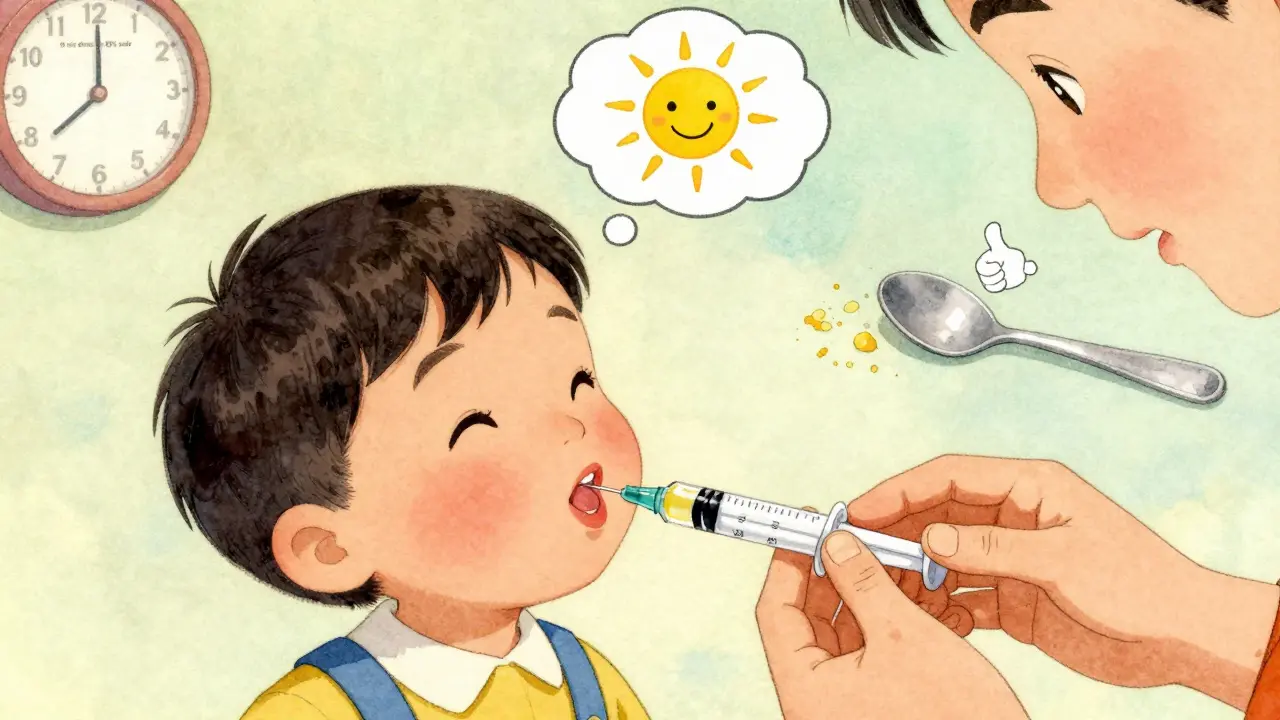
When to Use a Medicine Cup Instead
For kids over 5 who can drink from a cup without spilling, a medicine cup can work - especially for doses over 5 mL. But even then, accuracy drops. A 2023 study showed medicine cups have an 8% error rate for 10 mL doses, compared to 5% with syringes. And for infants, toddlers, or any child who can’t reliably drink from a cup? Stick with the syringe.Final Reminder: Always Follow the Prescription
Never guess a dose. Never use an adult medicine for a child. Never give more than the label says - even if your child still seems sick. If you’re unsure, call your pediatrician or pharmacist. There’s no shame in asking. Medication safety isn’t about being perfect - it’s about being careful.Can I reuse a dosing syringe for different medicines?
Yes, but only if you clean it thoroughly between uses. Rinse it with warm water immediately after each use, then let it air dry. Never mix medicines in the same syringe. Use a separate syringe for each medication, especially if they’re given at different times of day.
What if my child spits out most of the medicine?
Don’t give another full dose right away. Wait and call your pediatrician. Giving extra medicine can lead to overdose. If your child spits out more than half, the doctor might suggest giving a partial extra dose - but only if they say so.
Are oral syringes better than droppers?
Yes. Droppers are harder to control and often don’t have clear markings. A 2021 study found droppers had error rates of up to 30% for doses under 3 mL. Oral syringes are more precise, easier to hold, and safer for babies.
Can I use a syringe from a different brand?
Yes, as long as it’s labeled for oral use and has clear mL markings. Most syringes are standardized, so a 3 mL syringe from one brand works the same as another. But always check the markings - some cheap syringes have fuzzy or incorrect lines.
Do I need to refrigerate the syringe?
No. Store the syringe at room temperature in a clean, dry place. Don’t soak it in water or put it in the fridge. Just rinse it after use and let it air dry. Keep it out of reach of children - a syringe can be a choking hazard if left unattended.


9 Comments
OMG I wish I’d known this when my kid was on antibiotics last winter. I was using the little plastic spoon that came with the bottle and thought I was being careful. Turns out I was giving her like 6.5 mL instead of 5? She was so lethargic the next day I thought she was sick again. 🤦♀️ Now I only use the 3 mL syringe and even label them with masking tape so I don’t mix them up. Life changed. Seriously, if you’re still using spoons-stop. Just stop.
thx for the post! i got a 10ml syringe for my 2yo and used it for 1.2ml once and felt like i was using a firehose. learned the hard way. now i keep a 3ml and 1ml in the drawer. pharmacies give em free if u ask. also, shake like your life depends on it-literally.
Just a thought-what if we started labeling syringes by color like the new FDA ones? Like green for Tylenol, blue for Motrin? My husband and I argue over which is which sometimes. We’re both nurses. 😅 I got one of those color-changing ones last month and it’s like magic. My 18-month-old even points at it now. 🌈💉
Why the hell are we still talking about this? In 2025 we’ve got smart syringes that text you when your kid needs a dose, and you’re still debating whether to use a 3mL or 5mL? We’re not living in the Stone Age anymore. The FDA said it. The AAP said it. Even the damn pharmacist says it. Stop being lazy. Buy the right tool. Use it. Move on.
I just want to say thank you for this. My daughter had a seizure last year because I gave her too much ibuprofen. I thought I was measuring right. I used the cup. I swear I did. But the cup was warped. I didn’t know. I still have nightmares. This post? It’s not just helpful. It’s life-saving. 🙏❤️
So many people don’t realize how dangerous this is. I’m from India and we use spoons because it’s cheaper and everyone does it. But I read this and went to the pharmacy and got a 3mL syringe. My niece was on amoxicillin and she used to spit out half. Now she takes it like a champ. I showed my sister-in-law and she cried. She said she almost gave her kid a double dose last week. This isn’t just about medicine. It’s about trust. About safety. About not letting your child suffer because you didn’t know. Thank you for writing this. I’m sharing it with everyone.
Wow. Another ‘parenting guide’ that makes people feel guilty for not being perfect. Did you know 70% of parents are working full-time and don’t have time to read 12 paragraphs about meniscus alignment? Maybe the real problem is that we don’t have affordable, accessible healthcare that includes free dosing tools and nurse demos. But nooo, let’s just shame moms for using a spoon. Classic.
Per the 2023 FDA white paper on pediatric medication delivery systems (DOI: 10.1016/j.jped.2023.04.011), the 5% error margin for calibrated oral syringes is statistically significant (p<0.01) versus household utensils (p=0.07). However, cognitive load theory suggests that over-optimization of dosing protocols may induce decision fatigue in caregivers-particularly those with low health literacy. I’d recommend pairing syringe use with a visual checklist (PDF available on CDC.gov) to reduce working memory burden. Also, avoid silicone-tipped syringes-they degrade faster under UV exposure. Just saying.
I used a syringe once. My kid gagged. Never again.
Write a comment